

What does Jane App actually cost a chiropractic clinic in 2026? The price you see first is $59 a month, but that is the Balance plan: one practitioner, capped at 20 appointments a month (Jane, 2026). A working clinic runs on Practice at $79 or Thrive at $99, then adds a fee for every extra practitioner, a monthly add-on to bill insurance, and a card-processing cut of about 2.75% on everything patients pay you (Jane, 2026; Helcim, 2026). A two-provider insurance clinic lands closer to $194 a month in subscription, and the processing fees on your card revenue usually cost more than the software itself. This is the line-by-line breakdown, with three honest scenarios and the one number almost nobody budgets.
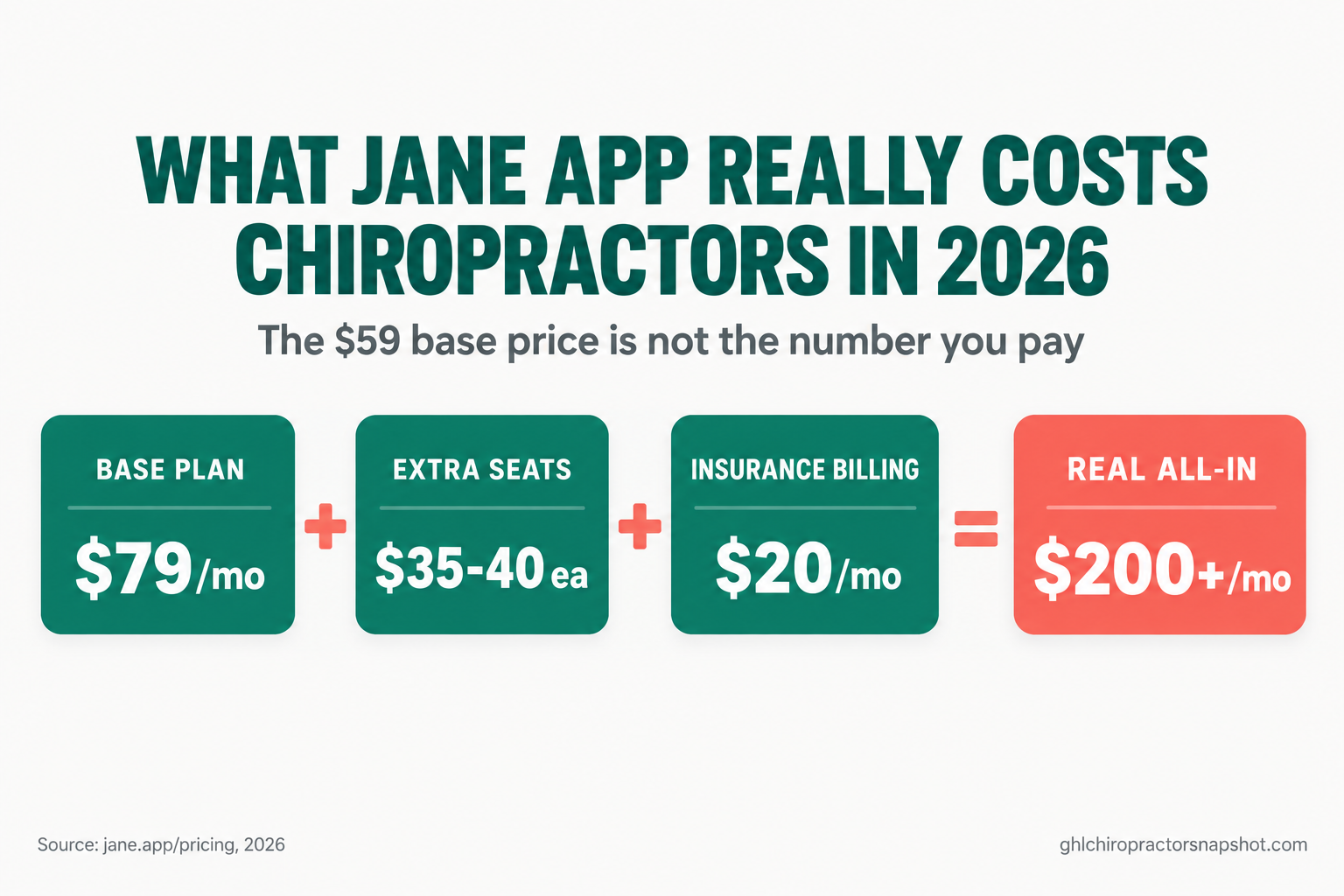
Here is the trap. Jane is one of the most liked practice-management systems in the business, partly because it posts its prices in public with no sales call. That honesty is real. But “I saw $59” and “my Jane bill” are two different numbers, and the gap is not hidden fees. It is the way the plan stacks: per seat, per add-on, and per card swipe. Every figure below is dated and linked, in US dollars from Jane’s own pricing page.
Table of contents
- What Jane App actually costs in 2026
- The per-seat math nobody budgets
- The add-ons that stack on top
- Card processing: the biggest number on the page
- What Jane really costs: three scenarios
- Where Jane is genuinely great, and where it leaves a gap
- The questions to settle before you commit
- Keep the texting HIPAA-aware, whatever you run
- Common objections
- Frequently asked questions
What Jane App actually costs in 2026
Start with the three numbers Jane will stand behind, because unlike most of its competitors it publishes all of them.
- Balance, $59 a month. One practitioner, capped at 20 appointments a month. A starter plan for a side practice, not a clinic (Jane, 2026).
- Practice, $79 a month. One full-time practitioner, unlimited appointments and staff profiles, online booking, telehealth, intake forms, charting, invoicing, and free SMS reminders where the region allows (Jane, 2026).
- Thrive, $99 a month. Everything in Practice, plus rooms and equipment scheduling, self check-in, automated waitlist, return-visit reminders, packages and memberships, and ratings and reviews (Jane, 2026).
For a solo cash practice, that is a clean, fair number, far below what ChiroTouch or a bundled phone system costs. For a one-chair wellness shop, Jane often is the cheapest option on the market.
The moment your clinic has more than one provider, or bills insurance, or takes cards (so, every clinic), the base price stops being the price. None of what follows is a hidden fee. It is all on Jane’s pricing page in plain sight. The problem is that owners budget from the headline and get surprised by the invoice.
The per-seat math nobody budgets
Here is the single biggest line owners miss. On Practice and Thrive, the base price covers one full-time practitioner. Every provider you add is billed on top.
Jane lists the extra-seat charge at about $35 a month per full-time practitioner on Practice and $40 on Thrive, with part-time seats at roughly half (Jane, 2026). That sounds small until you run a real roster. A clinic with a lead DC, an associate, and a massage therapist on Thrive pays the $99 base plus two extra full-time seats, about $179 a month before a single add-on.
This is not a complaint about Jane. Per-seat pricing is honest and scales with your capacity. But it means the right way to price Jane is to count every chair, not read the headline. A group that hires two associates this year will watch its bill climb in a straight line, by design.
The add-ons that stack on top
The base plan runs the schedule and the chart. A few things a US chiropractic clinic actually needs live on separate lines.
- Insurance billing. This is the one that catches insurance-based practices. Billing claims through Jane is a $20 a month add-on, plus about $5 per additional full-time practitioner and $2.50 per part-time, available only on Practice and Thrive (Jane, 2026). A cash practice skips it. An insurance or PI practice treats it as mandatory, so it is part of your base number, not an extra.
- AI Scribe. Automated note-taking is $15 a month per opted-in practitioner for unlimited notes, with five free notes on every plan (Jane, 2026). For a three-provider clinic where everyone wants it, that is $45 a month.
- Group Telehealth. One-to-one telehealth is included, but group video (up to 15 participants) is $15 a month per practitioner (Jane, 2026). Most adjusting-based clinics skip it; a clinic running group rehab will not.
- Jane Websites. An optional clinic website is $59 a month per clinic (Jane, 2026).
Stack a realistic set of these and the picture changes. A two-provider insurance clinic on Thrive with insurance billing and AI Scribe for both is already near $194 a month, before a single card payment.
Card processing: the biggest number on the page
Now the line that dwarfs everything above, the one almost nobody includes when they say “Jane costs $99.”
Jane Payments, powered by Stripe, charges a per-transaction cut on every card your clinic runs. Jane’s own figures put the in-person terminal rate near 2.6% plus $0.10 and online (card-not-present) payments near 2.75%, with no monthly fee and no contract on the processing itself (Jane, 2026; Helcim, 2026). That is a fair, normal rate. It is also, for most clinics, the largest software-related expense they have, and it hides in plain sight because it comes out of each transaction instead of landing as a bill.
Do the arithmetic on your own revenue. A clinic that collects $30,000 a month in patient card payments at 2.75% is paying about $825 a month, close to $10,000 a year, in processing. Compared to that, whether your subscription is $99 or $199 is almost a rounding error.
Processing rates: Jane Payments, 2026 and Helcim, 2026 (US figures; confirm your exact rate in-account). Dollar amounts are estimates on stated card volume, not quotes.
This is not a reason to avoid Jane Payments. Built-in processing is convenient, and the rate is in the normal 2% to 4% band any processor charges. It is a reason to price your true total as subscription plus processing, and to know that shaving a quarter-point off your rate saves more than agonizing over which $20 tier to pick.
What Jane really costs: three scenarios
Because Jane prices per seat and per add-on, the right number depends on your clinic. Here are three honest year-one estimates from Jane’s public figures, subscription only; add your processing on top.
Solo cash DC. One provider on Practice ($79) with AI Scribe ($15) is about $94 a month, roughly $1,130 a year, no insurance add-on and no extra seats. For a one-chair cash or wellness practice, this is where Jane shines.
Two-provider insurance clinic. Thrive ($99) plus one extra full-time seat ($40), the insurance-billing add-on ($20 plus $5 for the second seat), and AI Scribe for both providers ($30) is about $194 a month, or roughly $2,330 a year. Add your card processing and the all-in number climbs well past that.
Four-provider group. Thrive ($99) plus three extra full-time seats ($120), insurance billing ($20 plus $15), and AI Scribe for all four ($60) is about $314 a month before group telehealth or a website. That is roughly $3,770 a year in subscription, and it clears $5,000 once you add Jane Websites and telehealth, with the card processing on top running many thousands more.
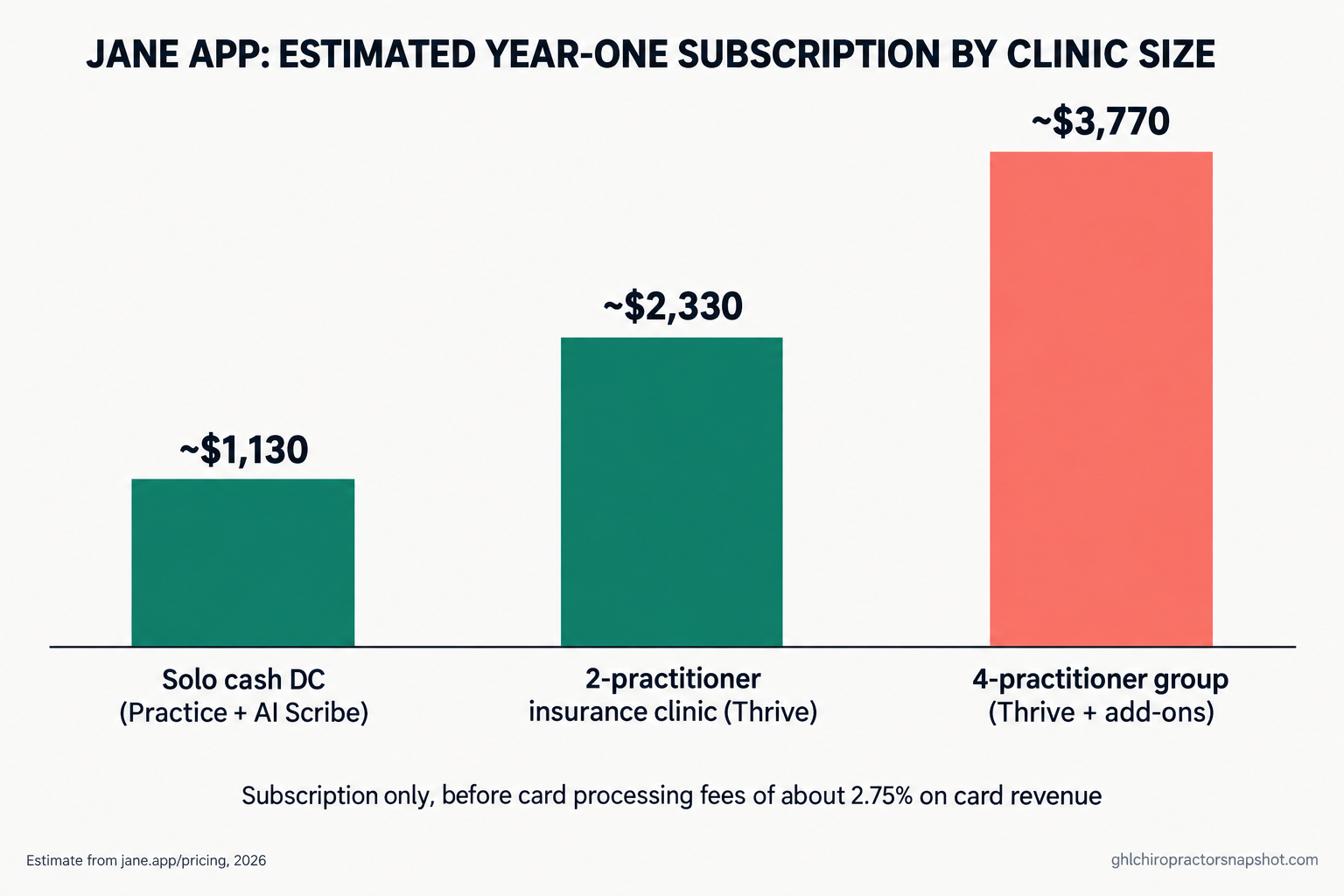
Estimate built from Jane’s public figures (Jane, 2026). Subscription only; per-seat pricing; not a quote.
Where Jane is genuinely great, and where it leaves a gap
Price only matters next to the job. Here is the honest read.
What Jane does well. It is one of the cleanest booking, charting, and patient-experience systems in the market. Online self-booking, intake forms, telehealth, and card-on-file are smooth. Pricing is public, there is no setup fee, no contract, and data import is free, which makes it low-risk to try and easy to leave (Jane, 2026). For a cash or wellness practice that wants a tidy front end patients enjoy, Jane is a strong pick (our four-way comparison puts it top for ease of use).
Where it leaves a gap. Jane reminds patients about appointments and asks happy ones for a review. It does not do the growth and recovery work that keeps a US chiropractic schedule full:
- It does not text back a missed call in 30 seconds while you are adjusting, so the caller who did not leave a voicemail is simply gone.
- It does not run a multi-step no-show recovery sequence that actually rebooks the patient, beyond the single reminder.
- It does not run a reactivation campaign to win back patients who drifted off after visit six, the biggest quiet revenue leak most practices have (why patients stop coming after visit six).
- It does not harvest reviews at the volume a local-ranking push needs, routing unhappy patients to a private channel first.
That is not a knock on Jane. No EHR is built to do it. But the expensive number in your clinic is not the software line. It is the new patient who called while the phone rang out, the no-show nobody chased, and the care-plan patient who faded away. Those leaks dwarf a Jane bill. In a $24.0 billion industry across about 66,061 US businesses (IBISWorld, 2026), the clinics that win are the ones that stop leaking patients, not the ones with the cheapest subscription.
The fix is to keep Jane for what it is good at and add a growth layer beside it: missed-call text-back, review harvesting, and a patient CRM with reactivation workflows. If you would rather not wire it yourself, a GoHighLevel development partner can install it.
The questions to settle before you commit
Jane publishes its prices, so you do not need a script to force numbers out of a rep. You need a checklist so your own math is right before you build your whole clinic around it.
A tool that posts its prices and lets you leave whenever you want is one you can trust. Just compare your real all-in total, seats and processing included.
Keep the texting HIPAA-aware, whatever you run
Jane includes SMS reminders, and the growth layer beside it sends texts too, so the compliance rules matter the moment you automate messaging. They do not change with the platform.
Under HIPAA, automated SMS and email must not carry diagnosis, condition, or treatment detail in the body, and patients need written notice of the risk of unencrypted messages before you start sending (HHS, 2026). “See you Tuesday at 3” is fine. A text that names a condition or a treatment plan is not, in plain SMS.
The other constraint is TCPA. Automated texts need prior express consent, a clear opt-out on every message, and respect for quiet hours (FCC, 2026). Set it up correctly once, with consent captured at intake and an opt-out in every sequence. For the full walkthrough, see our HIPAA-compliant patient texting guide and the chiropractic marketing compliance playbook.
Common objections
“Jane looks way cheaper than ChiroTouch. Isn’t this just talking me out of a good deal?” No. For a solo cash practice, Jane often is the better deal, and far cheaper than ChiroTouch’s real all-in cost (ChiroTouch pricing teardown). The point is only to compare the right number: Jane plus every seat plus processing, against ChiroTouch plus its add-ons. Priced honestly, Jane still wins for many practices.
“I bill insurance and do personal-injury work. Is Jane enough?” It can be, with the insurance-billing add-on, but check the fit. Jane’s billing is lighter than the claims-and-lien tooling that insurance-heavy and PI practices sometimes need, which is why some of those clinics stay on a chiropractic-specific system. Price the add-on and your own billing workflow before you commit.
“Do I really need to count card processing? It is just part of taking payments.” Yes, because it is the biggest software-related number most clinics have and it hides inside each transaction. Running $30,000 a month in cards at 2.75% is close to $10,000 a year (Helcim, 2026).
“If Jane does not do the growth stuff, do I have to replace it?” No, and you should not. Keep Jane for booking, charting, and billing, and add a separate growth layer beside it for missed-call recovery, no-show rebooking, reactivation, and reviews. Two tools doing two jobs beats one doing one job badly.
Frequently asked questions
How much does Jane App cost per month in 2026?
Jane publishes three US plans: Balance at $59 a month (one practitioner, capped at 20 appointments), Practice at $79, and Thrive at $99 (Jane, 2026). Practice and Thrive cover one full-time practitioner; extra seats, insurance billing, and add-ons are billed on top, so a working multi-provider clinic typically pays well above the base.
Does Jane App charge per practitioner?
Yes. On Practice and Thrive the base price includes one full-time practitioner. Each additional full-time seat adds about $35 a month on Practice and $40 on Thrive, with part-time seats at roughly half (Jane, 2026). Price the full roster you expect, not just today's.
Is insurance billing included in Jane App?
No. Insurance billing is a paid add-on at about $20 a month plus roughly $5 per additional full-time practitioner, and it is available only on the Practice and Thrive plans (Jane, 2026). Cash practices can skip it; insurance and PI practices should treat it as part of the base cost.
What are Jane Payments processing fees?
Jane Payments runs through Stripe at roughly 2.75% for online (card-not-present) payments and about 2.6% plus $0.10 in person, with no monthly fee on the processing itself (Jane Payments, 2026; Helcim, 2026). On a clinic collecting $30,000 a month in cards, that is close to $10,000 a year, usually the largest software-related cost a clinic has.
Does Jane App have a setup fee or a contract?
No. Jane bills month to month with no setup fee, free data import, and no cancellation penalty (Jane, 2026). That low-risk model is a genuine advantage over legacy systems that lock you into multi-year terms.
Is Jane App a full marketing and retention system for chiropractors?
No. Jane is a booking, charting, and billing system with appointment reminders and basic review requests. It does not text back missed calls, run multi-step no-show recovery, or win back lapsed patients. Most clinics pair Jane with a separate growth layer for that work.
Related reading
- Jane vs ChiroTouch vs ChiroFusion vs zHealth: the honest 2026 comparison
- ChiroTouch pricing in 2026: what it actually costs after add-ons
- The best chiropractic software in 2026: a practice owner’s buyer’s guide
- What Weave actually costs chiropractors in 2026
- Why patients stop coming after visit 6
- Missed-call text-back for chiropractors
Price the full number, seats and card processing included, not the $59 on the homepage. Then put your attention where the bigger money is: answering every call, rebooking every no-show, and keeping patients on plan long after the software has done its quiet, reliable job.