

It is a Thursday around 5:15 and there is a gap at 10:30 tomorrow where Mrs. Alvarez should be. She came in six weeks ago barely able to turn her head, did great through five visits, told you she felt “almost back to normal,” then quietly stopped booking. No cancellation, no complaint. Her plan was 24 visits. She did six.
Patients stop coming after visit 6 because that is exactly when the pain that drove them through your door finally lifts, and nothing in the visit replaces that pain as a reason to come back. The symptom was the motivation. Once it is gone, a Tuesday appointment competes with soccer practice and a tired drive across town, and loses. This is not a character flaw or a pricing problem. It is the most predictable, most expensive leak in a chiropractic practice.
A predictable drop-off is a fixable one, and not by motivating people harder. You fix it with a system that makes the value of visits 6 through 24 visible before the pain is gone, catches the lapse the moment it starts, and never lets a patient leave without the next step booked. This is that system, stage by stage.
Table of contents
- Why visit 6 is the cliff, not visit 1 or visit 20
- What the drop-off actually costs your clinic
- The retention system, stage by stage
- Run it three ways: solo, mid-size, multi-doc
- Staying compliant: HIPAA and TCPA on every message
- Objections a clinic owner actually raises
- Frequently asked questions
Why visit 6 is the cliff, not visit 1 or visit 20
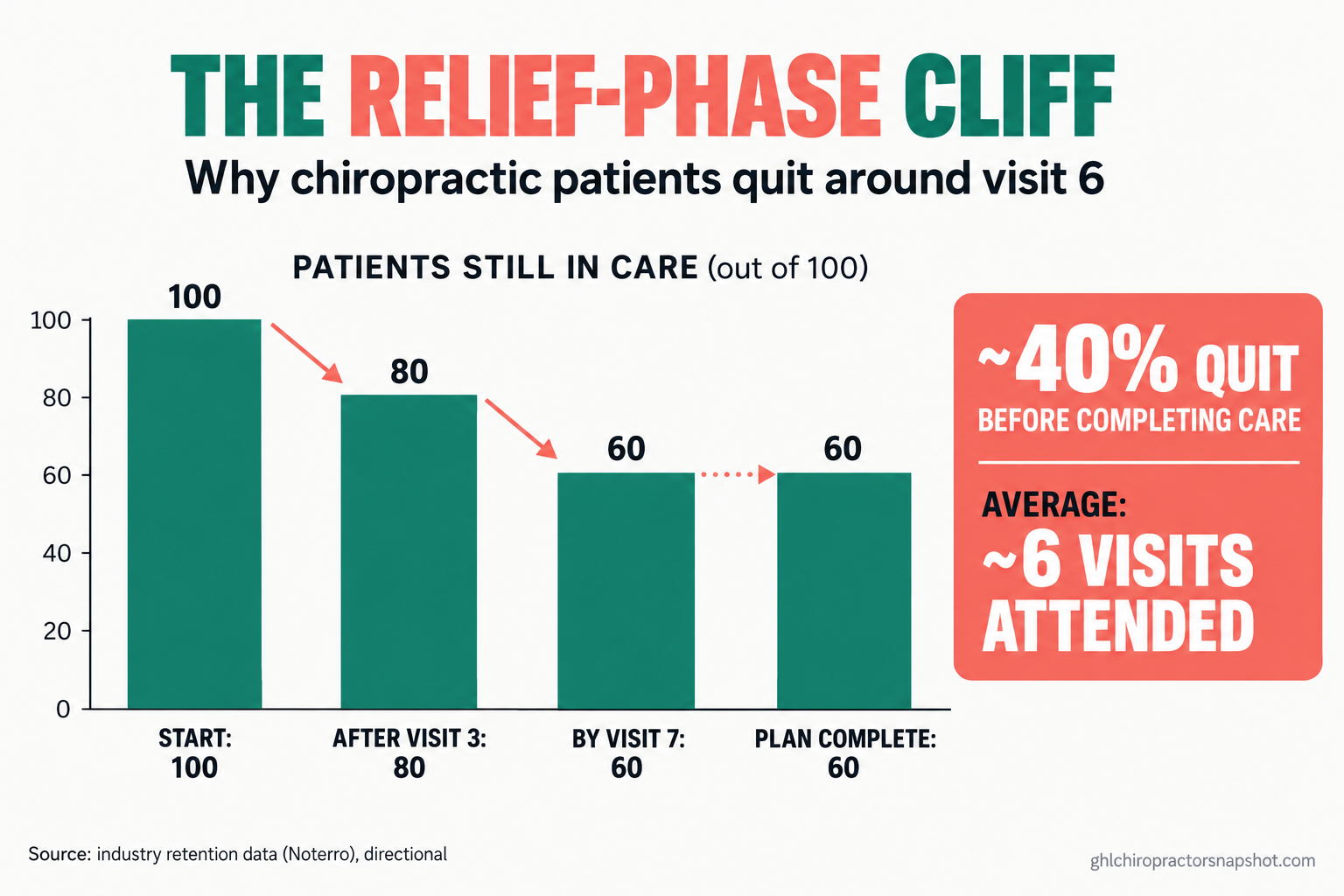
Patients leave in a front-loaded pattern. Industry retention data puts roughly 20% of patients out of care in the first 3 visits, and another 20% before the 7th, so about 40% quit before completing the care they agreed to, averaging only about six visits (Noterro). The biggest single break lands around visits 4 to 7. That is your cliff.
Patients still in care out of every 100 who start. About 40% never finish the plan. Source: industry retention data compiled by Noterro (directional).
Three things happen to a patient around that point, and all three fire at once.
The pain is gone. By visit 5 or 6 the pain is usually resolved, so the thing that drove them in stops firing. “Feeling better” is consistently the number one reason patients give for stopping care, long before the structural work is done.
The early wins have flattened. Visits 1 through 4 produce obvious change: less pain, better motion, better sleep. Visits 6 through 20 produce slower structural change a patient cannot feel, so they assume nothing is happening.
Normal life resumes its friction. Once the acute urgency fades, the 5:15 appointment competes with everything else and skipping carries no visible cost. One skip becomes two, and two becomes a lapse.
Treat the relief-phase cliff as a motivation handoff, not a loyalty problem: the patient arrived powered by pain, so you hand them a new reason to keep coming (visible progress and a clear plan) before the pain runs out. The healthcare retention benchmark sits around 60% to 70% (Noterro), and a practice on the wrong side of it is refilling a leaking bucket with expensive new patients. The fix is not a better closer at the Report of Findings. It is a handful of small systems that keep the patient moving through the drop-off window.
What the drop-off actually costs your clinic
The math is lopsided: a new patient costs 5 to 25 times more to acquire than to keep (HBR/Bain, 2014). Chiropractic already runs attrition near 17% (ClinicMind, 2026) in a $24.0 billion market of about 66,061 businesses (IBISWorld, 2026); a relief-phase cliff on top leaks from two holes.
Translate it to visits. Patient Visit Average (PVA) is the total a patient completes with you. The national PVA runs around 12, relief-only offices sit nearer 10 to 15, and corrective-plus-wellness practices target 30 or more (industry benchmarks, directional). The distance between a PVA of 12 and a PVA of 30 is the same patient, kept through the window where they usually quit. If a completed plan is worth $1,500 and half your plan patients bail at visit 6, you are losing most of the lifetime value of every patient who walks in. You feel it as a schedule that never quite fills.
The retention system, stage by stage
Each stage targets one reason patients fall off around visit 6, with how it works, how it breaks, and the copy to run. None of it needs a new login if it lives in one platform (we build ours on GoHighLevel) instead of scattered across your phone and a notepad.
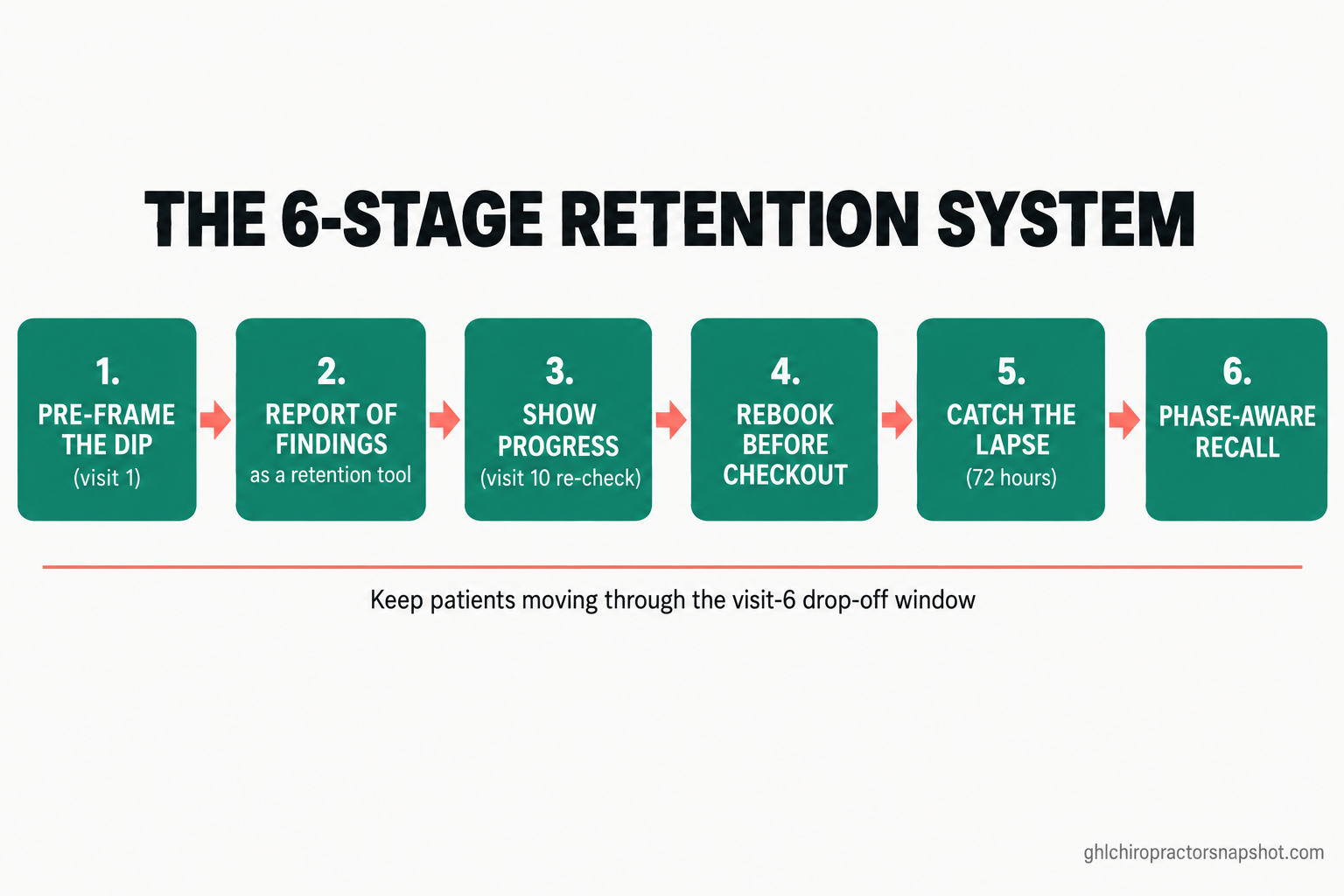
Stage 1: Pre-frame the dip at the very first visit
The most powerful move happens before the patient feels any relief. On the first visit, while they still hurt, set the expectation that feeling better is a milestone, not the finish line, because symptoms resolve well before the mechanics do.
How it breaks: the doctor says this once, verbally, during the most overwhelming appointment the patient will ever have, and they forget it by morning. Repeat the pre-frame in writing, when they are calm.
Stage 2: Make the Report of Findings a retention tool, not a sales pitch
The Report of Findings is where a relief patient either becomes a plan patient or starts counting down to visit 6. Clinics that hold patients use the ROF to set a concrete plan with phases and a finish line, so the patient knows what visit 6 and visit 18 are for. The ones that lose patients treat it as a one-time close.
How it breaks: the plan gets “sold” once and then disappears, so by visit 6 it feels optional. Make it a living document the patient sees on a schedule, not a contract in a drawer: name the current phase and state a visit count with a finish line (“visit 6 of 24”) the desk repeats every visit. For language that converts without pressure, see our Report of Findings script for care-plan conversion.
Stage 3: Make invisible progress visible
Between visit 6 and visit 20 the patient cannot feel the structural change, so you have to show it. A short re-exam around visit 10 to 12, with a before-and-after on range of motion or posture, gives a fresh win right when the pain-relief high has worn off, replacing the motivation they lost.
How it breaks: the re-exam never gets scheduled because nobody owns it, or the result lives in the EHR where the patient never sees it. Automate the trigger so a progress-check task and a patient message fire at the right visit count.
Stage 4: Rebook before they walk out the door
A patient who leaves without the next appointment booked has to decide, later, by phone, while feeling fine, to come back. That decision loses to everything else in their week. The most reliable retention habit in any practice is booking the next visit at the desk before the current one ends, every time.
How it breaks: the desk is slammed during the afternoon rush and lets a patient slip out with “just call us to schedule,” which makes them a reactivation problem waiting to happen. The rule to enforce: no patient on an active plan leaves without the next visit booked, and if they will not commit to a day, hold a provisional slot with a confirmation text they can change in one tap. If the desk cannot catch everyone during adjusting hours, a trained remote front desk can own it. See a GoHighLevel virtual front desk for chiropractors.
Stage 5: Catch the lapse in the first 72 hours
The cliff is not a single missed appointment. It is a missed appointment nobody noticed. A patient who cancels and hears nothing for two weeks has decided, by default, that they are done. One who gets a warm message within a day still thinks of themselves as “in care.” Speed is the whole game.
How it breaks: the recall fires too late (a generic “we miss you” three weeks later reads as marketing) or never fires because it depends on someone checking the gap report. Automate it off the missed or unbooked status and keep the first touch same-day.
Stage 6: Hand off to phase-aware recall for the long haul
A patient past visit 6 is not safe forever. The next break comes mid-plan, around visit 14, for different reasons. Once they clear the relief-phase cliff, hand them to a lighter, phase-aware recall: tighter during corrective care, lighter in maintenance. We cover that second break in why patients drop off at visit 14, and the win-back for patients who still slip away in building a patient reactivation campaign.
How it breaks: one recall cadence gets applied to everyone, so active corrective patients feel nagged and wellness patients feel forgotten. Tag by phase and let the automation send different cadences to each.
Run it three ways: solo, mid-size, multi-doc
The six stages do not change with practice size. Who does the work, and how much is automated, does.
Solo DC, 1 to 3 staff, 80 to 150 visits a week. You are the bottleneck, so automate everything that does not need your hands: the pre-frame text, the progress nudge, and the 72-hour save all fire on their own off visit counts and appointment status. Protect one human habit, Stage 4 same-visit rebooking, because it is the cheapest retention in the building and takes ten seconds. Turn those two on and the schedule tightens within a month.
Mid-size, 2 to 4 DCs, shared front desk. Your risk is inconsistency: one doctor pre-frames and rebooks every patient, another forgets both. Standardize the ROF format and the rebooking rule across providers, route the saves through one shared automation, and give one person a weekly “who lapsed this week” report so the cliff is visible instead of buried.
Multi-doc or multi-location. The enemy is handoffs. A patient who sees a different provider at a second location should still get one plan, one recall cadence, and one save sequence tied to them, not to a location. Centralize the record so phase tags travel with the patient, and watch the chiropractic KPIs that actually predict growth, because at this scale a half-point change in completion rate is real money.
Staying compliant: HIPAA and TCPA on every message
Every message here is automated and goes to a patient, so two rules govern all of it. Get them right once in the build and the system enforces them from then on.
HIPAA governs what is in the message. A plain SMS is not a secure channel, so no diagnosis, condition, or treatment detail goes in the body. “Time for your next visit” is fine. “Time to restart your disc decompression plan” names a condition and a treatment and turns a routine nudge into a privacy problem. Give patients written notice that text and email are not encrypted, and segment lists by visit behavior (“hasn’t rebooked,” “visit 10 reached”), never by condition. Targeting off a condition-based list is a HIPAA marketing issue under the HHS guidance on marketing.
The TCPA governs permission to send. Reminders and the lapse save sit under a lighter standard than promotions, but you still need consent to text, you still identify your clinic, and you still honor opt-outs instantly. Capture consent at intake, keep marketing consent separate from reminder consent, and make STOP work automatically. For the full breakdown, see HIPAA-compliant patient texting and the chiropractic marketing compliance guide.
The danger here is not one wrong text, it is 800 wrong texts: an automation that leaks a condition, or runs off a diagnosis-based list, does it to your whole patient base at once. Build the guardrails in (behavior-based segments, STOP handling, no clinical detail) and volume stops being a liability.
Objections a clinic owner actually raises
“Won’t patients find all these texts annoying?” Not if the content is useful and the volume is low. This is not a blast campaign: one expectation text after visit 1, one progress nudge around visit 10, and a short save sequence only if they lapse. A warm message when they miss a visit reads as care, not spam, and the ones who opt out were leaving anyway.
“I already sell a solid care plan at the Report of Findings. Isn’t that enough?” A great ROF gets the commitment. It does not keep it. The visit-6 cliff happens to patients who agreed to the whole plan and drifted once the pain left. Case acceptance and case retention are different skills. The ROF wins the first, this system wins the second, and you need both to move your PVA.
“My front desk is slammed during adjusting hours. How does this not add work?” It removes work. The pre-frame, progress nudge, and save sequence a desk would have to remember by hand all get automated. The only manual habit is same-visit rebooking, which takes seconds. If the desk still cannot keep up, that is a capacity problem a virtual front desk solves.
Frequently asked questions
Why do chiropractic patients stop coming after a few visits?
Because the acute pain that motivated the first call usually resolves by visit 5 or 6, and nothing in the visit replaces it as a reason to return. Industry data shows roughly 40% of patients quit before completing care, averaging about six visits. The fix is to build a new reason to come back (a clear plan and visible progress) before the pain is gone.
What is Patient Visit Average (PVA) and what should mine be?
PVA is the average visits a patient completes over their whole relationship with your practice. The national average runs around 12; relief-only offices sit near 10 to 15, and corrective-plus-wellness practices target 30 or more. These are directional, so track your own trend rather than chasing one number.
When should the first retention message go out?
The evening of the first visit, while the pain is still fresh. That is when you set the expectation that feeling better is a milestone, not the finish line. Waiting until they already feel good is too late, because by then the motivation to continue has started to fade.
Is it HIPAA-compliant to text patients recall messages?
Yes, if the body carries no diagnosis, condition, or treatment detail, patients were told text and email are not encrypted, and you honor opt-outs. Keep messages generic, segment by appointment behavior rather than condition, and get consent at intake. Promotions carry a stricter consent standard than reminders.
How is this different from reducing no-shows?
No-show tools keep patients who already have an appointment booked. The relief-phase cliff is about patients who stop booking at all once they feel better, often without missing a scheduled visit. You need reminders for the appointments that exist and this system to keep patients booking new ones.
Back to that 10:30 gap. In a practice running this system, Mrs. Alvarez never reaches it. She got the expectation text the night of visit 1, so feeling better at visit 5 did not read as “done.” Her range-of-motion re-check at visit 10 left her impressed. She walked out of every visit with the next one booked. And the one Thursday she did cancel, a warm text that afternoon had her back the following week. None of that took a better closer or a harder-working front desk. It took a system that keeps patients moving through the spot where they usually stop.