

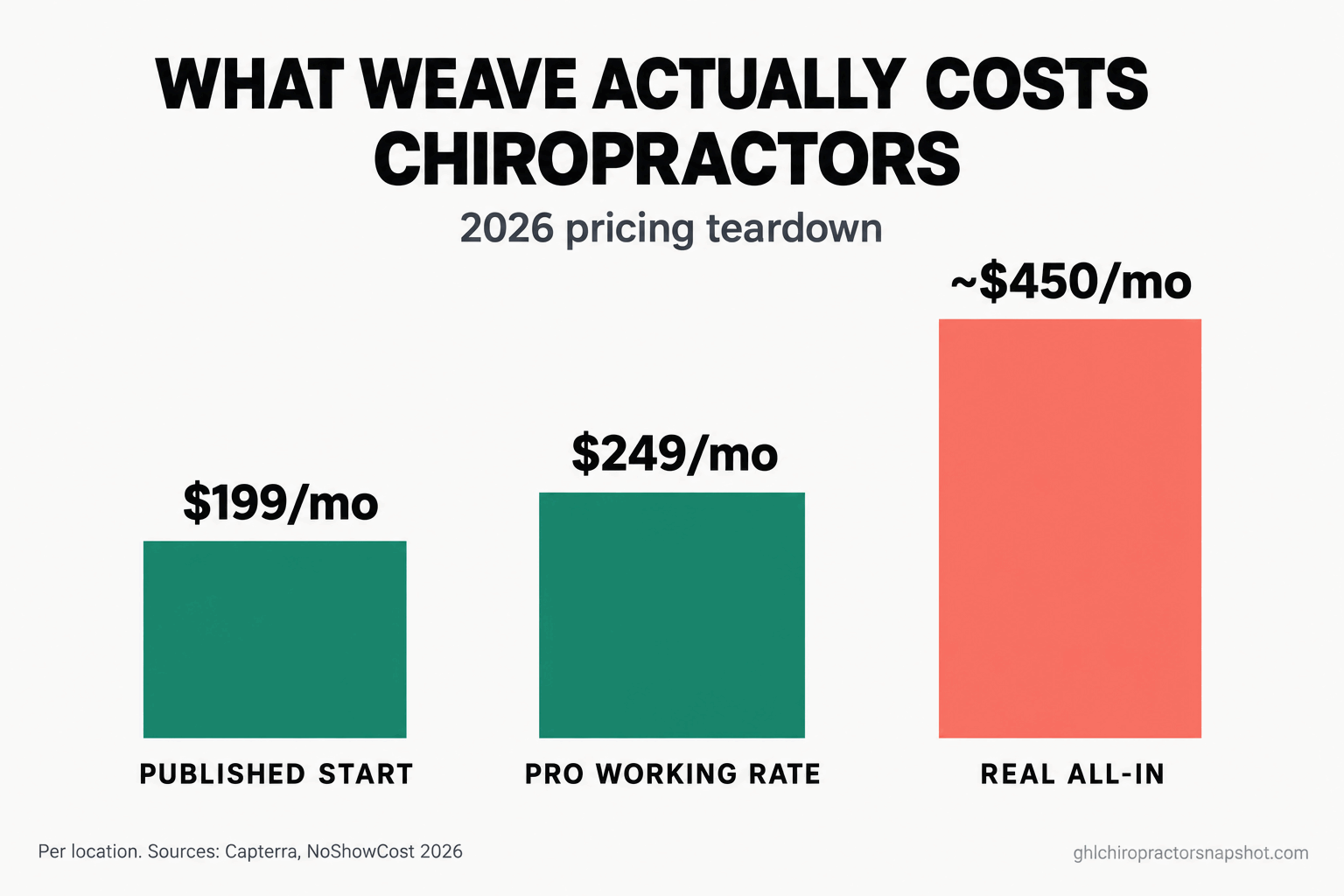
What does Weave actually cost a chiropractic clinic in 2026? The only price Weave publishes is a starting rate near $199 to $249 per month per location (Capterra, 2026; The Molar Report, 2026). The real number is higher once you add a one-time setup fee of about $500 to $750, a roughly $200 charge to migrate your digital forms, desk-phone hardware, add-ons for texting and analytics, and a multi-year contract. Third-party reviews put a single-location clinic’s real bundle at $300 to $700 a month, and year one past $4,000 once the setup fee lands (Pabau, 2026; NoShowCost, 2026). This is the line-by-line breakdown, plus the alternatives you can price without booking a demo.
Here is the problem every clinic owner hits. You ask Weave what it costs, and instead of a price you get a calendar link for a demo. The number a listing site shows is the entry tier, and most of the system you want sits one or two tiers up, behind a quote. Every figure below is dated and linked to its source. One thing up front: Weave sells hardest into dentistry, so most public pricing comes from dental and medical practices on the same plans. Weave does not publish chiropractic-specific pricing, which is itself part of the story.
Table of contents
- What Weave actually costs in 2026
- The tiers and add-ons that stack on top
- The hidden costs nobody quotes you
- What Weave really costs: three scenarios
- Four alternatives that skip the sales call
- The questions to force out of the rep before you sign
- Keep the texting HIPAA-aware, whatever you buy
- Your phone bill is not your biggest number
- Common objections
- Frequently asked questions
What Weave actually costs in 2026
Start with the one number Weave will stand behind. Capterra puts the entry point at $199 per month per location, where the starting plan covers appointment reminders, two-way texting, online scheduling, and up to 15 VOIP phones (Capterra, 2026). Independent reviewers put the real working plan, usually called Pro, closer to $249 per month per location, and note that Weave runs four paid tiers (Pro, Elite, Ultimate, Enterprise) with only that one entry price public (The Molar Report, 2026).
Two words do most of the budgeting damage: per location. That is not a flat company fee. A solo DC with one office pays once. The day you open a second location, the whole monthly rate repeats, because Weave meters by site, not by provider or patient volume.
The published rate is also not what most clinics report paying. Pull together the reviews and a realistic single-location bundle lands at $300 to $700 a month once you include the features a busy front desk uses (NoShowCost, 2026). That gap between the headline and the invoice is why Weave, along with ChiroTouch, shows up on every “hidden pricing” list.
The tiers and add-ons that stack on top
The entry plan buys the phones and the basics. A working clinic wants more, and each piece tends to live one tier up or on its own line.
- The higher tiers. Pro is the published floor. Elite and Ultimate add deeper review management, payments, and analytics, and are quote-only, so you cannot price them without a call (The Molar Report, 2026).
- Call intelligence and analytics. Real-time analytics and call-intelligence features are commonly sold as a separate pack, not bundled into the entry plan.
- Payments. Weave Payments is its own product with its own processing cut, and like any built-in processor the rate is rarely the cheapest you can get.
- Texting volume and extra phones. Reviewers repeatedly flag charges for additional phones and higher texting volume once you pass the base cap (Capterra, 2026).
- Desk-phone hardware. Weave is a phone system too, so plan for hardware on top of the setup fee (CostBench, 2026).
None of these are exotic. They are the features that make the platform worth having. The trouble is the “$199” a prospect remembers rarely includes the tier, the hardware, or the add-ons, so the first real invoice lands well above the number in their head.
The hidden costs nobody quotes you
These are the costs that appear on no listing page and often not in the first verbal quote either.
Setup and onboarding. Getting live is a project and it is billed like one. Reviews widely report a one-time setup fee of $500 to $750, frequently quoted at $750, covering number porting, phone-tree setup, and account creation, plus about $200 to migrate your existing digital forms (CostBench, 2026). It lands in year one on top of everything else.
The contract term. This is the one that traps people. Reviewers describe multi-year contracts as standard, and warn that unwinding one is painful if the platform does not work out (Pabau, 2026). A month-to-month tool is a different risk than a two-year commitment. Ask for the term in writing before you sign.
Price increases at renewal. Owners commonly cite price increases over time, and negotiation tends to happen at renewal and for multi-location commitments (Software Advice, 2026). The number on your first invoice is often the lowest you will see.
The cost of leaving. Moving your phone numbers, saved templates, and contact history out is real work. Ask what a clean export and a number port-out involve, and in what format, before you are a customer, because your bargaining power is highest then.
What Weave really costs: three scenarios
Because Weave meters by location, the right number depends on how many offices you run. Here are three honest year-one estimates, each using the Pro rate plus a midpoint setup fee, the forms charge, and a modest add-on allowance. These are estimates from public figures, not quotes.
Single location, solo DC. Pro at about $249 a month is roughly $2,988 across the year. Add a $750 setup, a $200 forms migration, and about $600 in add-ons, and you land near $4,500 in year one, or about $375 a month averaged, before hardware. Pabau’s own estimate puts year one past $4,000 on the same math (Pabau, 2026).
Two locations, growing group. Two sites at $249 is about $5,976 a year in subscription alone. Add two setup fees, two forms migrations, and a larger add-on allowance, and year one runs near $8,700, or roughly $725 a month. Nothing is shared across your sites.
Four locations, established group. Four sites is about $11,952 a year in subscription. Add four setups, four forms migrations, more phones, and the analytics pack most groups end up wanting, and year one clears $16,000, or about $1,340 a month. At this size the quote-only Enterprise tier enters the conversation, and so does real negotiating room at renewal (Software Advice, 2026).
Four alternatives that skip the sales call
Weave is a capable platform, and for a clinic that wants one vendor to answer the phone, text patients, and chase reviews, it is a real option. But you should never have to book a demo to learn what software costs. These four publish their prices and cover most of what a chiropractic front desk needs.
Patient-communication options you can price without a demo (2026)
| Plan | Weave | GoHighLevel | Emitrr | zHealth | ChiroFusion |
|---|---|---|---|---|---|
| Price | $199–$249+ / mo / location | $97–$497 / mo (flat) | from $149 / mo | $99–$299 / provider / mo | from $129 / mo |
| Feature 1 | Only the entry tier is public; the rest is quote-only | Fully published pricing, 14-day self-serve trial | Published pricing, texting-focused | Published tiers; it is an EHR, not just comms | Transparent cloud pricing, no hidden hardware |
| Feature 2 | $500–$750 setup + ~$200 forms migration | Two-way SMS, email, calendars, reviews, pipelines | HIPAA-compliant SMS, reminders, review requests | Patient texting and reminders built in on higher tiers | Chiropractic EHR with reminders and messaging |
| Feature 3 | Phones, texting, reviews, payments; not an EHR | No per-location multiplier at the account level | Lighter than a full phone system | Chiropractic-specific records and billing | +$49/mo per extra provider |
| Feature 4 | Multi-year contract reported as standard | Platform our snapshot is built on | Good fit for a single busy front desk | Replaces more than Weave does | Lower entry cost, demo optional |
Sources: Weave (Capterra, 2026), GoHighLevel (2026), Emitrr (2026), zHealth (2026), ChiroFusion (2026).
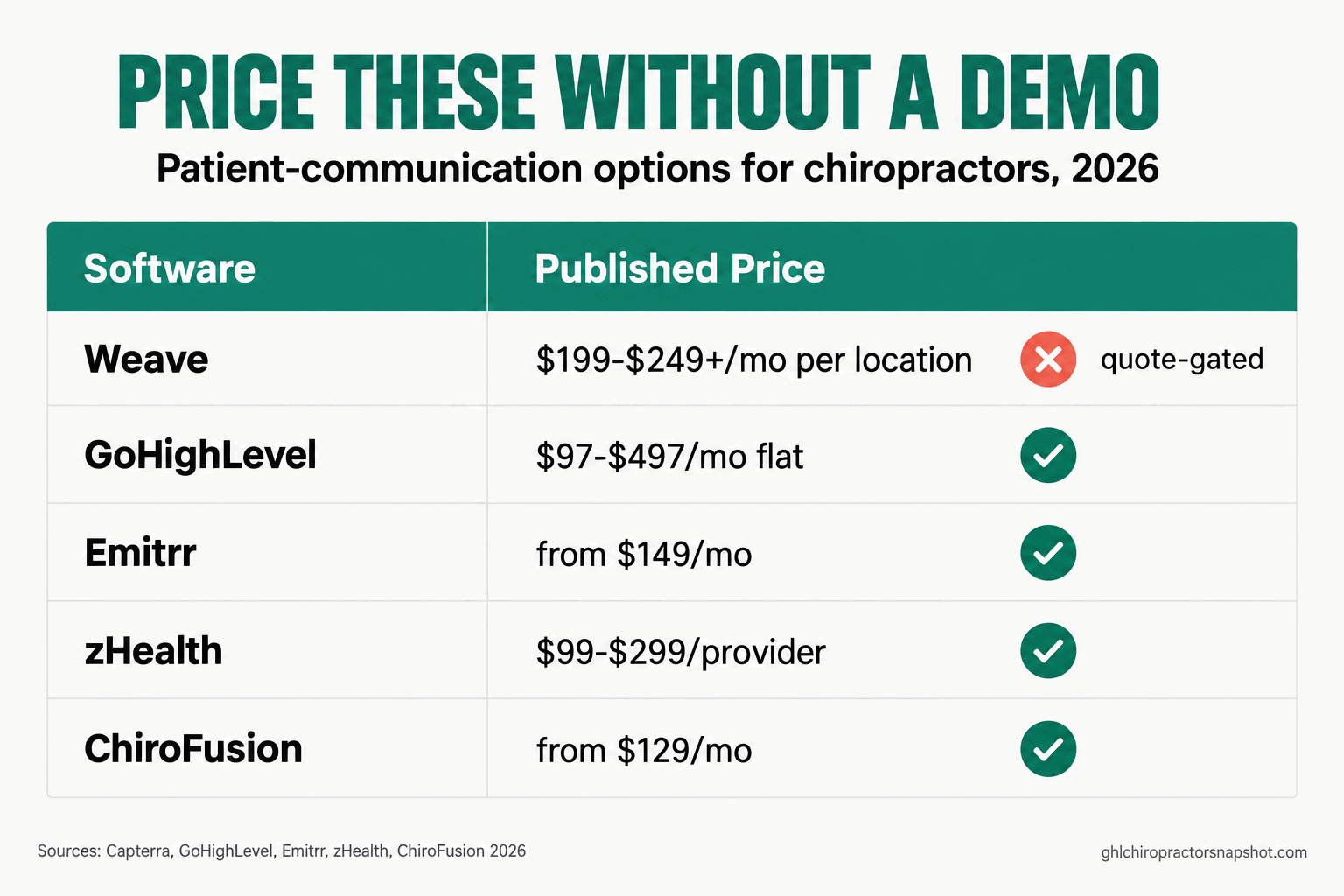
Who each one is right for. Weave fits a clinic that wants a bundled phone system with messaging and does not mind a contract. GoHighLevel fits a clinic or agency that wants two-way texting, email, calendars, reviews, and automation under one flat, published price, which is why our system is built on it. Emitrr fits a single office that mostly needs HIPAA-aware texting and reminders. zHealth and ChiroFusion are chiropractic EHRs that bundle messaging, so they replace more of your stack than Weave does. For the full head-to-head, see our best patient communication software for chiropractors comparison and our chiropractic software buyer’s guide.
The questions to force out of the rep before you sign
Because most of Weave’s pricing is not published, your best defense is a script. Take it to any demo, for any vendor, and refuse to move forward until every line has a written answer.
A vendor that answers all of that plainly is one you can trust. One that keeps steering you back to “let’s get you started” is telling you something.
Keep the texting HIPAA-aware, whatever you buy
A communication tool makes it easy to text a lot of patients fast, which is why compliance matters. Whatever platform you pick, the rules do not change.
Under HIPAA, automated SMS and email must not carry diagnosis, condition, or treatment detail in the body, and patients need written notice of the risk of unencrypted messages before you start sending (HHS, 2026). A reminder that says “see you Tuesday at 3” is fine. One that references a condition or a treatment plan is not, in plain SMS.
The other constraint is TCPA. Automated texts need prior express consent, a clear opt-out on every message, and respect for quiet hours (FCC, 2026). That is not a reason to avoid texting. It is a reason to set it up correctly once, with consent captured at intake and an opt-out wired into every sequence.
State board advertising rules bite on the “free exam” hook specifically. Louisiana and West Virginia require any free or discounted-service ad to disclose the usual charge and have the patient sign a disclosure, and Arizona bars vague free-service ads. If your texts push an offer, verify your state’s rule first. The platform never makes your content compliant; your templates do. For the full playbook, see our chiropractic marketing compliance guide and the HIPAA-compliant patient texting walkthrough.
Your phone bill is not your biggest number
Here is the reframe that changes the decision. The communication software is a knowable, boring number. The expensive number is the revenue your front desk quietly lets slip: the new-patient call that rang while someone was being roomed, the no-show nobody chased, the care-plan patient who drifted off after visit six.
Those leaks dwarf a software bill. A single new patient can be worth well over a thousand dollars in lifetime value, and a busy solo clinic loses several a month to missed calls alone. In a $24.0 billion industry across about 66,061 businesses (IBISWorld, 2026), the clinics that win are the ones that stop leaking patients, not the ones with the cheapest phone system.
A phone system and a growth system are two different jobs. Weave answers and routes calls. It was never built to text back a missed call in 30 seconds off your own calendar, run a reactivation campaign, or recover a no-show automatically. That work lives in your missed-call text-back, appointment automation, review harvesting, and patient CRM and workflows, and it is usually where the money is.
Common objections
“I already pay for Weave. Is this article telling me to rip it out?” No. If Weave answers your phones and your team likes it, keep it. Price it honestly at renewal, negotiate the rate and an increase cap, and drop tiers you do not use. Then make sure the growth automation, the missed-call recovery and reactivation, is actually running, because that is the line costing you most.
“Isn’t a cheaper tool just worse?” Not automatically. GoHighLevel, zHealth, and ChiroFusion publish their prices and are well regarded. A single-location cash practice may be over-buying with a full phone-system bundle it barely uses. “Worse” depends on the jobs you need done. Match the tool to the work, not the brand name.
“Do I need to be technical to compare this stuff?” No. You need the question script above and the discipline to make every vendor answer in writing. Wiring up the automation is what a done-for-you system or a GHL development partner handles. Your job is to know your real all-in number.
“Won’t patients find automated texts annoying?” Only if you over-send. A single, well-timed reminder and a fast reply to a missed call read as good service, not spam. The annoyance comes from volume, which you control in the template, not from automation itself.
Frequently asked questions
How much does Weave cost per month in 2026?
The only public price is a starting rate around $199 to $249 per month per location (Capterra, 2026; The Molar Report, 2026). Weave runs four tiers (Pro, Elite, Ultimate, Enterprise) and keeps the upper three quote-only, so your real cost depends on the tier, add-ons, and hardware you configure.
Does Weave charge a setup fee?
Yes. Reviews widely report a one-time setup fee of $500 to $750, often quoted at $750, for number porting, phone-tree setup, and account creation, plus about $200 to migrate your existing digital forms (CostBench, 2026).
Is Weave pricing per location or per user?
Per location. Each office you add repeats the full monthly rate, so the model favors a single-site clinic and gets more expensive linearly as you open more locations.
Does Weave require a long-term contract?
Reviewers describe multi-year contracts as standard and note that unwinding one is difficult (Pabau, 2026). Confirm the term length and cancellation notice window before signing, and ask whether month-to-month is available.
What is the cheapest Weave alternative you can price without a sales call?
GoHighLevel ($97 to $497 a month, flat and published, with a self-serve trial), Emitrr (from $149 a month), ChiroFusion (from $129 a month), and zHealth ($99 to $299 per provider) all publish pricing and let you start without a demo.
Is Weave an EHR for chiropractors?
No. Weave is a phone and messaging platform that sits alongside your records system. It does not keep SOAP notes or file claims, so it never replaces ChiroTouch, Jane, zHealth, or ChiroFusion. Budget it as a second bill, not a swap.
Related reading
- The best patient communication software for chiropractors: Weave vs Podium vs Solutionreach vs GoHighLevel
- ChiroTouch pricing in 2026: what it actually costs after add-ons
- Jane vs ChiroTouch vs ChiroFusion vs zHealth: the honest comparison
- Missed-call text-back: turn every missed call into a booked visit
- HIPAA-compliant patient texting for chiropractors
Price the full number, not the headline, and refuse to book a demo just to learn what a tool costs. Then put your attention where the bigger money is: answering every call, chasing every no-show, and keeping patients on plan.