

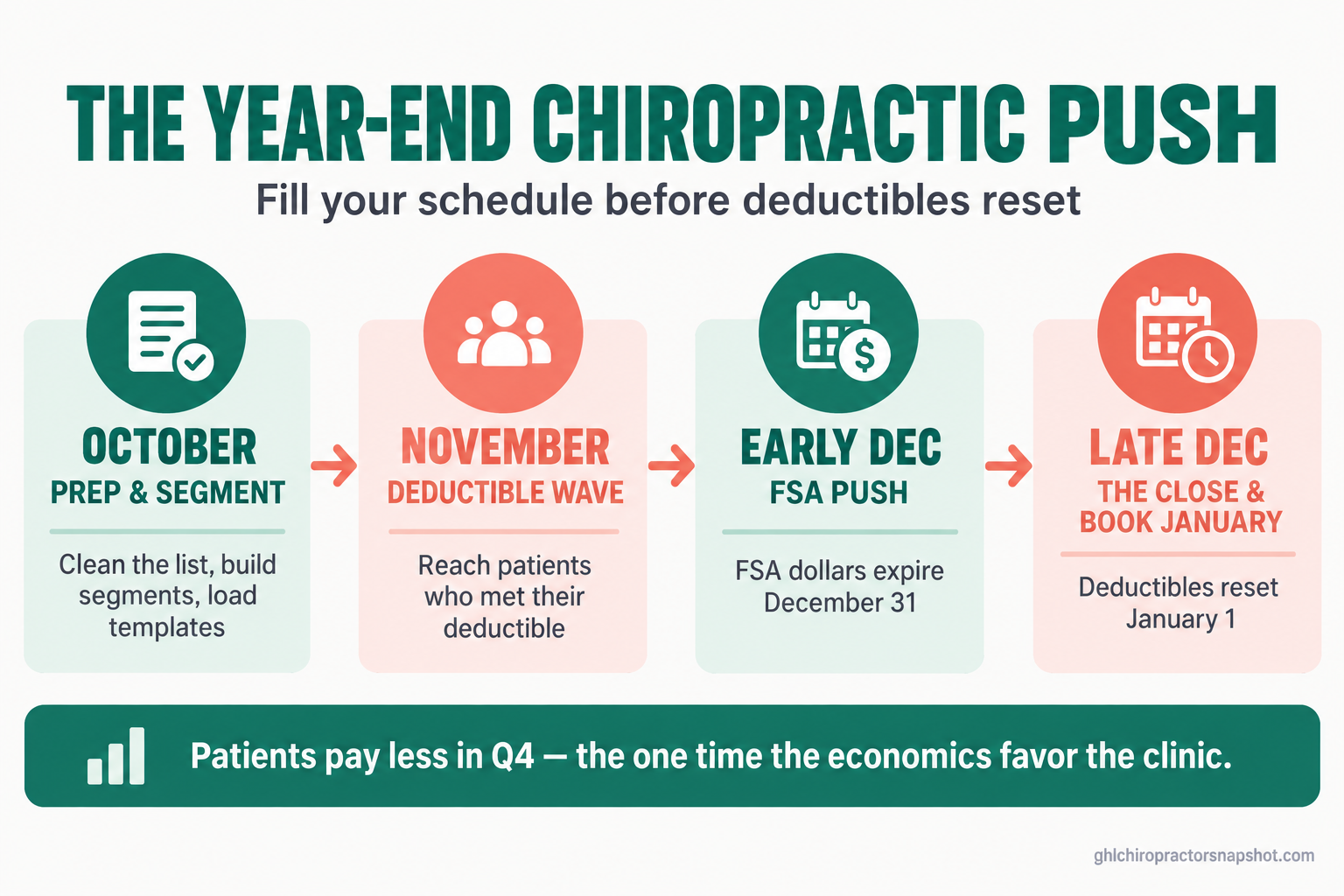
It is the third week of October and your late-December schedule already looks thin; your front desk has quietly written off the last two weeks of the year. Meanwhile, a few hundred people on your list are sitting on two things they are about to lose: a deductible they have paid down to near zero, and flex-spending dollars that disappear at midnight on December 31.
The last ten weeks of the year are the cheapest time all year for an insured patient to finish a care plan, and the most expensive time for you to ignore that. A patient who has met their deductible pays a fraction of what the same visit costs them in January, when the meter resets to zero. If you do not remind them, they do not act, and both of you leave money on the table. What follows is the segmented, compliant, mostly automated sequence that captures it.
Table of contents
- Why the last ten weeks are a revenue window
- What the year-end window is worth
- The four-phase calendar
- Phase 1: prep and segmentation
- Phase 2: the deductible wave
- Phase 3: the FSA push
- Phase 4: the close
- The plan by clinic size
- Compliance rules you cannot skip
- Objections from the front desk
- FAQ
Why the last ten weeks are a revenue window
The reason this works is boring and dependable: insurance math. A deductible is the amount a patient pays before their plan starts covering care (HealthCare.gov). Most plans run on a calendar year, so that counter resets to zero on January 1. A patient in and out of your office and other providers all year has probably chipped most of it away by October. Their next visit is cheap; their first visit in January costs full freight again.
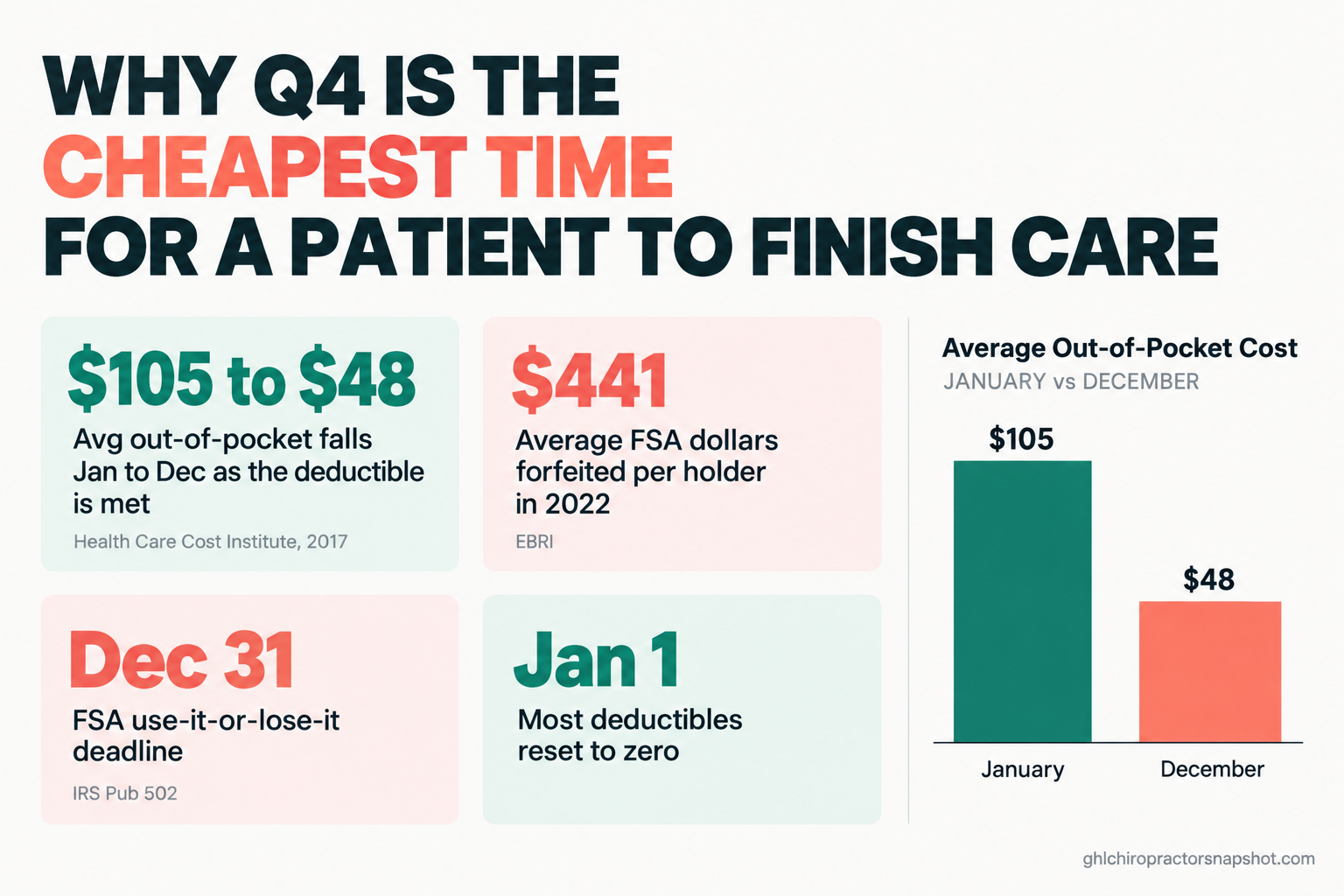
You can see it in hard numbers. When the Health Care Cost Institute tracked out-of-pocket spending on insulin through a calendar year, the average fell from $105 in January to roughly $48 by December as people met their deductibles, and in high-deductible plans January cost more than four times December (HCCI). Insulin is not an adjustment, but the mechanism is identical: the closer to year-end, the less the patient’s wallet feels each visit.
Average out-of-pocket insulin spending, January vs. December, as enrollees meet their deductible. Source: Health Care Cost Institute, 2017.
Then the second clock. Flexible spending accounts are, for most employers, use-it-or-lose-it: whatever is left on December 31 is gone. Chiropractic care for a genuine medical need is an eligible FSA and HSA expense; IRS Publication 502 states plainly that “you can include in medical expenses fees you pay to a chiropractor for medical care” (IRS). And people leave real money behind: the Employee Benefit Research Institute found about half of FSA accountholders forfeited funds in 2022, an average of $441 each (EBRI). A patient sitting on $300 they will otherwise forfeit, who also needs two visits to finish a plan, just needs a reminder before the deadline, from someone they trust.
What the year-end window is worth
The average chiropractic patient makes 8.3 visits a year at about $87 per visit, roughly $721 a year (MEPS, 2007 to 2016). Your active patients run higher; use those as a floor.
Say you have 400 patients who went quiet in the last six to twelve months. A sequence that wins back 8% brings 32 people back. If each returns for three visits at $87, that is over $8,300 in care you would not otherwise have billed, most of it in weeks your schedule was half empty, with no new lead, no ad spend, and no discount.
For 2026 the IRS set the health FSA contribution cap at $3,400 and the carryover maximum at $680 (Revenue Procedure 2025-32, via Newfront). Anything above that is forfeited, and patients would rather spend it on care than hand it back to payroll.
Average FSA dollars forfeited per accountholder. Source: EBRI FSA Database analysis.
The four-phase year-end calendar
Four phases, each with one job. Start before Halloween and the run-up is calm; start in December and you are rushing a compliant campaign out the door.
- •Oct 15 to Nov 1
Phase 1: Prep and segment
Clean the list, build segments, confirm consent, load templates.
- •Nov 1 to Nov 30
Phase 2: Deductible wave
Reactivate patients who likely met their deductible. Lead with cost and the January reset.
- •Dec 1 to Dec 18
Phase 3: FSA push
Remind FSA/HSA holders funds expire Dec 31. Make booking two taps.
- •Dec 18 to Dec 31
Phase 4: The close
Final-call messaging, and book January appointments now.
Phase 1: October prep and segmentation
Nothing goes out yet. The work is segmentation, because a blast to your whole list is both less effective and more likely to get you in trouble than four tight segments. Build these groups in your CRM:
- Met-deductible likely. Had an insurance claim run through your office this year and have not finished recommended visits. Your warmest targets.
- FSA/HSA payers. Anyone you know pays with a flex card. Tag them at every checkout.
- Care-plan drop-offs. Stopped partway through a plan, the group that quietly drains a practice. For the full diagnosis, read why patients stop coming after visit 6.
- Lapsed wellness. Used to come monthly, not booked in 90-plus days.
Then the setup:
- Fix the data: dedupe, drop opt-outs, confirm each contact has a valid mobile number and email.
- Confirm messaging consent for every number before you text it. No consent, no SMS; those contacts get email or a call.
- Write and load all four phases of templates now, so November is just pressing go.
- Set a daily send cap and quiet hours so nothing fires overnight.
A tidy, tagged list makes every phase work; that cleanup is the highest-value hour you spend this quarter. Our patient reactivation campaign guide goes deeper on the segmentation logic.
Phase 2: the November deductible wave
November is the deductible message, to the met-deductible segment and care-plan drop-offs. The hook is cost plus the January reset: a true financial fact and an offer of a spot.
The opening text, ready to steal:
Hi [First Name], it’s [Clinic Name]. If you’ve met your insurance deductible this year, finishing your visits now usually costs you less than it will in January, when most plans reset. Want me to hold a spot before the schedule fills? Reply YES or call [number]. Reply STOP to opt out.
The email version, same week, same segment:
Subject: Your insurance deductible resets January 1
Hi [First Name], a quick note. Most plans reset your deductible on January 1, which means care you’ve already paid toward this year can cost more once the new year starts. If you’ve been meaning to finish up, the next few weeks are usually the most cost-effective time. Reply here or book: [booking link].
Then a cadence:
- Day 1: the text, plus the email to the same people (two channels, same day, reinforce).
- Day 4: to non-responders only, a short follow-up text: “Hi [First Name], circling back from [Clinic Name]. Still happy to hold a spot before year-end. [booking link].”
- Day 8: a front-desk call task for anyone who opened or clicked but did not book.
The day-8 call matters most: automation gets the patient leaning in, a person at the desk books the visit. If the phone is failing you, missed calls during adjusting hours is the companion fix.
Phase 3: the early-December FSA push
December 1 to 18 is the flex-spending message to your tagged FSA/HSA payers. The clock is hard: most FSAs forfeit whatever is left on December 31, chiropractic care is an eligible expense (IRS Publication 502), and roughly half of accountholders lose money this way every year (EBRI).
The steal-this text:
Hi [First Name], it’s [Clinic Name]. Heads up: if you have FSA dollars left, they usually expire December 31. Chiropractic care is an eligible expense, so it’s a good way to use what’s left before it’s gone. Want a spot this month? Reply YES or book: [booking link]. Reply STOP to opt out.
The email, same segment, early December:
Subject: Don’t let your FSA dollars disappear on December 31
Hi [First Name], most flexible spending accounts are use-it-or-lose-it, and anything left in yours on December 31 is forfeited. Care in our office is FSA-eligible, so now is the window. We have appointments open over the next three weeks: [booking link].
Booking has to be two taps, not phone tag. If the only way to act is to call during office hours, you lose the patient who read it at 9pm. Put a self-booking link in every message. If online booking is not wired up cleanly, online scheduling for chiropractors is the piece to fix first.
All December, the front desk should ask at every checkout: “Do you have flex-spending dollars to use before year-end?” It is a service, not a pitch, and it catches people your segmentation missed.
Phase 4: the late-December close
The last two weeks have two jobs. First, a short final-call message to anyone still sitting on an unused FSA balance or unfinished plan:
Hi [First Name], last call from [Clinic Name] before the year ends. If you want to use remaining benefits or finish your visits, we have a few spots left this week. [booking link]. Reply STOP to opt out.
Second, the job most clinics forget: book January now. A patient whose deductible is about to reset is not a lost cause; the ones who book their January visit in late December actually show up. Book the next appointment before they leave, and run a light “new year, fresh start” reactivation to the quiet wellness segment in early January.
The plan for a solo, mid-size, and multi-doc clinic
The framework is one thing; how you run it depends on how many hands and hours you have.
| Solo DC | Mid-size, 2 to 3 DCs | Multi-doc, 4 to 5 DCs | |
|---|---|---|---|
| List to work | 150 to 400 | 400 to 900 | 900 to 2,500 |
| Channels | Text + email, calls for warm opens | + planned call blocks | Full sequence, front-desk owner |
| Daily send cap | 40 to 60 | 75 to 125 | 150 to 250, staggered |
| Who owns it | Owner, 20 min a day | One front-desk lead | Coordinator, per-provider |
| Biggest risk | No time for calls | Segments blur | Overbooking, double-booked DCs |
Solo DC: lean on automation and spend your human time only on the day-8 call for warm opens. Mid-size: tag discipline matters as segments overlap, so name one campaign owner and schedule call blocks. Multi-doc: your risk is coordination, not reach. Route booking by provider so the push does not stack onto one doctor’s December, and give a coordinator a dashboard of who was messaged, replied, and booked. At this size a connected patient CRM and workflow layer is what keeps it off a spreadsheet.
The compliance rules you cannot skip
A year-end campaign touches patients, money, and advertising at once: three sets of rules, none hard, all easy to trip over in a rush.
Keep protected health information out of the message. A text or email that names a diagnosis, condition, or specific treatment is a problem. Keep every message generic: “finish your visits,” “use your benefits,” never “your lower-back treatment.” Patients should also have had written notice that unencrypted messaging carries a privacy risk. Our chiropractic marketing compliance guide and HIPAA-aware texting playbook have the exact language.
Respect texting consent and quiet hours. Only text patients who have consented, include a clear opt-out such as “Reply STOP,” and do not send outside daytime hours. The federal standard for marketing calls and texts is generally 8am to 9pm in the recipient’s time zone. Set that window and honor every STOP.
Watch the discount rules if you promote one. You do not need a discount here; the savings is the patient’s own deductible math. But if you advertise a free or discounted service, some states regulate it: Louisiana and West Virginia require such an ad to disclose the usual charge and have the patient sign a disclosure, and Arizona bars vague free-service ads. Time-of-service cash discounts are generally kept to roughly 5% to 15% to avoid dual-fee-schedule exposure. Verify your state board’s rules first.
Objections from the front desk
“Won’t patients find these messages annoying?” Not if they are relevant and infrequent. Segmentation means you are not blasting everyone; you are reminding specific people of a real, time-boxed fact that benefits them. A patient who gets one text about FSA dollars they were about to forfeit is usually grateful. Annoyance comes from untargeted volume.
“We’re slammed. When do we build this?” Once, in October, in a few hours; then it runs mostly on its own for ten weeks. The ongoing work is answering replies and a short daily call list, and against a half-empty December it is the best hourly return in your quarter.
“We already use ChiroTouch or Jane for reminders. Isn’t this the same?” No. That software reminds people who already have appointments. This is reactivation: reaching people who do not, and giving them a reason to book. Different job, different list. Our software comparison lays out what each one does and costs.
“What if someone replies with a medical question?” Route it to a human and answer by phone, not text. Build the workflow so any reply that is not a simple YES or STOP creates a front-desk call task. That keeps you on the right side of care and privacy.
FAQ
When should a chiropractic clinic start its year-end campaign?
Mid-October. Phase 1 (list cleanup, segmentation, consent checks, loading templates) should be done before November. The deductible wave goes out in November, the FSA push in early December, and the book-January close in the last two weeks.
Why do patients pay less for care at the end of the year?
Most plans reset the deductible on January 1. A patient who met their deductible has little left to pay, so their share of each visit is lower now than in January. The Health Care Cost Institute found out-of-pocket spending fell steadily through the year as enrollees met their deductibles.
Is chiropractic care really FSA and HSA eligible?
Yes, when it is for medical care. IRS Publication 502 says you can include fees paid to a chiropractor for medical care as a qualified medical expense. FSAs are typically use-it-or-lose-it by December 31, while HSA balances roll over, so the deadline mainly affects FSA holders.
How many lapsed patients should I expect to reactivate?
A tight, well-segmented sequence commonly wins back high single digits to low double digits of a lapsed list. On 400 quiet patients, 8 to 12 percent returns roughly 32 to 48 people, most in weeks the schedule is normally soft.
Can I text patients about their benefits without violating HIPAA?
Yes, as long as the message carries no diagnosis, condition, or treatment detail, you have consent to text the number, you include an opt-out, and patients had written notice that unencrypted messaging carries privacy risk. Route any clinical reply to a phone call.
Related reading
- Build a patient reactivation campaign for your chiropractic clinic
- Why patients stop coming after visit 6
- The care-plan drop-off at visit 14, and how to close it
- HIPAA-aware patient texting for chiropractors
- Chiropractic marketing compliance in 2026
The year-end window is the one time the economics are on your side. The deductible math and the FSA deadline do the persuading; your job is to remind the patient before the calendar does. Set the four phases up in October, and your softest weeks become the ones that quietly rescue the quarter.