

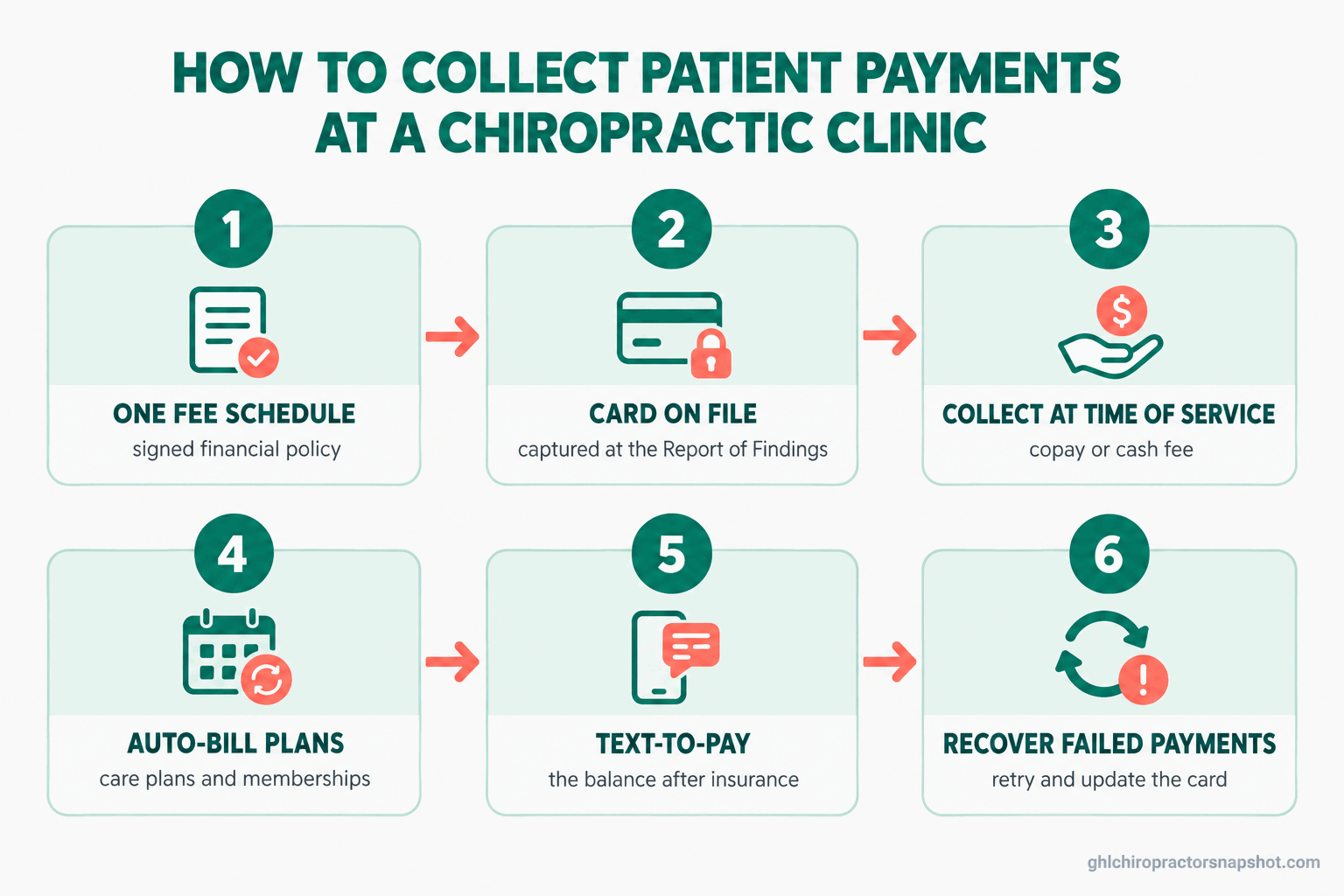
How do you actually collect patient payments at a chiropractic clinic without chasing people for months? You stop billing after the visit and start collecting at it. Run one fee schedule, capture a card on file at the Report of Findings, collect the patient’s portion at time of service, auto-bill care plans and memberships on a schedule, text a pay link for whatever is left after insurance, and wire up a failed-payment recovery sequence. That is the whole system. The hard part is not the software. It is the policy and the order you do things in, because the money you lose is almost never money a patient refused to pay. It is money you asked for too late.
Picture a Thursday at 5:50pm. The last patient just left with a $38 copay you meant to collect and forgot. Her statement goes in the mail next week, lands under a stack of junk, and you text her twice over the next month. Maybe you get the $38. Across a year, that $38 happens a few hundred times, and it is the difference between a practice that pays its people well and one that is always a little tight. This is a plumbing problem, not a patient problem, and you can fix the plumbing once.
Table of contents
- What slow collection actually costs you
- The six-stage collection system
- Stage 1: One fee schedule and a written financial policy
- Stage 2: Card on file at the Report of Findings
- Stage 3: Collect the patient portion at time of service
- Stage 4: Auto-bill care plans and memberships
- Stage 5: Text-to-pay the balance after insurance
- Stage 6: Recover failed payments before they become write-offs
- The same system at three practice sizes
- The compliance guardrails you cannot skip
- Common objections
- Frequently asked questions
What slow collection actually costs you
Insurance used to be the payer. It is not anymore, or at least not most of it. The average deductible for single coverage reached $1,886 in 2025, and about a third of covered workers (34%) sit in a plan with a deductible of $2,000 or more, a share that climbs to 53% at small employers (KFF, 2025). For a chiropractic patient early in the plan year, that means the first several visits are effectively cash. You are the collector now, whether you signed up for the job or not.
Here is the uncomfortable part. Once a patient walks out owing a balance, the collection rate collapses. Revenue-cycle surveys reported by HFMA put the amount providers actually collect of what patients owe at roughly 24% (HFMA, 2024). The patient’s portion is now about 35% of total provider revenue and has climbed close to 30% since 2000 (Cedar, 2025). So a third of your money is riding on the one slice you collect worst.
Compare that to the right moment. The AAFP’s benchmark for a healthy adjusted collection rate is 95% to 99% of what you are owed (AAFP, 2026). The gap between 95% and 24% is not a billing-staff problem or a stingy-patient problem. It is a timing problem.
The six-stage collection system
Every reliable collection setup, cash or insurance, runs the same six stages. They go in order, because each one makes the next easier.
- One fee schedule and a written financial policy every patient signs.
- Card on file, captured at the Report of Findings, not chased later.
- Collect at time of service, with a compliant time-of-service discount where it fits.
- Auto-bill care plans and memberships on a set schedule.
- Text-to-pay the balance after insurance posts.
- Recover failed payments before they age into write-offs.
The first two stages are front-desk policy. The last four are where automation carries the load, so your team is not the thing standing between you and your money. Let me walk each one, including how it breaks, because the failure modes are where most practices actually lose the cash.
Stage 1: One fee schedule and a written financial policy
Before any automation, you need two documents: a single fee schedule, and a financial policy the patient signs at intake. The fee schedule is the compliance backbone. You charge the same price for the same service regardless of who pays. Charging an insurer $100 for an adjustment and a cash patient $50 for the identical service is a dual fee schedule, and it is illegal in many states (Chiropractic Economics, 2026). The right structure is one posted fee, with any discount applied transparently on top of it, documented, and defensible.
The financial policy is what makes collection normal instead of awkward. It states, in plain language, that the patient is responsible for copays, coinsurance, deductibles, and non-covered services; that payment is due at the time of service; that you keep a card on file; and how care-plan and membership billing works. A patient who signed that at visit one does not flinch at the desk at visit six.
Build these before you touch software. A payment system layered on top of a vague policy just automates the awkwardness. For the moment of the sale itself, the Report of Findings, see our Report of Findings script for care-plan conversion, because that is where the financial conversation actually lives.
Stage 2: Card on file at the Report of Findings
The single most valuable change most clinics can make is capturing a card on file at the Report of Findings, the visit where you present the care plan. The patient is already deciding to commit to a course of care. That is the natural moment to say, “We keep a card on file so you never have to think about payment again, and we only charge the agreed amount.” It is a service, framed correctly, not a grab.
Card on file is what turns every later stage into a background process. The copay at each visit, the care-plan installment, the balance after insurance, all of it runs off the card instead of off a conversation. Industry estimates suggest card-on-file and autopay programs shorten days in accounts receivable meaningfully, by a month or more in some practices (ReveleMD, 2026). The mechanism is simple. You removed the step where a human has to ask.
The compliance line here is that a card-on-file authorization must be specific and revocable, and the card data has to live with a payment processor that handles PCI compliance for you. Your job is the authorization and the notification, not the vault.
Stage 3: Collect the patient portion at time of service
With a card on file and a signed policy, time-of-service collection stops being a daily battle. For a copay, you charge the known amount at check-in or checkout. For a cash patient, you collect the posted fee, or the posted fee minus a compliant time-of-service discount.
That discount is worth getting right, because it is where good intentions turn into exposure. A time-of-service or prompt-pay discount is generally permitted, but it has to reflect the real administrative savings of not billing a claim, and it has to be modest. An OIG advisory opinion treated 5% to 15% as a reasonable range, and practitioner guidance lands on 10% to 15%; past 20%, you look less like a practice saving billing costs and more like one running a dual fee schedule (Chiropractic Economics, 2026). The other hard rule: you generally cannot give a time-of-service discount on a service you are also billing to that patient’s insurance. Pick one path per service.
Stage 4: Auto-bill care plans and memberships
Care plans and memberships are where a chiropractic practice earns predictable revenue, and they only work if the billing is automatic. A patient who commits to a 12-visit plan or a $79-a-month wellness membership should be charged on a schedule, off the card on file, with a receipt each time. No invoice, no reminder call, no front-desk follow-up.
The retention math is the reason this matters so much. Predictable monthly revenue smooths the cash-flow whipsaw of a practice that lives visit to visit, and it changes behavior: a patient on an auto-billed plan shows up more consistently than one paying per visit. We walk the pricing and the real numbers in our membership pricing and retention math guide, and the slow leaks that quietly kill these programs in chiropractic membership revenue leaks.
Stage 5: Text-to-pay the balance after insurance
Insurance patients create the balance you collect worst: the amount left after the claim posts, days or weeks after the visit. The patient is long gone, and a mailed statement is the slowest possible way to ask. Text-to-pay fixes this. When the balance is known, you send a short message with a secure pay link. The patient taps, pays with the card they already have, and the balance clears the same day.
This is also the stage with the sharpest compliance edge, because now you are texting about money and a prior visit. The HIPAA rule is that a plain SMS or email must not contain a diagnosis, condition, or treatment detail in the body, and patients should have written notice of the risk of unencrypted messaging (HHS, 2026). A balance-due text is fine. A balance-due text that says “for your lumbar disc treatment” is not. Keep it to the amount, the clinic name, and the link.
Ways to collect the patient portion, compared
| Plan | Card on file + autopay | Collect at time of service | Text-to-pay link | Mailed statement |
|---|---|---|---|---|
| Price | Highest collection rate | Very high collection rate | Good collection rate | Lowest collection rate |
| Feature 1 | Charges copays, installments, and post-insurance balances automatically | Copay or cash fee taken at check-in or checkout | Secure link sent the day the balance is known | Slow, easy to ignore, expensive to print and mail |
| Feature 2 | Near-zero front-desk effort once authorized | No aging balance to chase | Same-day payment from the patient's phone | Collection odds fall as the balance ages |
| Feature 3 | Needs a signed, specific, revocable authorization | Depends on front-desk discipline and a signed policy | Keep every message free of clinical detail (HIPAA) | Use only as a last step, not a first one |
| Feature 4 | Best for care plans and memberships | Compliant time-of-service discount can apply | Best for post-insurance balances | Where most uncollected money goes to die |
Stage 6: Recover failed payments before they become write-offs
Even with cards on file, a share of recurring charges fail every month: expired cards, new numbers, insufficient funds. If nothing catches those, your “recurring revenue” quietly erodes and you find out at month-end. This is the least glamorous stage and one of the most valuable, because recovering a failed charge costs almost nothing and the revenue is already yours.
The system is a dunning sequence: retry the card on a smart schedule, and when it keeps failing, message the patient to update it. The tone stays light, because most failures are honest. A new card arrived in the mail and they forgot to tell you.
All six stages, the card capture, time-of-service collection, auto-billing, text-to-pay, and recovery, run inside the patient CRM and workflows layer, firing off your calendar and claim status instead of your front desk’s memory.
The same system at three practice sizes
The six stages do not change with size, but where the money leaks does. Here is how the same system plays out for three common setups.
Solo DC, mostly cash. You see 80 to 150 visits a week and bill little or no insurance. Your leaks are forgotten copays, cash patients who “pay next time,” and memberships billed by hand that slip a month. Your highest-return moves are Stages 1 through 4: a signed policy, a card on file at every Report of Findings, strict time-of-service collection, and auto-billed memberships. Text-to-pay matters less because you rarely have a post-insurance balance. Get the card on file and you have fixed most of it. This is the setup where the time-of-service discount earns its keep, applied compliantly off one posted fee.
Two to three providers, insurance and cash mix. Now the post-insurance balance is a real line of revenue, and it is the one you collect worst. Stage 5, text-to-pay, moves the needle most here, paired with the card on file so a lot of those balances clear automatically with a notification instead of a request. You also feel Stage 6 more, because more recurring charges mean more that fail. Watch your days in accounts receivable; the AAFP’s benchmarks are a good target (AAFP, 2026).
Four or more providers, established group. At this size, inconsistency between front desks is the enemy. One office collects at the desk, another lets balances ride, and your collection rate is an average of good and bad habits. The fix is less about new tools and more about one enforced policy and automation that removes the human discretion creating the variance. Your reporting has to roll up by location so you can see which desk is leaking.
The compliance guardrails you cannot skip
Collecting money from patients sits on top of real rules. None of them should stop you from collecting well. They just shape how you do it.
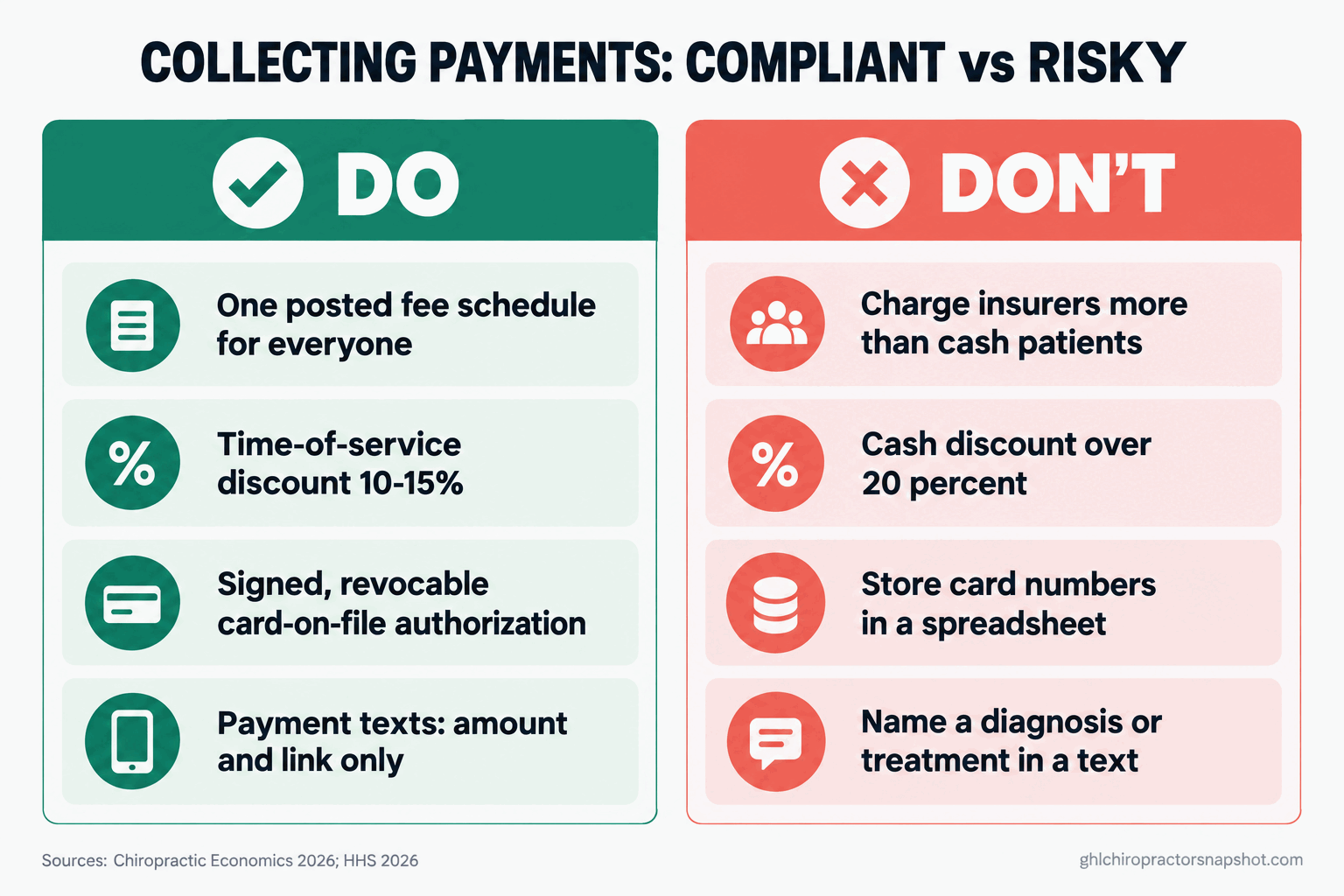
One fee schedule, no dual pricing. Charging an insurer more than a cash patient for the same service is a dual fee schedule and is illegal in many states (Chiropractic Economics, 2026; zHealth, 2026). Keep one posted fee and apply any discount transparently on top of it.
Time-of-service discounts stay modest and documented. Reasonable is roughly 5% to 15%, with 10% to 15% the common recommendation, and above 20% invites scrutiny (Chiropractic Economics, 2026). State board advertising rules also bite: Louisiana and West Virginia require any free or discounted-service ad to disclose the usual charge and have the patient sign a disclosure, and Arizona bars vague free-service ads. Verify your state before you promote a discount, and see our chiropractic marketing compliance guide.
HIPAA and TCPA on payment messages. A plain payment text or email must not name a diagnosis, condition, or treatment, and patients need written notice of the risk of unencrypted messaging (HHS, 2026). Automated texts also need prior express consent, an opt-out on every message, and respect for quiet hours (FCC, 2026). Our HIPAA-compliant patient texting guide has the full line.
Medicare is its own lane. Original Medicare covers only manual manipulation of the spine to correct a subluxation, not exams, imaging, or maintenance care (Medicare.gov, 2026). You cannot route a covered Medicare service through a cash discount to dodge the claim, and routinely waiving a Medicare patient’s 20% coinsurance is a compliance problem, not a courtesy.
Common objections
“My patients will think a card on file is pushy.” Only if you frame it as collection. Framed as a convenience, “so you never wait at the desk or get a surprise statement,” it reads as good service. The authorization is specific and revocable, and the patient is notified of every charge. Most people already keep a card on file with their gym and their dentist. You are catching up to a normal expectation, not inventing one.
“We already bill through our EHR. Why add anything?” Most chiropractic EHRs can post a charge and print a statement. Far fewer run a card on file across copays and memberships, text a pay link the day a balance posts, and recover failed payments with a sequence. If your system does all of that well, keep it. If, like most, it stops at “generate statement,” the automation layer is exactly the gap, and it sits next to the EHR you already trust. See our take on the patient CRM and workflows that fill it.
“Isn’t text-to-pay a HIPAA risk?” Not when the message carries only the amount, the clinic name, and a secure link. The risk is clinical detail in the body, which you simply never include (HHS, 2026). The pay link itself routes to a PCI-compliant processor, so card data never travels by text.
“I run a cash practice, so collection is easy.” Cash practices lose money differently: forgotten point-of-sale collection, memberships billed by hand that slip, and over-aggressive cash discounts that create a dual-fee-schedule problem. Stages 1 through 4 and the discount guardrails are written for you. The leaks are quieter, not smaller.
“Do I need to be technical to set this up?” No. You need one fee schedule, a signed financial policy, a PCI-compliant processor, and the automation wired once. The wiring is the part a done-for-you system handles. Your job is the policy and the decision to collect at the right moment, every time.
Frequently asked questions
When is the best time to collect the patient's portion?
At time of service for copays and cash fees, and off a card on file for installments and post-insurance balances. Collecting at the desk or from a stored card lands near the AAFP's 95% to 99% target, while mailing a statement after the visit collects only about 24% of patient balances (AAFP, 2026; HFMA, 2024).
Is keeping a credit card on file legal and HIPAA-compliant for a chiropractic clinic?
Yes, with a signed, specific, revocable authorization and card data stored with a PCI-compliant payment processor rather than by your office. Notify the patient of each charge. The card-on-file authorization itself is not protected health information, but keep any related messaging free of clinical detail per HIPAA (HHS, 2026).
How big can a cash or time-of-service discount be?
An OIG advisory opinion treated 5% to 15% as reasonable, and practitioner guidance recommends 10% to 15%, reflecting the administrative savings of not filing a claim. Above 20% starts to look like a dual fee schedule, which is illegal in many states, and you cannot apply a time-of-service discount to a service you are also billing to insurance (Chiropractic Economics, 2026).
What is a dual fee schedule and why does it matter?
It is charging an insurer or third-party payer more than a cash patient for the same service. It is prohibited in many states. The compliant approach is one posted fee schedule for everyone, with any discount applied transparently and documented on top of it (Chiropractic Economics, 2026; zHealth, 2026).
Can I text patients about money they owe?
Yes, if the message contains only the amount, your clinic name, and a secure pay link, with no diagnosis, condition, or treatment detail. You also need prior express consent and an opt-out on every message under the TCPA, and patients should be told of the risk of unencrypted messaging (HHS, 2026; FCC, 2026).
How do I handle recurring payments that fail?
Use a dunning sequence: retry the card automatically, then send a friendly 'update your card' message, and involve a person only if it keeps failing. Most failures are expired or replaced cards, not refusals, so a light tone recovers the money without alienating a loyal patient.
Does this replace my EHR or billing software?
No. It sits alongside the records and claims system you already use. The EHR files the claim; the collection system captures the card, collects at time of service, auto-bills plans, texts the balance, and recovers failed payments. Two different jobs.
Related reading
- Membership programs in chiropractic: pricing, onboarding, and the real retention math
- Chiropractic membership revenue leaks: where recurring revenue quietly disappears
- The Report of Findings script that converts consults into care plans
- HIPAA-compliant patient texting for chiropractors
- Why patients stop coming after visit 6
- Patient visit average (PVA): the number that runs your practice
Collection is not a personality trait or a tougher front desk. It is an order of operations. Set one fee schedule, get the card on file at the Report of Findings, collect at the moment of service, automate the recurring charges, text the balance the day it is known, and catch the payments that fail. Do that, and the $38 you used to lose on a Thursday afternoon becomes money that was never at risk in the first place.