
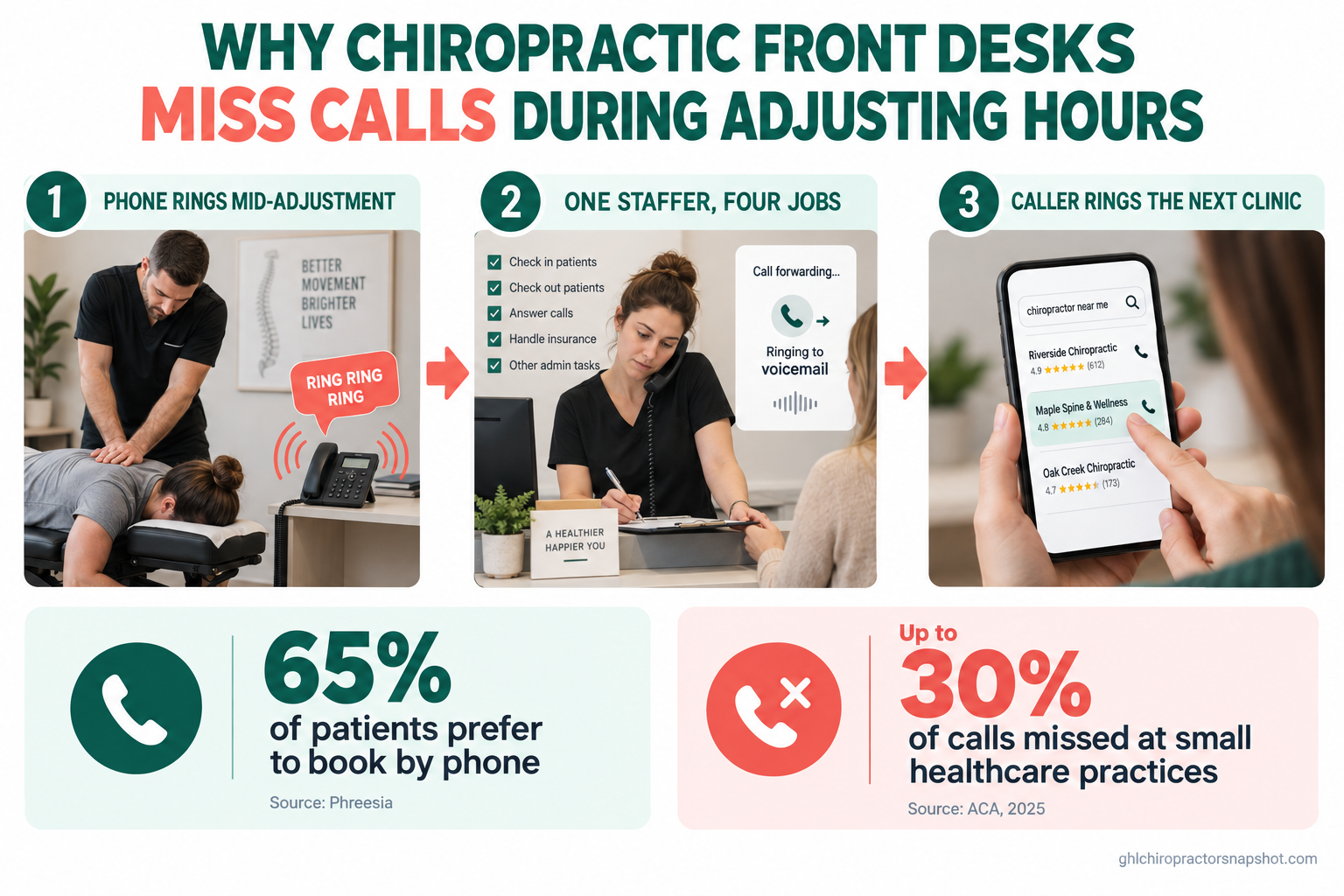
It is 10:40 on a Tuesday. You are mid-adjustment in room 2, hands on a patient, and the phone at the front rings. Your one front-desk person is checking out the 10:15, taking a card payment, and fielding a superbill question all at once. The phone rings four times and rolls to voicemail. The caller, a guy with three days of low-back pain who Googled “chiropractor near me” ninety seconds ago, does not leave a message. He taps the next result and books there.
Chiropractic front desks miss calls during adjusting hours because the busiest part of your clinical day and the busiest part of your phone day are the same hour, and one person cannot room a patient, run checkout, and answer a ringing phone at once. The phone loses, every time, to the human standing in the lobby. It is not a lazy receptionist. It is a math problem, and it quietly costs you new patients you never know called.
A predictable leak is a fixable one, and not by telling the front desk to “answer faster.” You fix it with a system that catches the call the second it is missed, gives the caller a way to book without waiting on hold, covers the hours a human cannot, and never lets a recovered caller fall through a crack. This is that system, stage by stage.
Table of contents
- Why the phone goes unanswered exactly when it matters
- What one missed call actually costs you
- The call-recovery system, stage by stage
- Run it three ways: solo, mid-size, multi-doc
- Staying compliant: HIPAA and TCPA on every message
- Objections a clinic owner actually raises
- Frequently asked questions
Why the phone goes unanswered exactly when it matters
Start with the demand. In 2022, 11% of U.S. adults used chiropractic care, up from 7.4% two decades earlier (NCCIH, National Health Interview Survey), inside a $24.0 billion U.S. industry of about 66,061 practices (IBISWorld, 2026). That is a lot of people in pain, searching, and dialing, and most want the phone: 65% of patients prefer to book by phone (Phreesia).
How patients prefer to schedule a medical appointment (percent). Source: Phreesia survey of about 14,000 patients.
Now overlay your schedule. Call volume is not flat. It clusters in the same windows as your appointments, because the same forces that fill your table (people awake, at work, feeling a flare) also make them dial. Your heaviest call hour and your heaviest adjusting hour are the same hour, and during it your single front-desk person is already doing four jobs: checking in the arrival, checking out the finisher with a payment to run, answering an insurance question, and keeping the lobby moving. A ringing phone is the fifth job, and the only one that can be ignored without anyone in the room noticing. The patient in front of you is visible and impatient. The caller is invisible. And you, the one other person who could help, have your hands on a patient and cannot stop. The call has nowhere to land.
Up to 30% of incoming calls at small healthcare practices go unanswered during office hours (ACA, citing Invoca), and the caller does not wait around. 69% of people who reach voicemail leave no message (Moneypenny). They dial the next clinic, because someone with acute back pain is comparison-shopping and books whoever answers first. Your voicemail light at 6pm is not a to-do list. It is a record of patients who already chose someone else.
What one missed call actually costs you
The instinct is to treat a missed call as a small thing, because most are nothing: a patient confirming a time, a vendor, a wrong number. The problem is the new-patient call hides in that pile, and it is worth more than every other call of the week combined.
Do the math with your own numbers. A new patient is worth your average revenue per visit times the visits they complete (their Patient Visit Average). Say a visit is worth $65 and a plan runs 20 visits: that patient is worth about $1,300, before referrals or a membership. We break that down in the patient visit average guide and chiropractic patient lifetime value. Now price the leak: if even one genuine new-patient call goes unrecovered each working day, that is dozens of lost patients and well into six figures of lifetime value a year. You never see it, because there is no report line called “patients who called once and gave up.”
This is why speed matters. A lead contacted within the first hour is about 7x more likely to turn into a qualified conversation than one reached an hour later, and far more likely than one you reach a day later (Harvard Business Review, 2011). The value of a new-patient inquiry decays by the minute, which is why an automated reply in under a minute beats a human callback hours later.
The call-recovery system, stage by stage
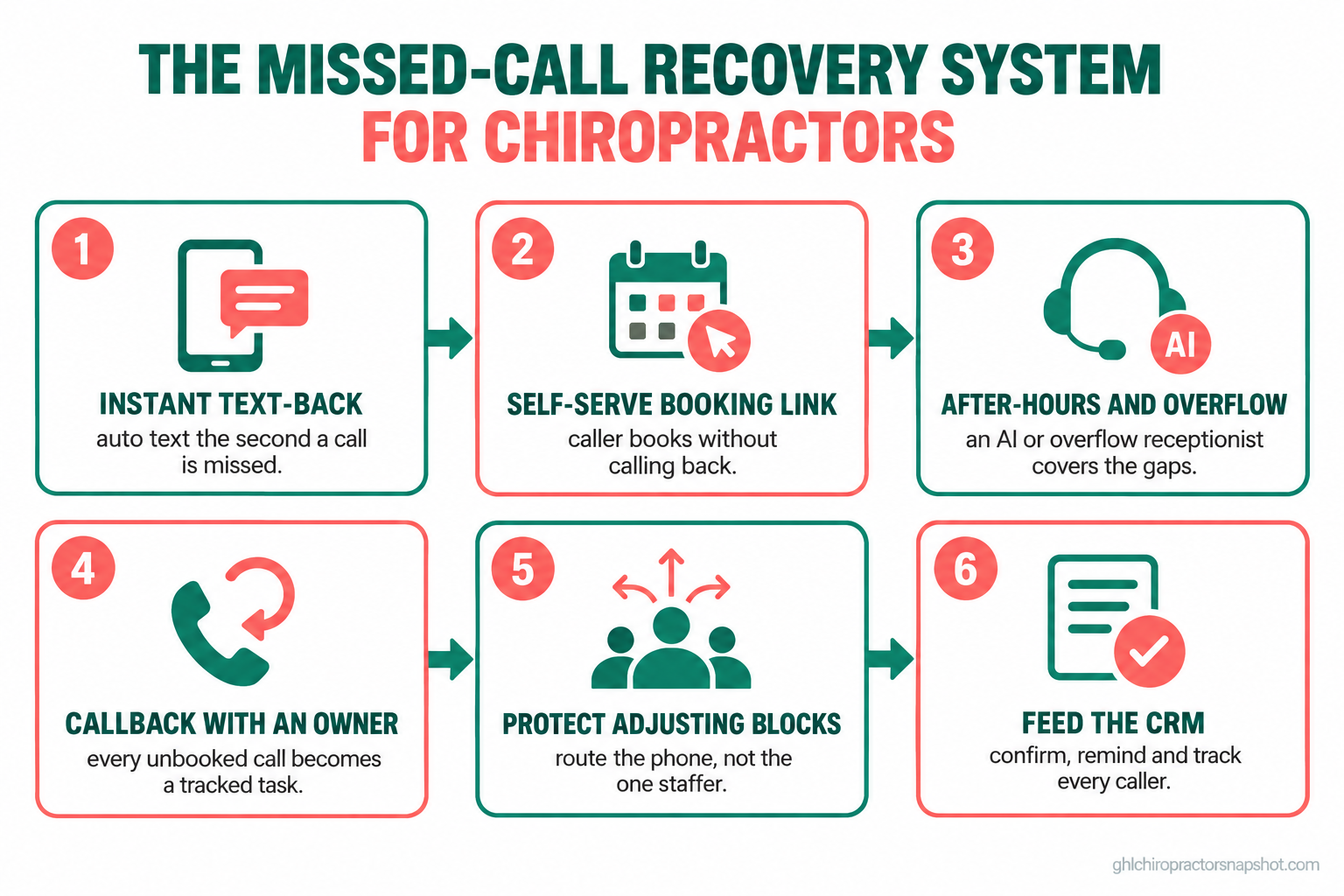
The goal is not “answer every call live.” That is impossible during adjusting hours. The goal is that no genuine inquiry ever dies in voicemail. Each stage below closes one way a missed call leaks, and none needs a new login if it lives in one platform (we build ours on GoHighLevel) instead of scattered across the phone, a sticky note, and someone’s memory.
Stage 1: Text the caller back the second you miss them
The single highest-return fix is missed-call text-back. The moment a call rings out, an automatic text goes to that number: a warm message from your clinic, not a robocall. It reaches the caller while your clinic is still the one they just dialed, before they tap the next search result, and turns a dead voicemail into an open text thread. Most people would rather text than hold anyway.
How it breaks: the text sounds like a marketing blast, or it fires on every call including vendors and existing patients. Keep it human and short, and send it only on unanswered inbound calls. Full build details are in our missed-call text-back guide for chiropractors.
Stage 2: Give them a way to book without calling back
A text that says “call us back” hands the problem back to the caller, and they will not call twice. The recovery text has to carry a self-serve path: a booking link that drops them straight into your real availability. The ones who want to book now will do it themselves in the gap between meetings, with no human needed, which is the point, because a free human is exactly what you do not have during adjusting hours.
How it breaks: the link points at a generic contact form, or a calendar showing fake wide-open availability, so the patient books a slot you cannot honor. Point it at live availability with real rules (buffers around adjusting blocks, no double-booking) so a self-booked patient lands in a slot that works. We cover that without wrecking your adjusting rhythm in online scheduling for chiropractors.
Stage 3: Cover the hours and moments a human can’t
Text-back handles the missed call, but some callers want to talk, and some call at 8pm. This is where after-hours and overflow coverage earns its keep: an answering service, a remote receptionist, or an AI receptionist that picks up when your desk cannot, qualifies the caller, answers the basics, and books the appointment or routes an urgent issue to a human. During adjusting hours it absorbs the overflow; after hours it means the 8pm back-pain caller still reaches “your clinic.”
How it breaks: people try to make the robot do everything, so it fumbles a nuanced insurance question and the patient feels handled by a machine. Scope it tightly: let it handle the routine 80% (hours, location, “are you taking new patients,” booking, rescheduling, sending the intake link) and escalate the hard 20% to a person with a warm transfer or same-hour callback. The rule is simple: the machine never guesses about health or money. We lay out what to automate and what to escalate in what AI receptionists actually do for chiropractors.
Stage 4: Put a name and a timer on every callback
Some recovered callers still need a human to call them back, and the failure is that “someone will call them back” means nobody owns it. The voicemail, the text reply, the web form, and the after-hours booking pile into different inboxes, and the one that gets forgotten is the one worth $1,300. Every unbooked inbound needs to become a task with an owner and a deadline, in a pipeline you can see.
How it breaks: callbacks live in someone’s head or a notepad, so they slip the moment the clinic gets busy, which is always. Route every unbooked inquiry into one “new-patient callback” pipeline with a service-level rule the whole team can see, and make the system nag until the task is closed.
Stage 5: Protect adjusting blocks by routing the phone, not the person
The deepest fix is structural: stop making the one person at the desk the only path a call can take. During adjusting blocks, route the phone so it does not depend on a human who is rooming patients, whether that is an auto-attendant (“press 1 to book, press 2 for a callback”), a ring group that tries a second number, or sending adjusting-hour calls straight to the AI receptionist and text-back flow instead of a voicemail box nobody checks.
How it breaks: clinics bolt on a phone tree so deep that a simple “I want to book” caller gives up, which is worse than a missed call. Keep the tree one layer deep, always offer a fast path to book or get a text, and route by time of day. Pair it with a desk that is not trying to do everything: if the front person is drowning, that is a capacity problem a remote GoHighLevel front desk can own without adding a salary.
Stage 6: Feed every recovered caller into the CRM so none leak
A recovered call is not a win until it is booked and tracked. The last stage closes the loop: every caller, booked or not, lands in your CRM with a tag and a status, so booked ones get a confirmation and reminder sequence and not-yet-booked ones get a short, warm follow-up instead of silence. It is also the only way you learn how big the leak was.
How it breaks: the recovered caller books but no-shows because nothing confirmed them, or the “thinking about it” caller hears nothing and forgets you. Wire the confirmation and reminder sequence to every booking, and give the undecided caller a two-touch nudge. For patients who go quiet long-term, hand them to a reactivation campaign.
Run it three ways: solo, mid-size, multi-doc
The six stages do not change with practice size. What changes is how much leans on automation versus a person.
Solo DC, 1 to 3 staff, 80 to 150 visits a week. Your front desk is one human who cannot clone themselves, so automate what does not need a person: text-back and the booking link do the heavy lifting, and an AI or overflow receptionist covers the adjusting-hour spikes and after hours. Turn those on first; they recover the most calls for the least effort.
Mid-size, 2 to 4 DCs, shared front desk. Your risk is inconsistency: two providers finish at once, the desk is slammed, and three calls drop with no record of who they were. Standardize the routing so adjusting-hour calls always hit the same overflow path, run every unbooked inquiry through one shared callback pipeline, and give one person a daily “who called and did not book” report.
Multi-doc or multi-location. The enemy is handoffs. A call to location A that nobody answers should route to a central overflow desk or AI receptionist that can book into any location’s calendar. Centralize the CRM so a caller is tracked to the practice, not one building, and watch answer rate and callback speed as clinic KPIs, because at this scale a few points of answer rate is real money.
Staying compliant: HIPAA and TCPA on every message
Every recovery message here is automated and goes to a patient or prospect, so two rules govern all of it. Build them in once and the system enforces them.
HIPAA governs what is in the message. A plain SMS is not secure, so the text-back and follow-ups carry no diagnosis, symptom, or treatment detail. “Were you looking to book an appointment?” is fine. “Still want to treat that herniated disc?” names a condition and turns a helpful text into a privacy problem. Give patients written notice that text and email are not encrypted, and segment lists by behavior (“called, did not book”) rather than condition, since targeting off a condition-based list is a marketing issue under the HHS guidance on marketing. Full walkthrough: HIPAA-compliant patient texting for chiropractors.
The TCPA governs permission to send. Texting someone back about the reason they just called is generally a response to their own inquiry, but you still identify your clinic, keep the content transactional, honor opt-outs instantly, and log consent at intake for anything beyond that first reply. The danger with automation is scale: a flow that ignores STOP or slips a condition into a text does it to everyone at once, so the guardrails are the build, not an afterthought.
Objections a clinic owner actually raises
“Won’t an automatic text feel robotic?” Only if it reads like a robot. A short, human text (“sorry we missed you, the desk was with a patient, want to book?”) reads as a clinic that cares. The alternative is not a warm human chat, it is voicemail, and 69% of callers will not even leave one (Moneypenny). A text beats silence.
“I already check voicemail. Isn’t that enough?” Voicemail is where new patients go to die. The caller has to choose to leave a message (most will not), then wait hours for a callback, by which point they have booked elsewhere. Text-back and a booking link put the work on your system and let the caller act in the next ten seconds.
“Do I have to rip out my phone system?” No. Most of this layers on top of the number you already have: text-back and routing work with your existing line, the booking link is just a URL, and an AI or overflow receptionist sits behind your current number. You are adding a safety net, not replacing the phone.
“Do I need staff by the phone at night?” No, and that is the point. After-hours coverage is the job automation does best: a caller at 8pm gets answered, booked, or texted back with nobody awake, and you wake up to booked appointments instead of a voicemail box.
Frequently asked questions
Why does my chiropractic front desk keep missing phone calls?
Because your busiest call hour and your busiest adjusting hour are the same hour. One person cannot check patients in and out, run payments, and answer a ringing phone at once, and the doctor cannot stop an adjustment to grab a call. Up to 30% of calls at small healthcare practices go unanswered during office hours. It is a capacity math problem, not a staffing attitude problem.
What is missed-call text-back and does it work for clinics?
It automatically sends a friendly text to any caller you did not answer, turning a dead voicemail into an open text thread while your clinic is still the one they just dialed. It works because most people prefer texting to holding, and because 69% of callers who hit voicemail never leave a message, so a text reaches them before they ring the next clinic.
How fast do I need to respond to a new-patient call?
As fast as possible. A lead contacted within the first hour is about 7 times more likely to become a qualified conversation than one reached an hour later (Harvard Business Review, 2011). Automated text-back responds in under a minute, which is why it recovers calls a human callback hours later cannot.
Is it HIPAA-compliant to text a patient back after a missed call?
Yes, if the message carries no diagnosis, symptom, or treatment detail, patients were told text and email are not encrypted, and you honor opt-outs. Keep it generic (a booking offer, not a health reference), segment lists by call behavior rather than condition, and make STOP work automatically. The content, not the act of texting, is what HIPAA regulates.
Do I need an AI receptionist, or is text-back enough?
Text-back alone recovers most missed calls for the least effort, so start there. Add an AI or overflow receptionist when you want callers who prefer to talk to reach someone during adjusting spikes and after hours. Scope it to routine questions and booking, and escalate anything clinical or billing-related to a human the same hour.
Back to that 10:40 caller with three days of back pain. In a clinic running this system he never hits a dead end. The call rings out because the desk is slammed, but within a minute his phone buzzes with a text from your clinic apologizing for the miss and offering two openings this week. He taps the link, grabs the 4:15 Thursday, and gets a confirmation, all while your hands are still on the patient in room 2. That is what recovering a missed call looks like: not a heroic front desk, just a system that catches what one person on a busy morning never could.