

A first-time caller decides whether to book you in the first 30 seconds, and price is almost never the real reason they hang up. A call converts when the front desk answers fast with the clinic’s name and a warm question, asks two discovery questions before anyone says a number, reframes the “how much is it” question instead of blurting a price, offers two specific appointment times instead of “do you want to come in,” then locks the booking with a confirmation and an intake link before the call ends. Do those five in order and your new-patient bookings climb without spending another dollar on ads; skip any one and the caller quietly dials the clinic down the street. Here is the exact script, stage by stage, with the lines you can steal and the ways each stage breaks.
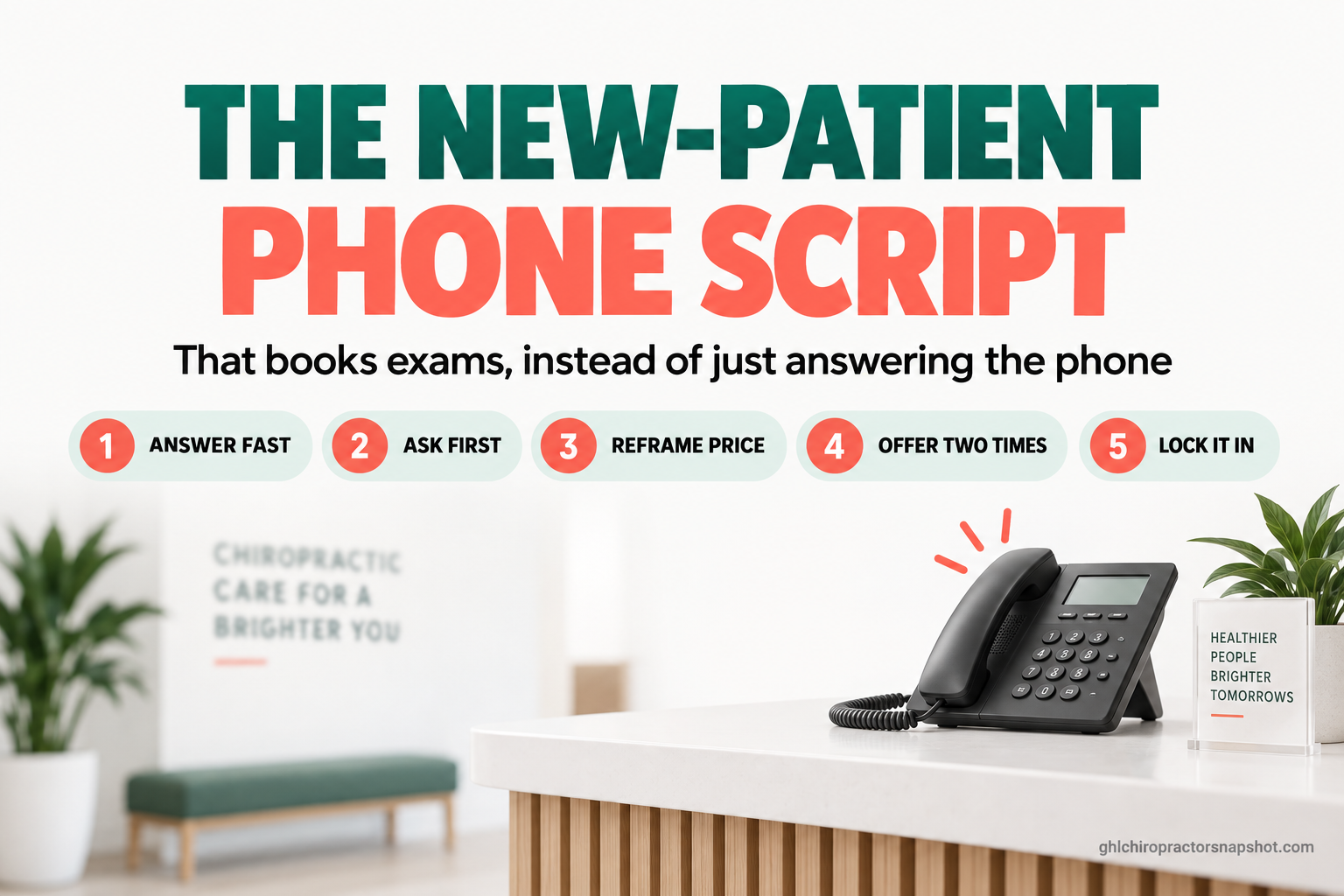
It is 2:15 on a Tuesday. Your one front-desk person is checking out a family of three and rebooking a care-plan patient at the same time. The phone rings. It is a woman with three weeks of low back pain who found you on Google and is calling three clinics in a row. Nobody can grab the line, so it rolls to voicemail. She does not leave one. She calls the next result, gets a human who books her for Thursday, and you never know she existed. You did not lose her on price or on care. You lost her on a call nobody answered, and a script nobody had. Both are fixable, and neither needs a bigger team.
Table of contents
- What a missed or fumbled call actually costs
- Why “how much is it” is a trap, not a question
- The five-stage new-patient phone script
- Steal this: the exact lines and messages
- Run the script three ways: solo, group, multi-location
- Staying compliant: HIPAA, TCPA, and ad rules
- Common objections
- Frequently asked questions
What a missed or fumbled call actually costs
Chiropractic in the United States is a $24.0 billion industry across about 66,061 businesses (IBISWorld, 2026), and Gallup-Palmer put patient volume at 33.6 million adults, about 14%, in a single year (Gallup / Palmer College, 2015). The demand is there. What decides who gets the patient is who answers the phone well.
Here is the part that stings. Harvard Business Review, auditing 2,241 companies, found the average first response to a web lead took 42 hours, and 23% never responded at all (Harvard Business Review, 2011). A phone call collapses that window into a few seconds. When the caller is holding the phone, in pain, deciding right now, the practice that picks up and knows what to say wins before the second clinic rings. When the call rolls to voicemail, most callers do not leave one, they move to the next name on the list. That is the leak, and it is a follow-through problem, which means a script and a system fix it.
Why “how much is it” is a trap, not a question
Most front desks think they lose calls on price. They lose them on the fumble around price. A first-time caller who opens with “how much is a visit” is rarely a bargain hunter. They are anxious, they do not know how to judge a clinic, and price is the only ruler they own. Answer with a flat number and go quiet, and you have handed them a way to compare you to the cheaper place on that number alone, and skipped the part where they decide they trust you.
The fix is not to hide the price. Patients hate that. It is to earn the right to quote by asking first, then answer with the number plus the reason the first visit is worth it, then move straight to booking. Every stage below runs on that idea: connect, understand, then guide.
The five-stage new-patient phone script
Run these five stages in order on every new-patient call. The order carries the outcome as much as the words.
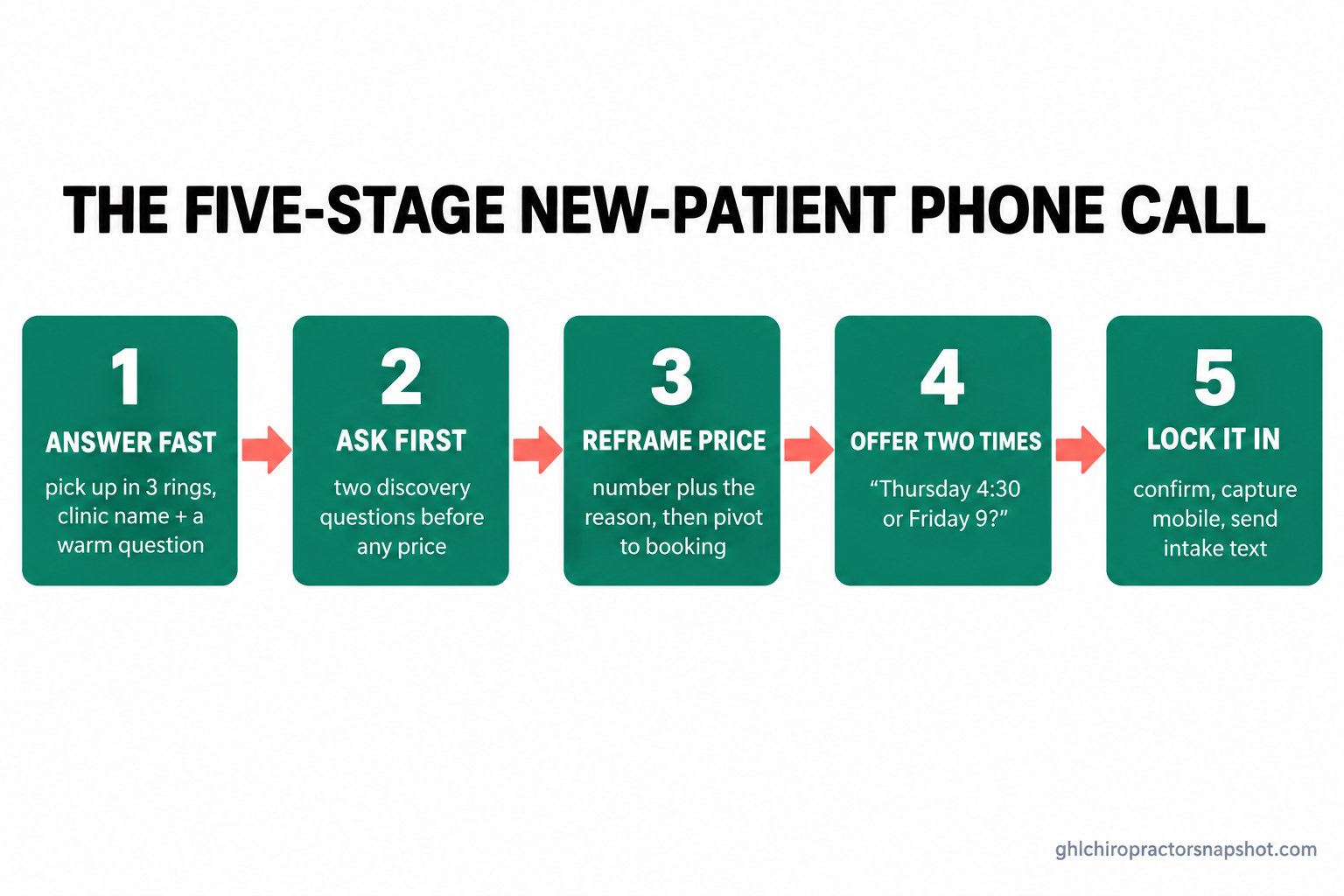
Stage 1: Answer fast, warm, and by name
Pick up inside three rings and lead with the clinic name, your name, and a question that invites them to talk. A flat “Doctor’s office, please hold” tells an anxious caller they are an interruption.
“Thanks for calling Lakeside Chiropractic, this is Maria. Are you calling about getting some pain looked at, or is it something else?”
That one question does the sorting for you. It signals you expect new patients and invites them to describe the problem. Failure mode: the front desk answers mid-task and rattles off a robotic greeting. The caller hears “busy” and shortens the call. If your one person truly cannot pick up, that call must not die (Stage 5 handles it), but the goal is a warm human inside three rings.
Stage 2: Ask two questions before anyone says a number
Before price, before insurance, before hours, get two things: what is going on, and how long. This is discovery, and it is where trust gets built.
“I’m sorry you’re dealing with that. So I can point you the right way, can you tell me a bit about what’s going on and how long it’s been bothering you?”
Let them talk. Do not interrupt to quote a price. When they finish, reflect it back: “Okay, so it’s the low back, about three weeks, worse when you sit at your desk. That’s exactly the kind of thing we see a lot of.” Now they feel heard. Failure mode: the front desk jumps to logistics (“we’re open till six, it’s $60”) before the caller describes the problem. The human moment never happens, and the call reverts to a price comparison.
Stage 3: Reframe “how much is it” instead of dropping a number
When the price question comes, and it will, do not answer it naked. Give the number, the value, and a step toward booking, all in one breath.
“Great question. The first visit is a full exam with the doctor so we find out what’s actually causing the pain, not just treat around it, and that’s $65. Most people want to get in this week while it’s fresh. I’ve got a couple of times open, do mornings or afternoons work better?”
You gave them the number, told them what it buys, and pivoted to scheduling before silence could turn into “let me think about it.” Failure mode: the front desk quotes a price and stops talking. Dead air after a number is where the caller says “okay, thanks” and hangs up to compare. Never end on the number, always on the next step.
Stage 4: Offer two specific times, never “do you want to come in”
An open invitation puts the whole decision back on the caller. Two concrete options make it small: which of these, not whether at all.
“I have Thursday at 4:30 or Friday at 9 in the morning. Which one’s easier for you?”
If neither works, offer two more. You are guiding, not pressuring. The moment they pick one, the exam is booked. Failure mode: “So do you want to schedule something?” hands the caller an easy exit, and “I’ll call you back to book” almost never converts. Book it live, on this call.
Stage 5: Lock it in with a confirmation and intake link
Do not hang up on a verbal “sure.” Repeat the details back, capture a mobile number, and set the automatic follow-up before the call ends.
“Perfect, I’ve got you Thursday at 4:30 with Dr. Lee. What’s the best mobile number to send your confirmation and intake forms to? Great, you’ll get a text in a minute with everything, and a reminder the day before. See you Thursday.”
The text that fires from that number is what makes the booking stick. Failure mode: the booking lives only in someone’s head or a paper daybook, no confirmation goes out, and the patient forgets or gets cold feet with nothing to anchor them. A booked exam with no confirmation is a coin flip.
Steal this: the exact lines and messages
Here is the copy your front desk and automations can use today, on top of the phone lines above. Keep every automated text HIPAA-aware (no diagnosis, condition, or treatment detail) and TCPA-safe (consent captured, opt-out on every message).
Missed-call text-back (fires within seconds when a call goes unanswered):
“Hi, this is Lakeside Chiropractic, sorry we missed your call! We’re with a patient. Would you like us to call you right back, or would you rather book a time here: [link] Reply STOP to opt out.”
Front-desk callback opener (when you return a missed call within the hour):
“Hi, this is Maria at Lakeside Chiropractic returning your call. Is now an okay time for a quick minute so I can help you get scheduled?”
Booking confirmation text (immediately after scheduling):
“You’re booked! [Date] at [time] with Dr. Lee at Lakeside Chiropractic. Reply here with any questions. Your intake forms: [link] Reply STOP to opt out.”
Day-before reminder (automatic):
“Reminder: your visit at Lakeside Chiropractic is tomorrow at [time]. Reply C to confirm or R to reschedule. Reply STOP to opt out.”
Text reminders alone earn the setup: a study found text appointment reminders cut no-shows by 38% (Klara, 2024). The whole set is simple in principle. The human handles the live call; the automation catches what the human cannot: the missed call, the confirmation, the reminder, the nudge.
Run the script three ways: solo, group, multi-location
The five stages do not change. Who runs them, and where calls overflow, does. Here is the same script at three sizes.
Solo practice (one doctor, one or two staff). The hardest case: the one person who answers is also checking patients out and running the room. You cannot answer every call live, and pretending you can is why calls leak. Protect the calls you can take (three-ring rule, the full script) and automate the rest. Missed-call text-back is the whole safety net here: when the front desk is with a patient, the text fires in seconds and the caller gets a link, so the call is handled instead of lost. Then return it within the hour using the callback opener above.
Group practice (2 to 5 doctors, a front-desk team). The problem is consistency, not capacity. Several people answer phones, each with their own habits, so half your calls get the full script and half get “we’re open till six.” Make the script the standard, post the five stages by every phone, and listen back to a few calls a week to coach with specifics. A shared inbox or CRM, so anyone can see who called and what was promised, kills the “I thought you called them back” gaps. Same script; the discipline is what you manage.
Multi-location or high-volume. The leak is overflow: location A cannot answer while location B sits quiet, and calls spill into voicemail at the exact busy hours new patients call. The fix is a shared, routed phone system where calls flow to whoever is free, the same automations at every site, and an AI receptionist or trained virtual assistant to catch overflow so no location is the one that misses. The script still runs; you are making sure a human or a good automation always exists to run it.
Staying compliant: HIPAA, TCPA, and ad rules
A phone system that books patients touches three sets of rules. None are hard to follow, and all are cheaper than getting them wrong.
HIPAA in plain messaging. Automated SMS and email should never carry diagnosis, condition, or treatment detail. “Your appointment Thursday at 4:30” is fine; “your low back exam” is not. Patients should also get written notice that unencrypted text and email can be intercepted, and give consent, before you message them that way (HHS HIPAA for professionals). Every template above stays on logistics for this reason.
TCPA on automated texts. Every automated or recurring text needs prior express consent and a working opt-out, which is why every message above ends with a STOP line (FCC on telemarketing and robocalls). Capture consent when you take the mobile number, and honor opt-outs instantly.
State board rules on “free exam” hooks. If your ads or phone script offer a free or discounted first visit, check your state board first. Louisiana and West Virginia require the ad to disclose the usual charge and have the patient sign a disclosure, and Arizona restricts vague free-service ads. Time-of-service cash discounts generally sit in the 5 to 15% range to avoid dual-fee-schedule exposure, though it varies by state and payer, so verify your own situation.
Common objections
“Scripts sound robotic. My front desk should just be natural.” A script is not a teleprompter. It is the order of the conversation and the two or three lines that matter, so nobody has to improvise the hardest moments cold. The words flex; the structure holds. “Natural” without a structure is how you get “we’re open till six, it’s $60” and a hang-up. The best front desks sound the most human because the plan is handled and they can focus on the person.
“We’re too busy to answer every call as it is.” Then the script matters more, not less: you have to win a higher share of the calls you do answer and automate the ones you cannot. Missed-call text-back exists for exactly the busy practice. You are not promising to pick up every ring, only that no call dies in silence.
“My front desk won’t actually use it.” They will if it is short, posted where they can see it, and if someone listens back to a few calls a week and coaches with specifics instead of “answer better.” When the team sees bookings tick up on the weeks they run the script, it becomes their habit, not your rule.
“Do I need software to do this?” No for the live call, yes for everything around it. You can run the five stages tomorrow with the script taped by the phone. But the missed-call text-back, the confirmation, the intake link, and the day-before reminder only fire every time if something automatic sends them. That is where a GoHighLevel workflow build or a trained GHL virtual assistant earns its keep, firing the follow-up while the front desk is heads-down in the room.
Frequently asked questions
What should a chiropractic front desk say when answering the phone?
Answer within three rings with the clinic name, your name, and a question that invites the caller to describe the problem, for example: 'Thanks for calling Lakeside Chiropractic, this is Maria, are you calling about getting some pain looked at?' Warmth and a question convert better than a flat greeting and a hold.
How do you handle the 'how much is a visit' question on a new-patient call?
Do not quote a bare number and go silent. Ask two discovery questions first, then answer with the price, what the first visit includes, and an immediate move to booking, all in one breath. Ending on the number is what sends callers off to compare.
Why do new patients hang up without booking?
Usually the call was slow to answer, felt transactional, or ended on a price with no next step. Most first-time callers are anxious, not cheap. Responding in 5 minutes rather than 30 makes you about 21x more likely to qualify a lead (MIT / InsideSales), and asking about the problem before quoting books far more of them.
What is missed-call text-back and does it work for chiropractors?
It is an automatic text that fires within seconds when a call goes unanswered, offering a callback or a booking link. It catches the caller while they are still holding the phone, rather than losing them to voicemail. It is HIPAA-aware and TCPA-safe when it stays on logistics and includes an opt-out.
Is it compliant to text new patients their appointment details?
Yes, as long as the text stays on logistics: date, time, doctor, and a general confirmation, with no diagnosis, condition, or treatment detail in plain SMS. Patients need written notice about unencrypted messaging and must consent, and every automated text needs a working opt-out under the TCPA.
Related reading
- Missed-call text-back: turn every missed call into a booked visit
- The first-visit funnel that turns clicks into booked exams
- The Report of Findings script that turns consults into care plans
- How to reduce no-shows at a chiropractic clinic
- Online scheduling that fills your calendar without overbooking
Back to the woman with three weeks of low back pain. The version of your practice that books her does not have a bigger team or a lower price. It answers inside three rings, asks about the pain before it mentions a dollar, quotes the visit with the reason attached, offers Thursday at 4:30 or Friday at 9, and locks it in with a text before she hangs up. On the afternoons nobody can get to the phone, a text catches her in seconds. That is the difference between a practice that leaks new patients and one that fills its schedule with the leads it already paid for.