

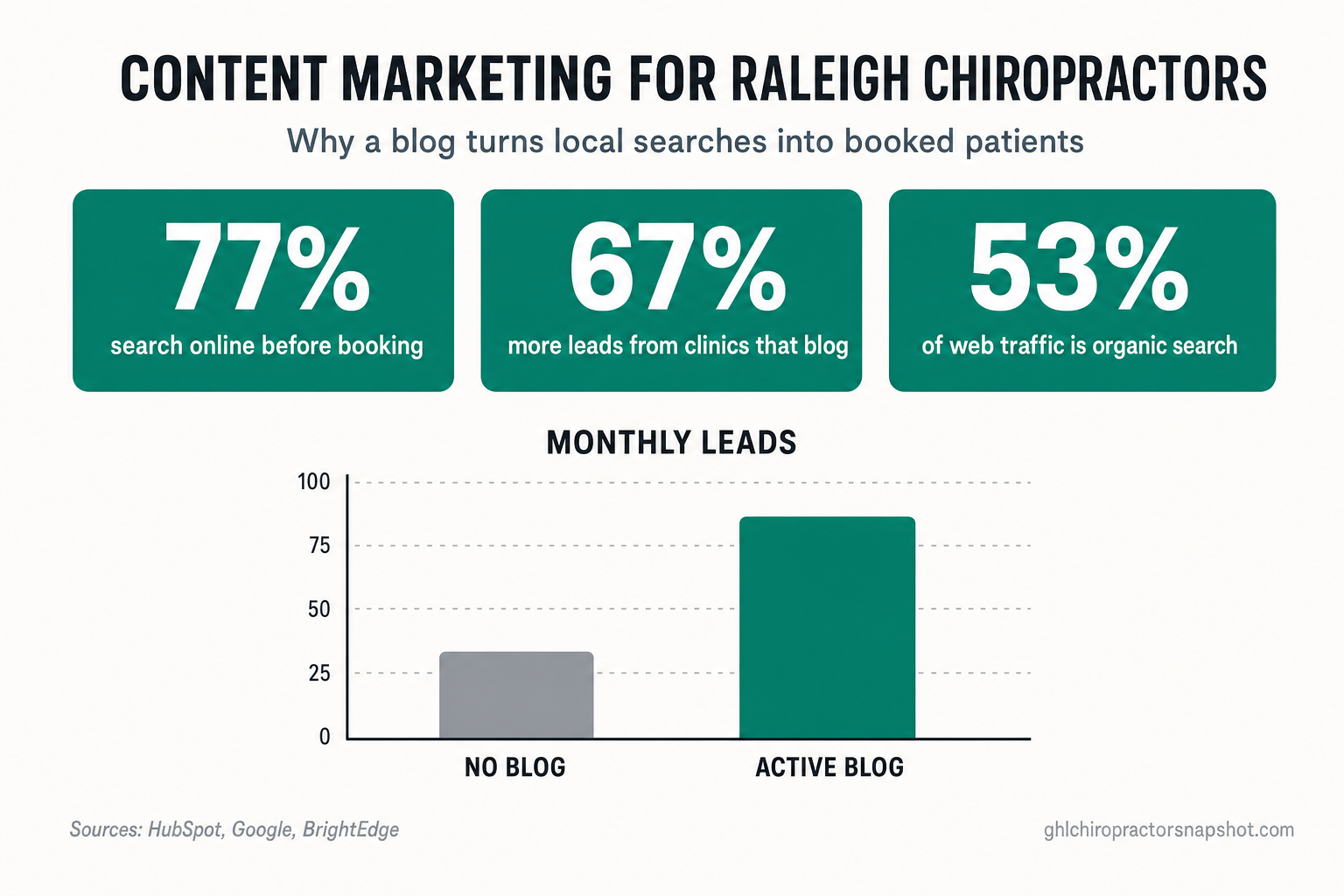
Yes — for a chiropractor in Raleigh, content marketing still works, and in 2026 it may be the most durable new-patient channel you have. A blog isn’t a diary; it’s the set of pages that answer the exact questions a person in Cary, Apex, or North Hills types into Google at 11 p.m. with a stiff neck — and then hands them a “Book Now” button while they’re still reading. The proof is in how patients now behave: 77% of patients run an online search before booking an appointment (MDConnect, citing Google), and businesses that keep an active blog generate 67% more leads per month than those that don’t (HubSpot).
This is a practical guide for chiropractic clinic owners in the Raleigh–Durham Triangle and the GoHighLevel agencies that market for them. We’ll cover why blogging still earns patients when so much else has changed, what a Raleigh clinic should actually publish, how to tell whether it’s working, and how a done-for-you content engine runs the whole thing without adding a task to your front desk. Every statistic below is dated and linked to its source.
Table of contents
- The short answer for a Raleigh clinic
- Why content marketing still works in 2026
- How a blog post actually books a patient
- What a Raleigh chiropractor should publish
- Content, AI search, and getting quoted
- How to know it’s working
- Why most clinic blogs die — and the fix
- Frequently asked questions
The short answer for a Raleigh clinic
If your website’s job is to turn a local search into a booked exam, the pages that do that job are your content — the articles that match what patients type, answer it better than the clinic down the road, and end with an easy way to book. A five-page brochure site (“Home, About, Services, Team, Contact”) gives Google almost nothing to rank for. A site with thirty well-built, locally-targeted articles gives it thirty front doors.
That’s why our Get a Website clinic builds ship research-based weekly articles as a core part of the service, not an afterthought — a fast Astro site is the storefront, and the content is what fills it with foot traffic. The mechanics are simple: someone in the Triangle searches a symptom, finds your article because it’s fast and well-structured, trusts you because it’s genuinely helpful, and books because the button is right there. Do that fifty times across fifty searches and you’ve built a patient-acquisition channel that keeps working while you’re adjusting patients.
The catch — and the reason most clinic blogs fail — is that content only compounds if it’s consistent and actually good. One post a quarter written by a burned-out front desk won’t move anything. That’s the problem a done-for-you engine solves, and we’ll get there. First, the case for why this channel is still worth running at all.
Why content marketing still works in 2026
Plenty of clinic owners assume social media replaced blogging, or that AI killed it. The data says the opposite: search is still where high-intent patients start, and content is still what search rewards.
Start with intent. A patient scrolling Instagram isn’t looking for a chiropractor; a patient Googling “why does my lower back hurt when I sit” absolutely is. That’s the difference between interruption and demand — and content marketing is the only channel that meets demand at the exact moment it appears. With 77% of patients searching online before booking (Google via MDConnect) and organic search accounting for roughly half of all trackable website traffic (BrightEdge), the search box is still the busiest waiting room in Raleigh.
Then there’s the compounding. A paid ad stops the second you stop paying. A blog post that ranks keeps earning — HubSpot’s research on “compounding” posts found that a well-optimized article can keep generating traffic and leads for years after it’s published (HubSpot). That’s why clinics with active blogs pull 67% more leads and 55% more traffic than clinics without one (HubSpot): every post is a small asset that keeps paying rent.
None of this means blogging is easy or instant — it isn’t. It means the physics of how patients find care still favor the clinic that shows up with a helpful answer. Now let’s look at how one of those answers turns into a booking.
How a blog post actually books a patient
The word “blog” undersells it. A good clinic article is a small, self-contained sales page disguised as helpful advice. Here’s the path it walks a Raleigh patient down.
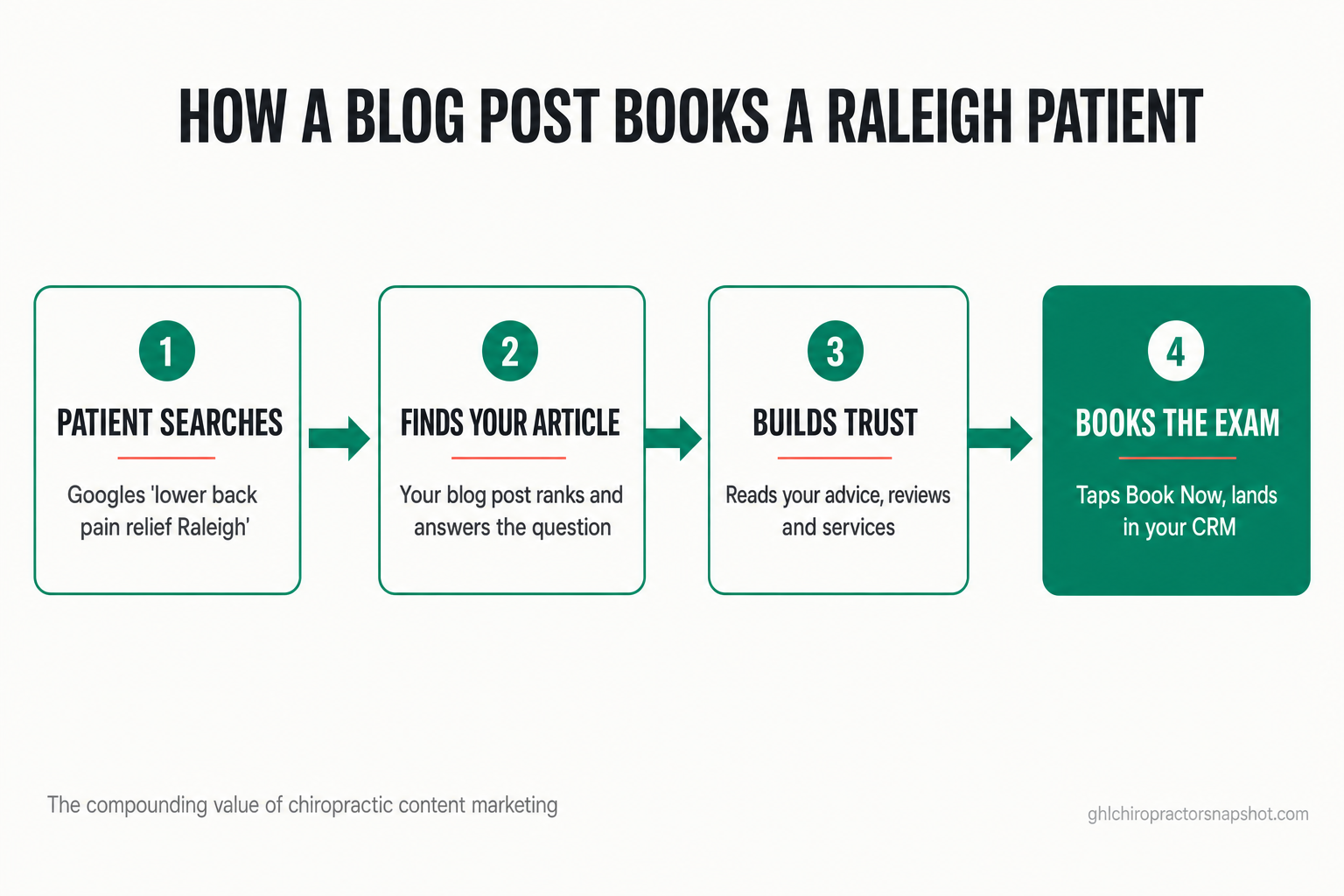
- The search. A person in Apex wakes up with sciatica and searches “sciatica relief Raleigh” or “is chiropractic safe for a herniated disc.” This is the highest-intent moment you’ll ever get — they have the problem and they’re looking for a solution right now.
- The find. Your article appears because it’s fast, well-structured, and written to match that exact question. Speed matters here: page experience is part of Google’s ranking systems, which is one reason we build clinic sites on a static Astro foundation rather than a heavy page builder.
- The trust. They read something genuinely useful — what sciatica is, when to see a chiropractor, what a first visit looks like at your clinic. Woven in are your reviews and your credibility. This matters because patients read reviews before choosing a provider as a rule, not an exception (BrightLocal, 2025).
- The booking. Because the article ends with a clear, in-line “Book Your Exam” button — not a phone number they have to remember tomorrow — they book while the intent is hot. The booking drops straight into your GoHighLevel CRM, where your online scheduling and reminder workflows take over.
That last handoff is the part clinics miss. A blog post without a booking path is a library card with no library. The article’s whole job is to earn enough trust that tapping “Book” feels obvious — and then to make tapping it effortless.
What a Raleigh chiropractor should publish
Generic health content is a commodity — there are ten thousand articles titled “5 Benefits of Chiropractic Care,” and none of them rank. What wins is content that pairs a specific patient question with your specific market. Think in three buckets.
1. Symptom + location pages. These match the searches that fill a schedule. “Lower back pain relief in Raleigh,” “chiropractor for sciatica in Cary,” “sports injury chiropractic in North Hills.” Each targets a real search and a real neighborhood in your catchment. In a fast-growing metro — Raleigh was among the ten fastest-growing large metros in the country in 2024–25 (Axios, 2026) — there’s a steady stream of newcomers who don’t have a chiropractor yet and are searching for one by symptom and by town.
2. “First visit” and objection content. The questions patients ask before they trust you: “What happens at a first chiropractic visit?” “Does an adjustment hurt?” “How much does a chiropractor cost without insurance?” “Is chiropractic covered by my plan?” These aren’t glamorous, but they’re the exact objections standing between a searcher and a booking. Answer them plainly and you remove the friction that keeps people scrolling.
3. Condition explainers with a local hook. Deeper pieces — auto-injury and personal-injury care after a wreck on I-40, desk-worker neck pain for the Triangle’s big tech-employer base, prenatal care, pediatric visits. This is where you demonstrate genuine expertise (E-E-A-T, in Google’s language) and where you can link internally to your service and patient-portal pages.
Every one of these should carry the same three things: a clear answer up top (so both patients and AI engines can grab it), your reviews and credibility woven in, and an obvious path to book. That combination is what turns a reader into a patient.
Content, AI search, and getting quoted
Here’s the shift that makes 2026 content more valuable, not less. Patients don’t only use ten blue links anymore — they ask ChatGPT and Perplexity, and they read Google’s AI Overviews. When a patient asks an AI assistant “who’s a good chiropractor in Raleigh for sciatica,” the assistant answers by reading and summarizing well-structured web content. If your article is the clearest, best-sourced answer to that question, you’re the practice it names.
That’s Answer Engine Optimization (AEO), and content is its raw material. The same qualities that help you rank in Google — a direct answer near the top, question-shaped headings, clean structure, honest sourcing — are exactly what make a passage quotable by an AI engine. A brochure site has nothing to quote. A clinic with fifty clear, answer-first articles is feeding the machines constantly. We go deep on this for chiropractic AI search optimization, but the headline is simple: content is now how you get found by both Google and the AI assistants patients increasingly trust.
This is also why the technical layer matters. Our builds ship correct schema, a clean sitemap, and an llms.txt file so AI crawlers can read your practice cleanly — the plumbing that turns a good article into a citable one. Content and technical SEO aren’t two projects; they’re one.
How to know it’s working
Content marketing has a reputation for being unmeasurable. It isn’t — you just have to watch the right numbers over the right horizon. Here’s what to track for a Raleigh clinic.
- Organic traffic and rankings. Are more people finding you through Google search each month? Are your symptom + location pages climbing? This is the leading indicator and it moves first.
- Keyword coverage. How many real patient searches does your site now have a page for? Thirty is a channel; three is a brochure.
- Bookings attributed to content. The one that pays the bills. Because articles feed a booking button that drops into your CRM, you can see which pages sent which new patients — the closed loop most clinics never build.
- AI visibility. Are you being quoted in AI Overviews or named by ChatGPT for Raleigh chiropractic searches? A newer signal, but a rising one.
Set expectations honestly: content is a three-to-five-month channel, not a switch. New pages need time to earn Google’s trust and climb. What makes the wait worth it is that the gains don’t evaporate — unlike ads, the traffic you build stays built. For how content fits the broader local-search picture, see our local SEO playbook for chiropractors.
Why most clinic blogs die — and the fix
Here’s the uncomfortable truth. Almost every chiropractor already knows they “should blog.” The graveyard is full of clinic blogs with three posts from 2021 and a “Welcome to our new website!” announcement on top. The problem was never the strategy. It’s that writing 2,500 well-researched, well-optimized words every week — with real sources, correct schema, a chart, images, and a booking CTA — is a genuine job, and a busy front desk will never win it against a full waiting room.
That’s the entire reason a done-for-you content engine exists. Instead of hoping someone at the clinic finds time, the system publishes a researched, locally-targeted, compliance-aware article every week, on a fast site, with the SEO and AEO plumbing done right — automatically. You get the compounding channel without the recurring task.
The math is the same one that decides every marketing channel: a metro of roughly 1.6 million people (NC OSBM, 2025) is running symptom-and-town searches every day, 77% of them search before they book (Google via MDConnect), and the clinic that has already written the answer is the one they find. Consistent content is the cheapest new-patient acquisition you’ll ever run — you just have to actually run it. For how it fits your overall plan and budget, see our pricing page.
Frequently asked questions
Does blogging still work for chiropractors in 2026?
Yes. Patient behavior still starts with search — 77% of patients run an online search before booking an appointment — and organic search still drives roughly half of all trackable website traffic. Content is what search rewards, and it now also feeds AI answer engines like ChatGPT, Perplexity, and Google AI Overviews. The clinics that publish consistent, locally-targeted, genuinely helpful articles get found; the ones with a stale five-page site don't.
How often does a chiropractic clinic need to publish?
Consistency beats volume, but the winning clinics publish weekly. One researched, locally-targeted article a week compounds into dozens of ranking pages over a year — each one a new front door for a patient search. A post every few months won't build enough coverage to move rankings. That cadence is exactly why most clinics use a done-for-you content engine rather than relying on the front desk.
What should a Raleigh chiropractor write about?
Pair a real patient question with your local market: symptom-plus-neighborhood pages (sciatica relief in Cary, sports injury care in North Hills), first-visit and cost/objection articles (what happens at a first visit, does it hurt, is it covered), and condition explainers with a local hook (auto-injury care after an I-40 wreck, desk-worker neck pain). Keep every piece answer-first, honest, sourced, HIPAA-aware, and ending with an easy way to book.
How long until content marketing brings in new patients?
Plan on three to five months before new pages earn Google's trust and start ranking in your catchment, then steady compounding after that. Unlike paid ads, the traffic you build stays built — a post that ranks keeps drawing patients for years. We won't promise day-one rankings or a specific new-patient number; your market, reviews, and offer decide that alongside the content.
Can you run the blog for me so I don't have to write it?
Yes — that's the point of our done-for-you content engine. As part of the Get a Website service we publish research-based, locally-targeted, compliance-aware articles every week on a fast Astro site, with schema, sitemap, and llms.txt handled and every booking flowing into your GoHighLevel CRM. You get the compounding search channel without adding a single task to your front desk.
About the author
Derek Osei is a Local Marketing & Reviews Specialist who helps chiropractic clinics get found and chosen in local search. He builds the Google Business Profile, review-generation, and content systems that move a clinic into the local Map Pack and keep the new-patient pipeline warm, and he writes practical, no-fluff playbooks on turning local search intent into booked exams. Derek is a marketing and automation specialist, not a licensed chiropractor, and nothing here is medical advice.
Related posts
- Local SEO for Chiropractors in 2026: The Complete Map Pack Playbook
- AI Search Optimization for Seattle Chiropractors: Getting Cited by ChatGPT & AI Overviews
- GoHighLevel Website vs Astro for Tampa Chiropractors: Page Speed, SEO & Cost
- Online Scheduling for Chiropractors: Turning Website Visitors into Booked Exams