

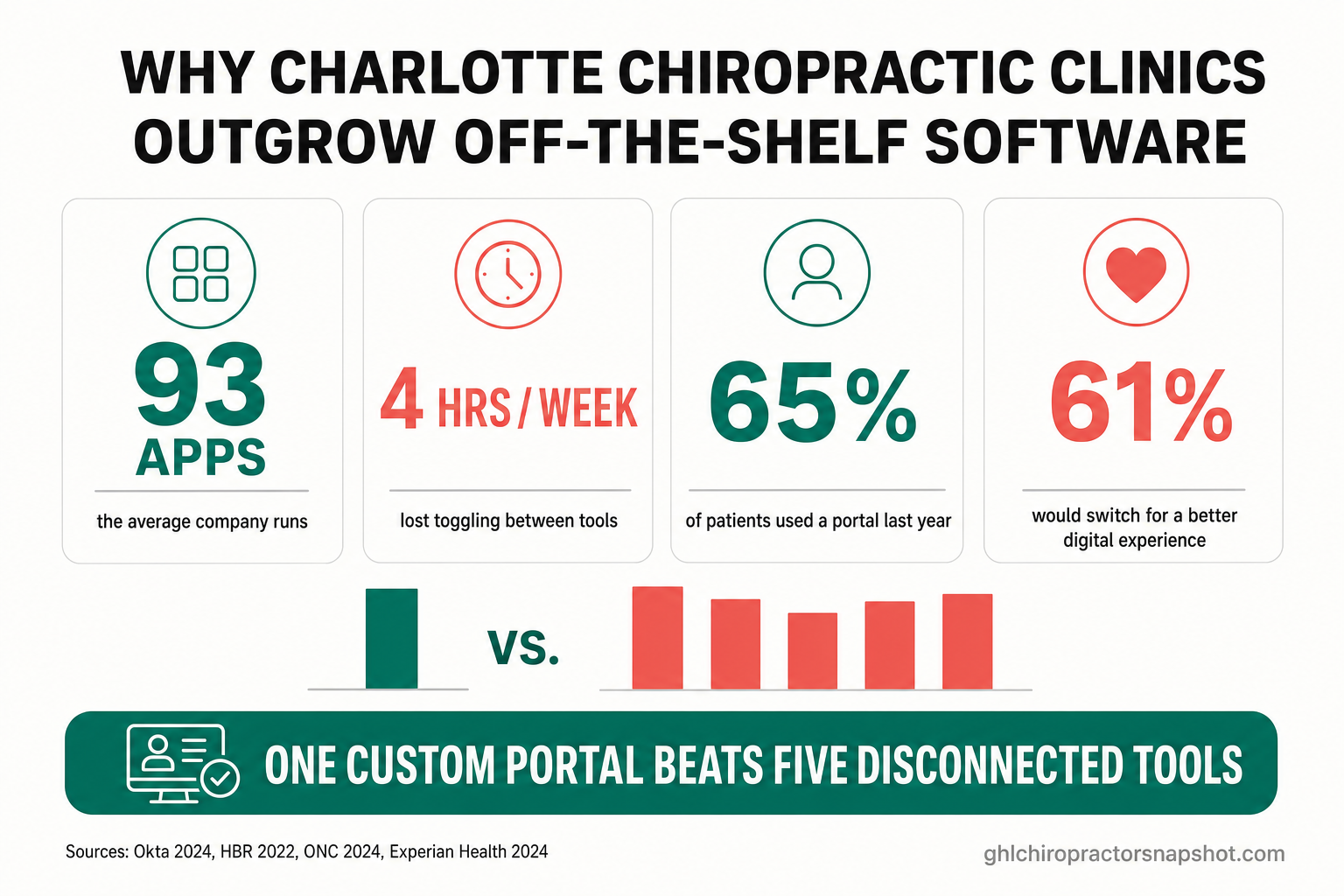
When does a Charlotte chiropractic clinic outgrow off-the-shelf software? The moment your team is re-keying the same patient’s details into three different tools, your front desk is fielding calls that a portal should handle, and no single screen shows you what’s happening across the practice. At that point, generic software isn’t saving you money — it’s quietly costing you staff hours, patient goodwill, and revenue. The average company now runs 93 separate apps (Okta, 2024), and workers lose roughly four hours a week — about five work-weeks a year — just toggling between them (Harvard Business Review, 2022). For a growing clinic in a competitive market like Charlotte, that friction is the difference between scaling smoothly and drowning in admin.
This is a practical, sourced guide for Charlotte-area clinic owners — and the GoHighLevel agencies that build for them — on the exact moment generic tools stop fitting, what it’s really costing you, and when a custom patient portal or unified system pays for itself. Every statistic below is dated and linked to its primary source.
Table of contents
- The short answer: when to outgrow off-the-shelf software
- Pain point 1: your stack is a pile of disconnected tools
- Pain point 2: your front desk is drowning in manual admin
- Pain point 3: patients expect a portal you can’t give them
- The cost of doing nothing
- What a custom patient portal actually includes
- Off-the-shelf vs custom: when each makes sense
- Frequently asked questions
The short answer: when to outgrow off-the-shelf software
Off-the-shelf software is the right call when you’re a single Charlotte clinic finding your feet — a scheduler, a spreadsheet, an EHR, and a payment tool will carry you a long way. You outgrow it at a specific, recognizable point: when the cost of the gaps between your tools exceeds the cost of closing them.
You’ve hit that point when any of these are true week after week:
- Your front desk re-types the same patient information into two or more systems.
- You can’t see the whole practice on one screen — visits, care-plan progress, outstanding balances, and reactivations all live in different tools.
- Patients call to do things a portal should handle — booking, rescheduling, forms, balances, records.
- You’re paying for seats and features you don’t use across several subscriptions just to cover one workflow.
- Growth (a second location, associate doctors, a personal-injury caseload) means the manual glue breaks under volume.
None of that means your current tools are bad. It means your practice has outgrown the shape they come in. The rest of this guide quantifies each pain — with sourced numbers — so you can decide whether a custom build is worth it for your clinic.
Pain point 1: your stack is a pile of disconnected tools
The typical growing clinic doesn’t choose sprawl — it accumulates it. One tool for scheduling, another for intake forms, an EHR for notes, a spreadsheet for recall, GoHighLevel for marketing, a separate processor for payments. Each was a reasonable decision. Together, they’re a tax.
The data on that tax is unambiguous. The average company deployed 93 different applications in 2024, up from 89 the year before (Okta, Businesses at Work, 2024). And the human cost of hopping between them is measurable: a Harvard Business Review study of workers at three Fortune 500 companies found people toggle between apps around 1,200 times a day, adding up to roughly four hours a week — about five work-weeks a year — just reorienting after each switch (Harvard Business Review, 2022). Separately, Asana’s Anatomy of Work index put the waste of duplicated and unnecessary work at 308 hours per employee per year (Asana, 2022).
For a chiropractic front desk, that abstract “toggling” cost is concrete: pulling up the schedule in one tab, checking eligibility in another, copying the new patient’s name and date of birth into the intake tool, then re-entering it a third time to send a payment link. Every hop is a chance for a typo, a missed field, or a dropped follow-up. The messy reality of a busy front desk is exactly where disconnected tools do the most damage — and where a single source of truth pays off fastest.
Pain point 2: your front desk is drowning in manual admin
Even inside healthcare’s biggest, best-funded organizations, manual administration is the single largest reducible cost. McKinsey estimates US healthcare spends roughly $1 trillion a year on administration — about 25% of total spend — of which around $265 billion (28%) could be removed without harming care (McKinsey & Company, 2021). Your clinic is a rounding error in that trillion, but the same physics apply at your scale.
The per-transaction math is the part that hits a chiropractic office directly. The CAQH Index — which tracks the cost of routine administrative transactions — found that a manual insurance eligibility-and-benefit check costs a provider $7.97, versus $2.18 when it’s fully electronic (CAQH Index, 2023). Scale that across every new patient, every personal-injury case, and every re-verification, and the manual premium adds up fast. CAQH also estimates that fully automating these workflows saves roughly 70 minutes of staff time per patient visit and leaves more than $20 billion in savings still on the table industry-wide (CAQH, 2024).
The burnout number is the one clinic owners underrate. In the AMA’s 2024 physician survey, 95% of physicians said administrative burden increases burnout (American Medical Association, 2024). Your front-desk team feels the same thing. Every hour they spend re-keying data or playing phone tag is an hour they’re not spending on the patient in the chair — and it’s the kind of grind that drives good staff to quit. Software that eliminates the busywork is a retention tool for your team, not just your patients.
Pain point 3: patients expect a portal you can’t give them
A decade ago, an online patient portal was a nice-to-have. In 2026 it’s an expectation — and increasingly, a switching factor. The federal Office of the National Coordinator (now ASTP) reports that 65% of individuals accessed their online patient portal or health record at least once in the past year, up from 57% in 2022, and that 77% were offered online access to their information (ONC, 2024). Portal use isn’t a young-patient niche either: caregiver and proxy access more than doubled, from 24% in 2020 to 51% in 2024 (ONC, 2024) — the grandparents and kids in your care plans are logging in too.
The commercial risk is the second number. Experian Health’s State of Patient Access 2024 survey found 89% of patients say being able to schedule appointments online or by mobile is important, and — critically — 61% would consider switching to a provider that offers a better digital experience (Experian Health, 2024). Yet only 63% of providers currently offer self-scheduling. That gap between what patients want and what most clinics deliver is your opening. A Charlotte clinic that lets patients book, complete intake, view their care plan, and message the front desk from their phone doesn’t just reduce call volume — it becomes the easier choice when a prospective patient is comparing two practices.
Most off-the-shelf tools give you a fragment of this: a booking widget here, a forms tool there, a portal locked inside an EHR you can’t customize. Stitching them into one experience a patient actually wants to use is precisely where a purpose-built portal earns its keep. And if online booking is your immediate gap, our online scheduling playbook for chiropractors is the fastest first step.
The cost of doing nothing
Put the three pains together and the “we’ll deal with it later” option has a price tag. Staff hours evaporate into toggling and re-keying. Manual transactions cost multiples of their automated equivalents. Patients who wanted to self-serve either call (adding to the load) or quietly book with the clinic down the road that made it easy.
This matters more in a market like Charlotte precisely because chiropractic is growing and crowded. The US chiropractic industry is worth $23.4 billion in 2025, projected to reach $24.0 billion in 2026, across 66,061 businesses (IBISWorld, 2025–2026), and the Bureau of Labor Statistics projects chiropractor employment will grow 10% from 2024 to 2034 — much faster than average (BLS, 2024). More clinics, more competition for the same patients, and a rising bar on digital convenience. The practices that win the next few years are the ones that operate like they’re bigger than they are — which is exactly what the right software lets you do. (If you’re not yet tracking where the leaks are, start with the KPIs every chiropractic practice should watch.)
What a custom patient portal actually includes
“Custom software” sounds like a hospital-scale project. It isn’t. For a chiropractic clinic, it usually means one unified layer that closes the specific gaps between the tools you already run. A well-built custom patient portal and admin system typically brings together:
- One patient-facing portal — book and reschedule, complete digital intake, e-sign consent, upload insurance cards, view care-plan progress, see balances, and message the front desk securely, all from a phone.
- A single source of truth — data entered once flows everywhere. No more re-keying a name and date of birth into three systems, which is where digital intake turns a 10-minute clipboard into a 90-second phone form.
- Care-plan and visit dashboards — the whole-practice view: who’s due, who’s dropping off, who owes, which reactivation is stalling. This is where protecting patient lifetime value becomes an operational habit, not a spreadsheet chore.
- Automation that removes busywork — eligibility checks, reminders, recall, and no-show recovery running in the background instead of on your front desk’s to-do list.
- Integrations with what you keep — your EHR, GoHighLevel, and payment processor wired together instead of copy-pasted between.
The build doesn’t have to be all-or-nothing. Many clinics start with the portal and the single source of truth, then layer on dashboards and automation as they grow. And if the real problem is that your systems live in different worlds, sometimes the right first move is a clean migration into GoHighLevel before any custom layer goes on top.
Off-the-shelf vs custom: when each makes sense
Custom isn’t automatically better — it’s better past a certain size and complexity. Here’s the honest comparison for a chiropractic practice.
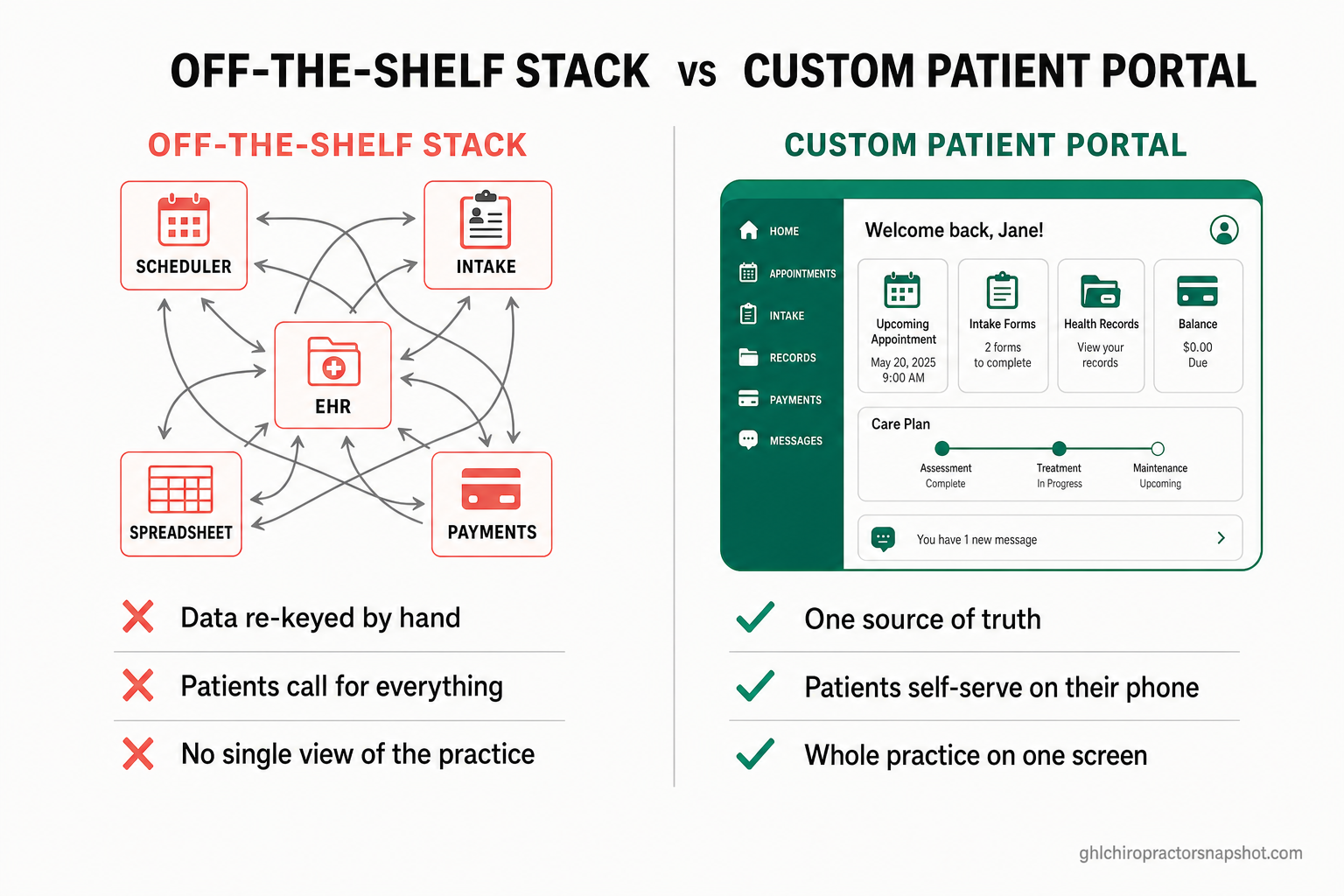
Off-the-shelf tools vs a custom unified system
| Plan | Off-the-shelf stack | Custom unified system recommended |
|---|---|---|
| Price | Low upfront | Higher upfront |
| Feature 1 | Fit: generic — you adapt to the tool | Fit: built around how your clinic actually practices |
| Feature 2 | Setup: fast, self-serve | Setup: designed and built for you (~4–8 weeks for a portal) |
| Feature 3 | Data: lives in silos; manual re-keying between tools | Data: one source of truth; entered once, flows everywhere |
| Feature 4 | Patient portal: fragmented or locked inside an EHR | Patient portal: one branded experience patients want to use |
| Feature 5 | Scales: fine for a single clinic, strains with growth | Scales: handles multi-location, associates, PI caseloads |
| Feature 6 | Best for: new or single-location practices | Best for: growing or multi-location clinics hitting the ceiling |
The tipping point is real and specific: as long as a single clinic runs comfortably on off-the-shelf tools, keep them. Once you’re paying — in staff hours, patient friction, and blind spots — for the gaps between those tools, a custom build stops being a luxury and starts being the cheaper option. Modern AI-assisted development has moved that tipping point closer for small practices: a purpose-built portal that used to be a six-figure enterprise project can now ship in weeks, which is why we can build custom software for clinics at a fraction of a traditional dev shop’s cost.
Frequently asked questions
When should a chiropractic clinic switch from off-the-shelf software to custom?
When the cost of the gaps between your tools exceeds the cost of closing them. Concretely: when your team re-keys the same patient data into multiple systems, you can't see the whole practice on one screen, patients call to do things a portal should handle, or growth (a second location or a personal-injury caseload) is breaking your manual glue. A single clinic running smoothly on generic tools doesn't need custom software yet — a growing or multi-location group hitting those walls usually does.
How much does a custom patient portal for a chiropractic clinic cost?
It depends on scope, but far less than it used to. Because we build with Claude Code — AI-assisted development — a patient portal that was once a six-figure enterprise project can typically be delivered in about 4–8 weeks at a fraction of a traditional dev shop's price. We scope your clinic's specific workflows and give you a fixed-price quote before any work starts, and the software is fully owned by you.
Is a custom patient portal HIPAA-aware?
Yes. We build patient-facing software to be HIPAA-aware by design — secure authentication, encrypted data, no protected health information sent in plain SMS, and audit-ready access controls. We are an automation and software product, not a healthcare provider or a substitute for clinical judgment, but the systems we build are engineered to keep patient data handled compliantly.
Can custom software work with my existing EHR and GoHighLevel?
That's usually the whole point. A custom layer is most valuable when it unifies the tools you keep — your EHR, GoHighLevel, and payment processor — into one source of truth so data is entered once and flows everywhere, instead of being copy-pasted between systems. Where a tool has no API, we can even automate the browser workflow directly.
Do patients in Charlotte actually use online patient portals?
Yes, and adoption is climbing. Nationally, 65% of individuals accessed an online patient portal in the past year (ONC, 2024), up from 57% in 2022, and caregiver access more than doubled to 51%. Meanwhile 61% of patients say they'd consider switching to a provider with a better digital experience (Experian Health, 2024). In a competitive market like Charlotte, an easy digital front door is increasingly the deciding factor between two clinics.
About the author
Rey Alcantara is a GHL Automation Strategist who builds the new-patient intake and recall systems that ship inside the Chiropractor Snapshot. After a decade running marketing-ops for multi-location wellness brands, he now spends his days mapping the messy reality of a busy front desk into clean systems — the unglamorous plumbing that keeps a chiropractic schedule full. He writes about speed-to-lead, no-show recovery, and the software that lets small clinics operate like bigger ones.
Related posts
- Digital Intake Forms for Chiropractors: Turn the Clipboard Into a 90-Second Phone Form
- Online Scheduling for Chiropractors: The Booking Setup That Fills Your Calendar
- The Chiropractic Practice KPIs Worth Tracking (and How to Watch Them)
- Migrating an Atlanta Chiropractic Clinic to GoHighLevel: A Step-by-Step Guide
- Chiropractic Patient Lifetime Value: The Retention Math That Runs Your Clinic