

Should a Tampa chiropractor build their website inside GoHighLevel’s page builder or on a purpose-built Astro site? For the public marketing site whose only job is turning a local search into a booked exam, an Astro build wins on the two things that decide it — page speed and Core Web Vitals — while GoHighLevel keeps doing what it’s genuinely best at behind the scenes: your CRM, pipelines, and automations. The stakes are concrete for a busy clinic. 53% of mobile visitors abandon a page that takes longer than three seconds to load (Google, 2016), and the median web page in 2024 shipped about 2.3 MB and 570 KB of JavaScript on mobile (HTTP Archive Web Almanac, 2024) — the kind of weight a page-builder stack piles on, and exactly what a static Astro site strips away.
This is a like-for-like comparison for chiropractic clinic owners in the Tampa Bay area and the GoHighLevel agencies that build for them — not a platform flame war. We love GoHighLevel; the Chiropractor Snapshot runs entirely inside it. But your public website and your CRM are two different jobs, and the honest answer is that they don’t have to live in the same tool. Every statistic below is dated and linked to its source.
Table of contents
- The short answer for a Tampa clinic
- What “building your site in GoHighLevel” actually means
- Why page speed decides whether a Tampa patient books
- Core Web Vitals, explained for clinic owners
- GoHighLevel page builder vs Astro: the head-to-head
- What GoHighLevel is genuinely great at
- The real cost over a year
- Frequently asked questions
The short answer for a Tampa clinic
If your website’s job is to get found in local search and turn a phone-wielding patient into a booked exam, the fastest, most SEO-ready build wins — and that is a static site, not a page inside a funnel builder. GoHighLevel is a superb CRM and automation platform. Its page and funnel builder is convenient for a quick landing page, but it renders every page through a builder runtime with shared JavaScript, embedded widgets, and builder “chrome” that a patient’s phone has to download and run before your headline appears.
A purpose-built Astro site does the opposite. It ships mostly static HTML from the edge and adds JavaScript only where a page truly needs it — a booking widget, a chat bubble — as small, isolated “islands.” That’s why our Get a Website clinic builds carry a guaranteed 90+ Google PageSpeed score, frequently a perfect 100, on both mobile and desktop, while a typical page-builder clinic site lands somewhere in the 40–70 range on mobile.
So the recommendation isn’t “leave GoHighLevel.” It’s use each tool for the job it’s best at: keep intake, recall, pipelines, and messaging in GoHighLevel, and serve your public marketing site — the thing Google ranks and patients judge in the first two seconds — from a fast static build.
What “building your site in GoHighLevel” actually means
Plenty of chiropractors, and the agencies serving them, spin up their whole website inside GoHighLevel because the account is already there. It feels efficient: one login, drag-and-drop sections, a form that drops straight into the CRM. For a single event page or a paid-ad landing page, that’s a perfectly good use of the builder.
The trouble starts when that same builder becomes your entire public website — home, services, town pages, blog, and all. A funnel/page builder is optimized for flexibility in the editor, not for shipping the leanest possible page to a patient’s phone. In practice that means:
- Shared runtime and builder scripts load on every page, whether the page needs them or not.
- Third-party embeds — calendars, chat widgets, review sliders, tracking pixels — stack on top, each adding its own JavaScript and network requests.
- Limited control over the technical SEO layer: the meta, structured data (schema), sitemap,
robots.txt, andllms.txtthat decide whether Google and AI answer engines can read your site cleanly.
None of that makes GoHighLevel “bad.” It makes it the wrong layer for the one asset where milliseconds and machine-readable markup translate directly into booked patients. To see why milliseconds matter this much, look at what happens on a phone.
Why page speed decides whether a Tampa patient books
A new patient in South Tampa, Brandon, or Wesley Chapel almost never types the word “chiropractor” into a desktop. They pull out a phone — often on a spotty signal in a parking lot — search a symptom plus “near me,” and tap the top result. If your page hasn’t rendered by the time their patience runs out, they’re gone before they ever see your reviews or your booking button.
The data on that impatience is brutal and consistent:
That third number is the one clinic owners underrate. Deloitte and Google, studying real retail and travel sites, found that improving mobile load by just one-tenth of a second lifted retail conversions 8.4% and average order value 9.2% (Deloitte/Google, 2020). Tenths of a second. Now stack the other direction: as a mobile page slows from one second to five, the probability that the visitor bounces rises 90%, and by ten seconds it’s up 123% (Google/SOASTA, 2017).
In a market the size of Tampa Bay — a metro of roughly 3.3 million people, the 17th-largest in the United States (U.S. Census Bureau, 2024) — you are one of many pins on the map for the same search. Speed is often the difference between the patient booking with you or tapping the next clinic before your page even paints.
Core Web Vitals, explained for clinic owners
You don’t need to become a developer, but you should know the three numbers Google actually measures, because page experience is part of Google’s ranking systems (Google Search Central) and has been a mobile ranking factor since the 2018 “Speed Update” (Google, 2018). The three Core Web Vitals, with their “good” thresholds (web.dev, 2024):
- LCP — Largest Contentful Paint ≤ 2.5s. How fast your main headline or hero image appears. Heavy builder JavaScript pushes this later.
- INP — Interaction to Next Paint ≤ 200ms. How quickly the page responds when a patient taps “Book.” Lots of scripts competing for the phone’s processor hurt it.
- CLS — Cumulative Layout Shift ≤ 0.1. Whether the page jumps around as it loads. Late-loading widgets and embeds are a common cause.
Here’s the honest part: there is no published study measuring GoHighLevel’s specific Core Web Vitals, so we won’t invent one. But the mechanics are not in dispute. A page rendered through a funnel builder with shared scripts and stacked embeds carries more JavaScript to parse and execute, which pressures LCP and INP; a static Astro page ships almost none, which is why passing all three “good” thresholds is the default rather than a fight. If you want a hard number for your own site, run your current page through Google’s PageSpeed Insights — it reports your real LCP, INP, and CLS in about a minute.
GoHighLevel page builder vs Astro: the head-to-head
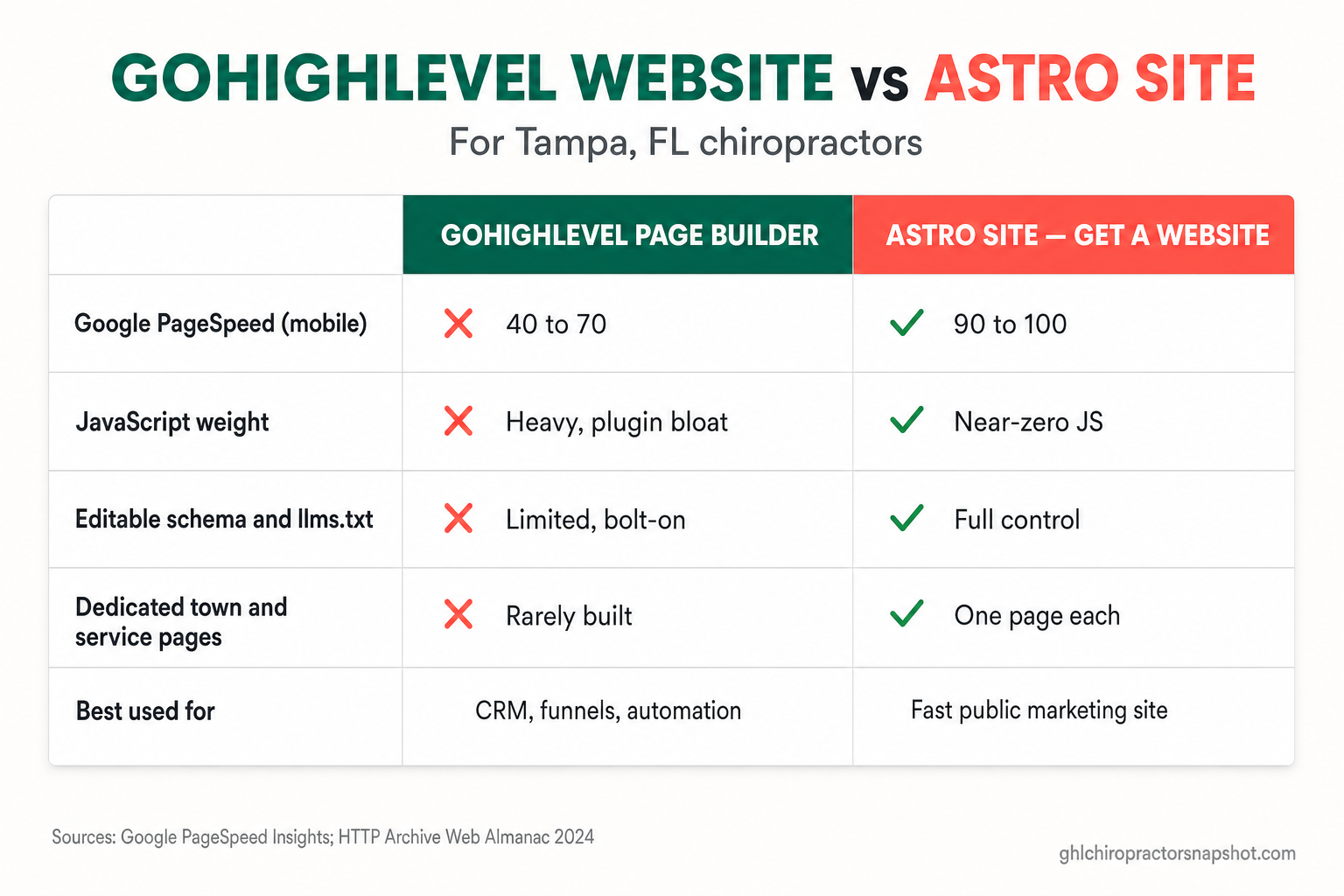
Here’s the like-for-like on the things that decide whether a Tampa clinic’s website earns patients. “GoHighLevel site” means your public marketing site built inside the GHL page/funnel builder; “Astro site” means a purpose-built static build like our Get a Website service.
| What matters for a clinic site | GoHighLevel page builder | Purpose-built Astro site |
|---|---|---|
| Google PageSpeed (mobile) | Frequently 40–70 | 90–100, with 90+ guaranteed |
| JavaScript & page weight | Heavy: shared runtime + stacked embeds | Near-zero JS; small islands only |
| Core Web Vitals (LCP/INP/CLS) | Pressured by builder scripts | Passes “good” thresholds by default |
Editable meta, schema & llms.txt |
Limited / bolt-on | Full control, built in |
| Pages for the towns you draw from | Rarely built out | One written page per town & service |
| Hosting, SSL & maintenance | Bundled with your GHL plan | Included, never itemized later |
| Best used for | CRM, funnels, automation, quick landers | The fast public marketing site Google ranks |
Notice what the table is not saying. It isn’t claiming GoHighLevel is a weak product — it’s claiming the page builder is the wrong layer for a whole public website. The moment your site needs to load in under two seconds, rank for dozens of “symptom + town + near me” searches, and be cleanly readable by AI answer engines, a static-first build is simply the right tool. This is the same conclusion we reached comparing Astro vs WordPress for Phoenix clinics — the platform changes, but the physics of page speed don’t.
What GoHighLevel is genuinely great at
Let’s be fair, because this matters for how you actually run your clinic. GoHighLevel is the engine we build the entire Chiropractor Snapshot on, and for good reason. It is excellent at:
- CRM and pipelines — every lead, patient, and case tracked in one place.
- Automations and workflows — new-patient intake, recall reactivation, and no-show recovery that run without the front desk lifting a finger.
- Two-way messaging — HIPAA-aware SMS, email, and social DMs from a single inbox.
- Booking and calendars — online scheduling with confirmations and reminders wired straight into the CRM.
- Quick landing pages — for a single ad campaign or event, the builder is fast and fine.
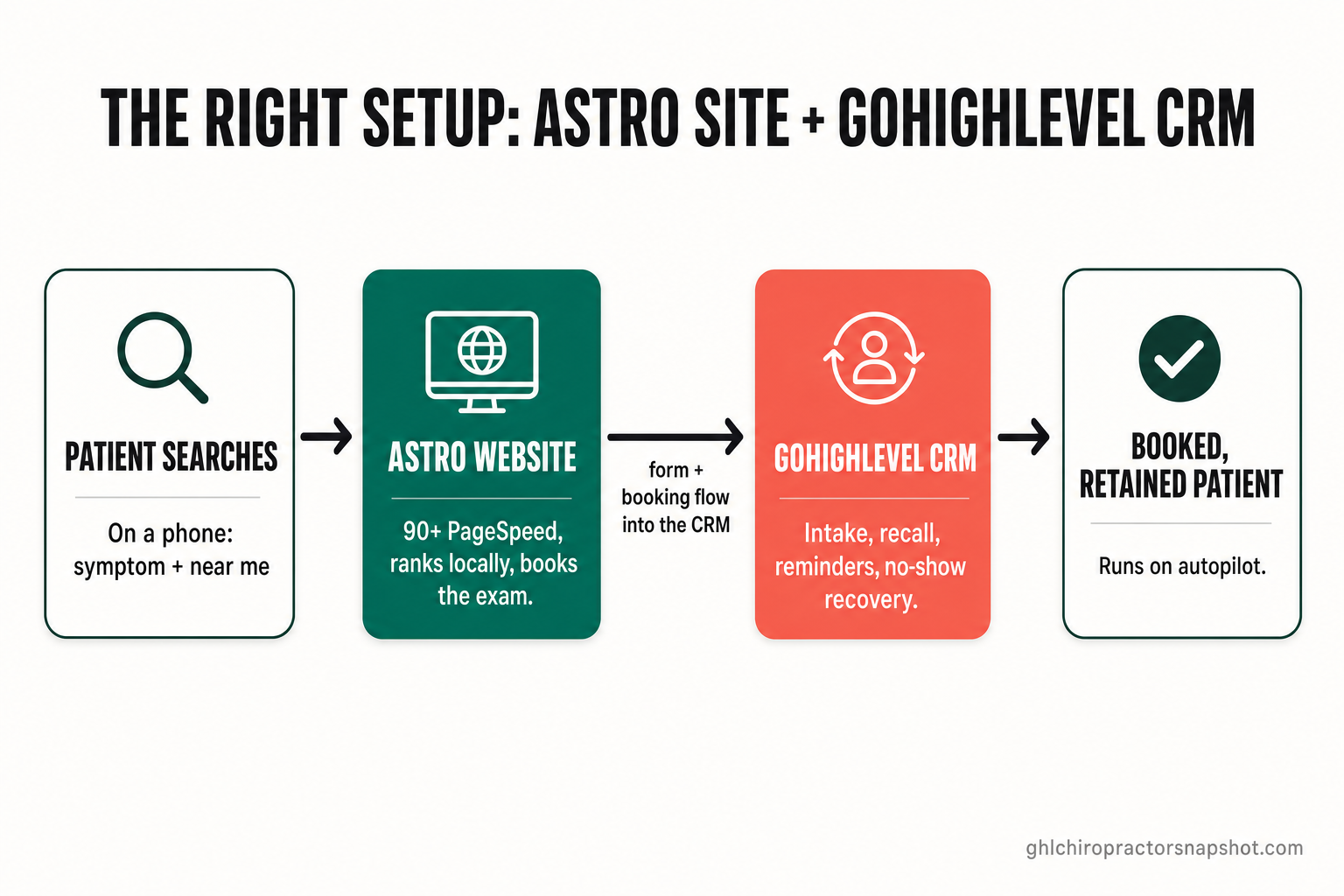
The distinction is simple. GoHighLevel is where your operations live. Your website is your storefront in local search. You want the storefront to be the fastest, most search-ready building on the street, and you want it to hand every lead it captures straight into GoHighLevel. That’s exactly how our prebuilt clinic website is set up: an Astro-fast public site whose forms drop into your GHL CRM by direct API, Zapier, or Make.
The real cost over a year
Cost is where clinic owners assume the page builder must be cheaper, and it’s usually a wash — or worse, once you count the patients a slow page loses. If you already pay for GoHighLevel to run your CRM, building the website there feels “free.” But the hidden bill is the conversions you never see: at the highest-converting 0–4 second load band, a fast site quietly books patients a slow one turns away (Portent, 2022).
A purpose-built Astro clinic site from our Get a Website service runs $97 a month plus a one-time $499 build fee for the Relief phase — and that price includes managed hosting, SSL, a CDN, free domain, and revisions, none of it itemized back to you later. Compare that to stitching your public site onto a page builder and then paying, in bounced patients, for every extra second it takes to load.
The math that actually decides it isn’t the subscription line; it’s this: a metro of 3.3 million people is running “near me” searches every day, 76% of them visit a business within a day (Think with Google, 2016), and 71% of consumers read local-business reviews regularly before choosing (BrightLocal, 2025). A page that loads before they give up, ranks for their search, and shows your reviews is the cheapest new-patient acquisition you’ll ever run. For the full pricing picture across phases of care, see our pricing page.
Frequently asked questions
Can I keep using GoHighLevel if my website is built on Astro?
Yes — that's the recommended setup. GoHighLevel stays your CRM, calendar, and automation engine. The Astro site is your fast public storefront, and every form or booking on it flows straight into GoHighLevel by direct API, Zapier, or Make. You get the speed and SEO of a static site with none of the operational features of GHL lost.
Is a website built in GoHighLevel bad for SEO?
It's not that it can't rank — it's that you're fighting uphill. Page-builder sites tend to load slower on mobile and give you limited control over meta, structured data, sitemaps, and llms.txt. Since page experience and Core Web Vitals are part of Google's ranking systems, a slower, less machine-readable site is at a disadvantage for the competitive local searches that fill a chiropractic schedule.
What Google PageSpeed score should my chiropractic website hit?
Aim for 90+ on mobile, and ideally pass all three Core Web Vitals: Largest Contentful Paint under 2.5 seconds, Interaction to Next Paint under 200 milliseconds, and Cumulative Layout Shift under 0.1. Our Astro builds guarantee a 90+ score, frequently a perfect 100. You can check your current site free at pagespeed.web.dev.
How long until a new Astro site starts ranking in Tampa?
With fast pages, real town-level pages, correct schema, and clean sitemap, robots, and llms files, we typically expect a site to start ranking in its own catchment within three to five months. We won't promise day-one rankings or a specific new-patient number — your market, offer, and reviews decide that alongside the website.
Do I have to rebuild everything at once?
No. Most clinics keep their GoHighLevel workflows exactly as they are and simply move the public website onto a faster Astro build, pointing the existing domain at the new site. Your CRM, pipelines, and automations don't change — only the storefront patients see gets faster and more search-ready.
About the author
Derek Osei is a Local Marketing & Reviews Specialist who helps chiropractic clinics get found and chosen in local search. He builds the Google Business Profile, review-generation, and website-performance systems that move a clinic into the local Map Pack and keep the new-patient pipeline warm. He writes practical, no-fluff playbooks on turning local search intent into booked exams. Derek is a marketing and automation specialist, not a licensed chiropractor, and nothing here is medical advice.
Related posts
- Astro vs WordPress for Chiropractor Websites in Phoenix: Page Speed & Core Web Vitals Compared
- Local SEO for Chiropractors in 2026: The Complete Map Pack Playbook
- AI Search Optimization for Seattle Chiropractors: Getting Cited by ChatGPT & AI Overviews
- Online Scheduling for Chiropractors: Turning Website Visitors into Booked Exams