

Should a Fort Worth chiropractic clinic that treats auto-accident patients run its personal-injury (PI) caseload on spreadsheets and generic software, or on a purpose-built case-management system? For any clinic doing more than a handful of PI cases a month, custom software wins — because a PI file is not an appointment, it’s a months-long financial instrument. Each case bundles a lien or letter of protection, a treatment clock the defense will scrutinize, a stack of records the attorney needs on demand, and a settlement that may land 6–18 months later. Tarrant County alone logged 28,074 crashes and 201 traffic deaths in 2024, part of a statewide toll of 251,977 people injured — one reportable crash every 57 seconds (TxDOT, 2024 Crash Facts). That injury pipeline is why PI is the most valuable — and most losable — work a Fort Worth clinic does.
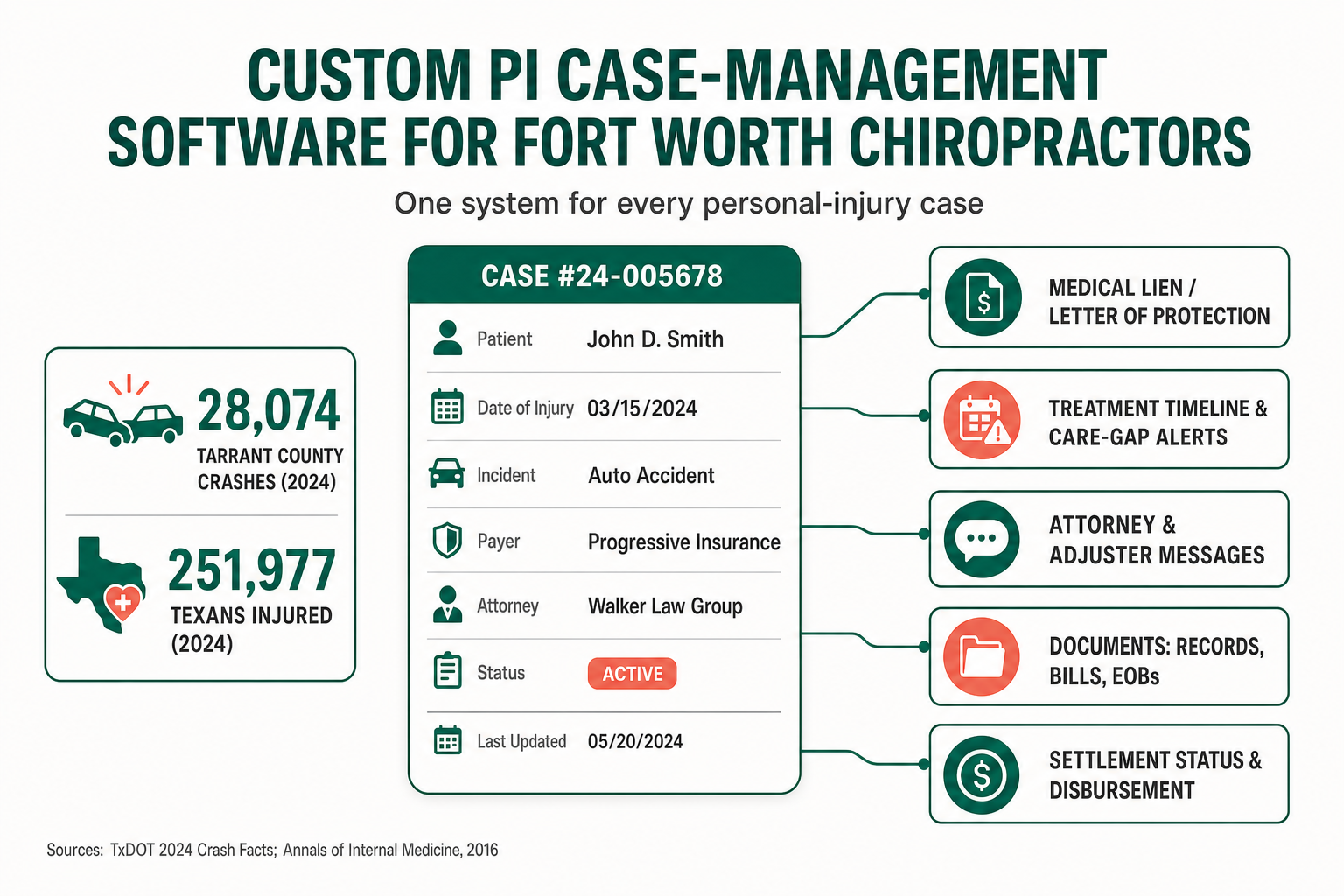
This is a decision guide for Fort Worth clinic owners — and the GoHighLevel agencies that build for them — weighing another spreadsheet against software designed around how a PI case actually moves. We build custom software for chiropractic and wellness clinics, so this is not neutral. But the argument below rests on dated, sourced numbers, not sales copy: what PI work demands, where generic tools quietly leak money, and what a case-management build changes. Every statistic is linked to its source.
Table of contents
- The short answer for a Fort Worth PI clinic
- Why Fort Worth is a personal-injury market
- What a PI case actually demands from your office
- Where spreadsheets and off-the-shelf tools break
- What custom PI case-management software does
- The math: hours saved and cases protected
- Building it right in Fort Worth: HIPAA, TCPA, records
- Frequently asked questions
The short answer for a Fort Worth PI clinic
If your clinic treats auto-accident patients, the single system that most directly protects revenue is not another marketing tool — it’s the one that holds every PI case in one place and tells you what’s about to slip. A PI file has moving parts a calendar and an EHR were never designed to track together: the medical lien or letter of protection, the date-of-injury and treatment-duration clock, the exact records the attorney’s office is waiting on, the adjuster’s last offer, and the settlement status. Miss one and you don’t lose an appointment — you lose a case worth many times a cash visit.
Off-the-shelf software forces that reality into boxes it doesn’t fit. So clinics improvise: a spreadsheet for liens, the EHR for notes, email for the attorney, a sticky note for “call the adjuster Friday.” Custom case-management software inverts it — the software is shaped around the PI workflow, not the workflow bent around the software. The recommendation isn’t “buy more tools.” It’s build the one tool the highest-value work in your clinic actually needs, and keep intake, recall, and messaging in GoHighLevel where they already run.
Why Fort Worth is a personal-injury market
Personal-injury chiropractic exists because collisions do, and North Texas produces a lot of them. Across the state in 2024, 251,977 people were injured and 4,150 killed on Texas roads — 18,218 of them seriously hurt — at a rate of one reportable crash every 57 seconds (TxDOT, 2024 Crash Facts). Tarrant County carried a heavy share: 28,074 total crashes and 201 fatalities in the same year (TxDOT county crash records, 2024). Every one of those injury crashes is a potential soft-tissue patient who will be referred, treated over weeks, and billed against a settlement.
The economics are why clinics fight for this work. A single PI case commonly runs 30–60 visits and $8,000–$15,000 in total billing, settling months later with one check that covers the whole course of care — worth many times a typical cash visit, as we broke down in how chiropractors build attorney referral relationships. But that value is locked behind time and paperwork. The case won’t pay until it settles, and it won’t settle cleanly unless the documentation is airtight. That is precisely where the wrong software costs you.
What a PI case actually demands from your office
A cash or insurance visit closes the same day. A PI case stays open for months and asks your front office to hold five things in sync the whole time:
- The lien or letter of protection. A letter of protection defers payment until the case resolves, so your clinic is effectively extending credit against a future settlement. Someone has to track the balance, the terms, and which attorney guaranteed it.
- The treatment clock. Gaps in care and treatment duration are the first things a defense adjuster attacks. The date of injury, visit cadence, and any lapse have to be visible and defensible.
- The records pipeline. Attorneys request narratives, bills, and notes — often urgently, near settlement. Slow or incomplete records delay the check and sour the referral relationship.
- The communication thread. Every call with the attorney’s paralegal and the adjuster’s last position needs a home, so nothing depends on one staffer’s memory.
- The settlement status. Where is the case — treating, demand sent, negotiating, settled, disbursing? That status drives whether you follow up this week or wait.
None of that is exotic, but all of it is documentation, and documentation is already the tax on clinical work. The landmark time-and-motion study of physician time found that for every hour of direct patient care, clinicians spend nearly two additional hours on the EHR and desk work — 49.2% of the office day versus just 27% in face-to-face care (Sinsky et al., Annals of Internal Medicine, 2016). Layer PI’s lien-and-attorney overhead on top of that baseline and the paperwork stops being a nuisance and starts being the bottleneck.
Where spreadsheets and off-the-shelf tools break
Most clinics run PI on a stack that was never meant to hold it: the EHR for clinical notes, a spreadsheet for liens, the email inbox for attorneys, the calendar for visits, and a person’s memory for “what’s next.” Four predictable failures follow.
Manual entry fails under exactly the conditions PI creates. Hand-keyed data is reasonably accurate when it’s calm — but error rates run 1–4% of fields on a normal day and spike to 18–40% under heavy or complex workloads (DigiParser, 2024). A busy PI desk is the definition of heavy and complex, and the fields that break — a date of service, a lien amount, a diagnosis code — are the ones an adjuster uses to discount or deny.
Errors get more expensive the later you catch them. The well-known 1-10-100 rule of data quality holds that a mistake costing about a dollar to prevent at entry costs roughly ten to fix later and a hundred once it reaches a filing or a customer (DigiParser, 2024). In PI terms, a lien typo caught at entry is nothing; the same typo discovered at settlement can shave real money off a check that took a year to arrive.
Disconnected tools tax every case. Across the workday, employees toggle roughly 10 apps 25 times a day and lose about four hours a week to context-switching (workplace technology overload data, 2026). Re-keying the same patient into the EHR, the lien sheet, and the attorney email is that tax, paid on your most valuable files.
Nothing warns you. A spreadsheet can’t tell you a patient hasn’t been seen in three weeks, that a records request has sat for five days, or that a case has been “negotiating” for two months. The information exists; nothing is watching it. PI leaks happen in silence — which is why the fix is software that watches the caseload, not just stores it.
What custom PI case-management software does
Custom software means the system is built around your PI workflow instead of forcing it into a generic CRM. For a Fort Worth clinic, a practical build — the kind we ship through our custom software service — centers on a few capabilities that off-the-shelf tools can’t combine:
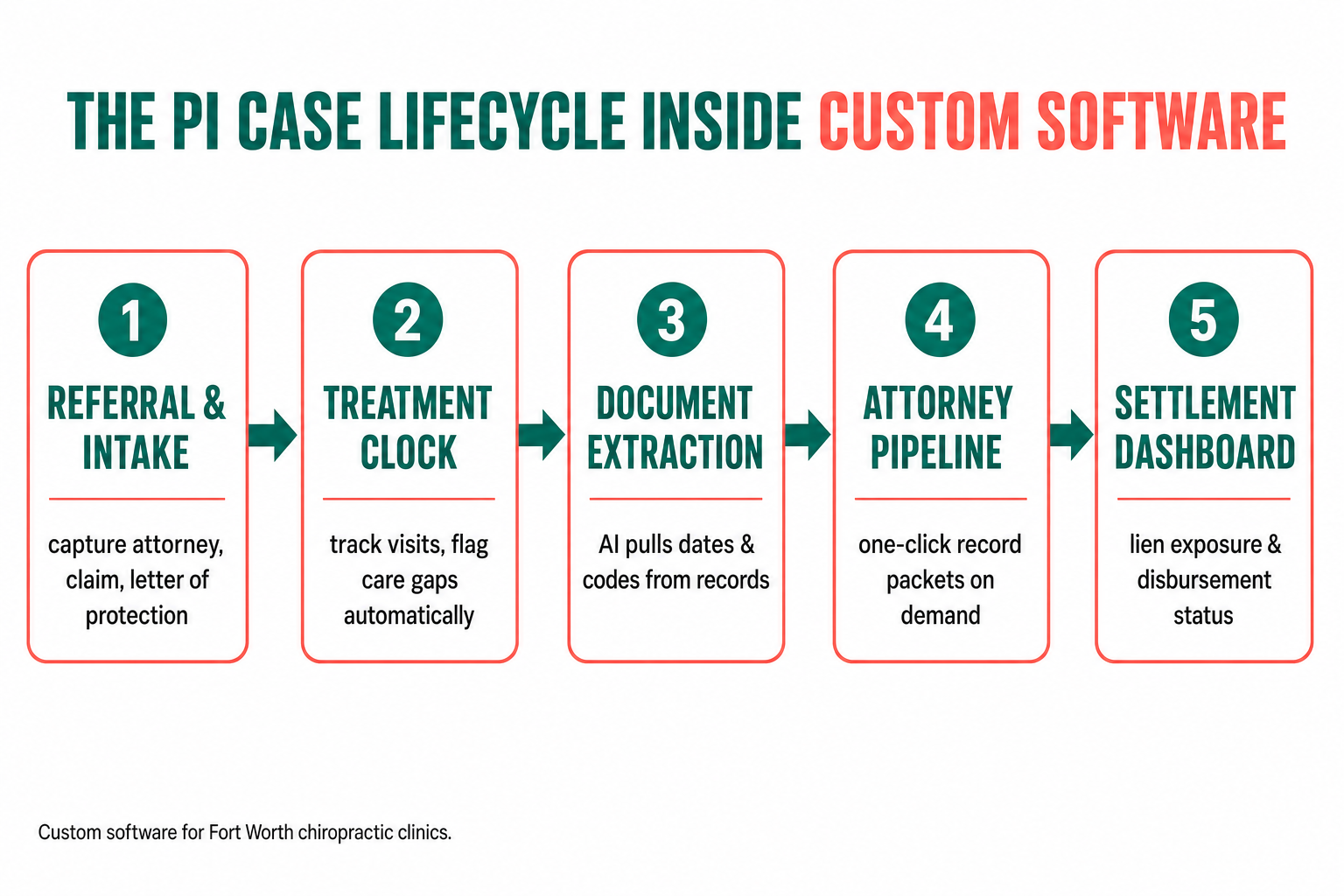
- A PI-shaped case record. One record per case with the fields PI actually uses: date of injury, referring attorney and firm, lien/letter-of-protection amount and terms, adjuster and claim number, treatment start, visit count, and a live status (treating → demand → negotiating → settled → disbursed). Not a generic contact — a case.
- A treatment clock with alerts. The software watches visit cadence and flags gaps before the defense does — “Patient not seen in 21 days,” “No note on file for last visit” — so care stays continuous and documentable.
- Automated document extraction. An AI document agent reads intake forms, police reports, and insurance EOBs and pulls the structured data — dates of service, diagnosis codes, coverage amounts — into the case record instead of a staffer re-keying it, removing the exact manual step that fails under load.
- An attorney and records pipeline. Every request, narrative, and bill is logged against the case, with one-click record packets and status you can share, so the paralegal near settlement gets what they need in minutes.
- Settlement and aging visibility. A dashboard shows every open case, its lien exposure, and how long it’s sat in each stage — the “what’s about to slip” view a spreadsheet can never assemble.
- You own it, and it connects. The build is yours, deployed on your accounts, and wired to the tools you already run — your patient CRM and workflows in GoHighLevel for intake, reminders, and recall — so nothing is re-keyed twice.
The math: hours saved and cases protected
The return on a PI case-management build comes from two places: hours the front desk stops losing, and cases the clinic stops leaking. The hours are quantifiable from the data above — removing the re-keying and app-toggling that costs roughly four hours per staffer per week, and cutting the entry errors that run into the double digits under load. The protected revenue is larger and lumpier: a single defended case is worth $8,000–$15,000, so preventing even one avoidable write-down or lost referral a quarter dwarfs the cost of the software.
Here is the same decision as a side-by-side. The rows are the jobs a PI case demands; the columns are how a stitched-together stack versus purpose-built software handles each.
| PI case job | Spreadsheets + off-the-shelf tools | Custom PI case-management software |
|---|---|---|
| Lien / letter of protection tracking | Separate sheet, updated by hand | Native field per case, with balance and terms |
| Treatment-gap alerts | None — you notice when it’s too late | Automatic flag before the defense sees it |
| Records into the file | Re-keyed from PDFs and EOBs | AI document extraction, no re-keying |
| Attorney / adjuster thread | Scattered across inboxes | Logged against the case, one-click packets |
| Settlement & aging view | Doesn’t exist | Live dashboard of exposure and stage |
| Data ownership & HIPAA posture | Spread across vendors | Yours, on your accounts, BAA-eligible stack |
Building it right in Fort Worth: HIPAA, TCPA, records
PI software touches protected health information and patient communication, so the build has to be compliant by design, not bolted on. In practice that means a BAA-eligible stack (the cloud, AI, and messaging vendors sign business-associate agreements), no PHI in plain SMS — patient and attorney texts point to secure links rather than carrying diagnoses — and access controls and logging so who-saw-what is auditable. Patient messaging stays TCPA-conscious, with clear consent and easy opt-out on any automated text.
None of this makes the clinic a law firm or changes your clinical judgment. It keeps the system inside the lines while your team treats patients and your attorneys move the case. Compliance is the clinic’s responsibility to operate; well-built software just makes staying compliant the path of least resistance rather than a constant manual effort. Done right, a Fort Worth clinic ends up with one place that holds every PI case, watches the ones about to slip, and hands the attorney what they need on demand — which is the whole point.
Frequently asked questions
Custom PI case-management software — Fort Worth chiropractors
What is custom PI case-management software for a chiropractic clinic?
It's software built specifically around how a personal-injury case moves through your clinic — one record per case holding the medical lien or letter of protection, the treatment timeline, the referring attorney and adjuster, the documents, and the live settlement status. Unlike a generic CRM or an EHR, it's shaped to PI's months-long, document-heavy workflow and can flag cases before they slip.
Why can't I just run PI on spreadsheets and my EHR?
You can, until volume rises. Manual data entry runs 1–4% errors normally but 18–40% under heavy or complex load (DigiParser, 2024), and a spreadsheet can't alert you to a care gap, a stalled records request, or a case that's been negotiating for two months. Purpose-built software watches the caseload instead of just storing it.
How does the software handle liens and letters of protection?
Each case carries native fields for the lien or letter-of-protection amount, terms, and the guaranteeing attorney, plus a settlement/aging dashboard that shows total lien exposure and how long each case has sat in each stage — so nothing is tracked on a side spreadsheet that no one is watching.
Is it HIPAA compliant?
It's built to be HIPAA-aware: a BAA-eligible cloud, AI, and messaging stack, no PHI in plain SMS (texts use secure links), and access controls with logging. Compliance remains the clinic's responsibility to operate within HIPAA, TCPA, and Texas board rules — the software is designed to make staying compliant the default, not an afterthought.
Does this replace GoHighLevel?
No. Keep intake, reminders, recall, and messaging in your GoHighLevel workflows — they're excellent at it. Custom PI software fills the gap GoHighLevel isn't built for: the lien, records, and settlement layer of a months-long case. The two are wired together so data isn't re-keyed twice.
How long does a build take and do I own the code?
Timelines depend on scope — a focused PI case tracker is faster than a full portal — and you own the code 100%, deployed on your own accounts and infrastructure. Start with a scoping call to size the smallest build that fixes your biggest leak, or see the full custom software service.
About the author
Derek Osei is a Local Marketing & Reviews Specialist who helps chiropractic clinics get found, chosen, and paid. He builds the Google Business Profile, review-generation, and personal-injury referral systems that move clinics into the local 3-pack and keep the attorney pipeline warm. He writes practical, no-fluff playbooks on turning local search intent — and auto-accident referrals — into booked exams and settled cases. Derek is an automation and local-marketing specialist, not a licensed chiropractor or attorney, and nothing here is medical or legal advice.
Related reading
- Personal Injury Marketing for Chiropractors: How to Build Real Attorney Referral Relationships
- Why Charlotte Clinics Outgrow Off-the-Shelf Software: The Case for a Custom Patient Portal
- Digital Intake Forms for Chiropractors: Faster, Cleaner, Compliant
- Best Chiropractic Software in 2026: An Honest Buyer’s Guide