

It is renewal month, and the ChiroTouch invoice is bigger than the one you signed for. The headline rate looked fine until the add-ons, the payment-processing cut, the 5 percent bump, and the reminder that you are one doctor paying for software built to carry six. So you type “ChiroTouch alternatives” into Google at 9 p.m.
What are the best ChiroTouch alternatives for a solo chiropractor in 2026? For a one-doctor practice, the strongest options are Jane (about $54 to $99 a month per practitioner), ChiroFusion (from $129 plus a $299 setup), zHealth (from $119 per provider), Genesis (around $79 to $97), Platinum System (quote-only), and the one most lists skip: keeping your records system and adding a published-price growth layer like GoHighLevel ($97 to $497) instead of ripping anything out. The right pick depends less on features than on one question almost nobody asks first: do you actually need to replace your EHR, or just the expensive bolt-ons around it? Every price below is dated and linked to its source.
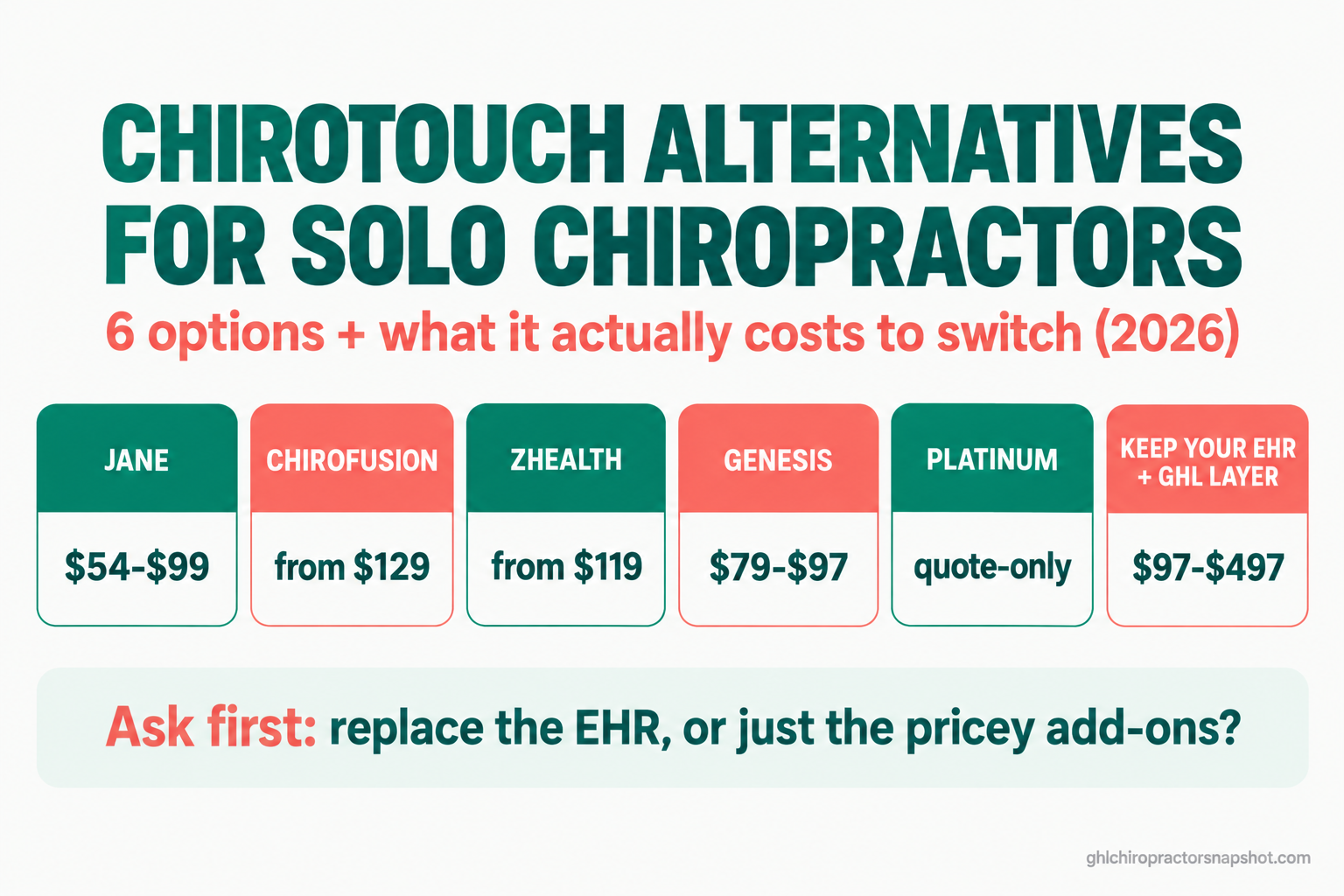
Table of contents
- Why solo chiropractors leave ChiroTouch
- First ask: do you even need to replace your EHR?
- The 6 ChiroTouch alternatives for a one-doctor practice
- What switching actually costs (the part nobody quotes)
- Three solo scenarios: cash, insurance-heavy, and growing
- Compliance you keep no matter which tool you pick
- Common objections
- The switch checklist
- Frequently asked questions
Why solo chiropractors leave ChiroTouch
ChiroTouch is a capable platform, and for a multi-doctor insurance clinic it earns its keep. The problem for a solo DC is not quality. It is that the pricing model was built for a bigger building than yours.
ChiroTouch lists $159 per provider per month for Core and $299 for Advanced, the tier you need to bill insurance, because Core does not scrub claims (Capterra, 2026). “Per provider” is fine math with one doctor, and the reason you leave the day you add an associate, because the whole rate re-multiplies.
Then come the parts that are not in the headline. Reported implementation runs $2,000 to $5,000, with another $500 to $3,000 to migrate records in, and renewals carry an annual increase near 5 percent (ITQlick, 2026). A payment-processing markup sits on card revenue. Independent teardowns put the three-year total near $40,000 to $45,000 for a three-doctor practice (ITQlick, 2026). A solo clinic pays less, but pays the same kind of money for a system it half-uses.
This does not make ChiroTouch a bad product. It means a one-doctor practice is often buying a Cadillac to drive to the grocery store. For the full line-by-line math, see our ChiroTouch pricing teardown.
First ask: do you even need to replace your EHR?
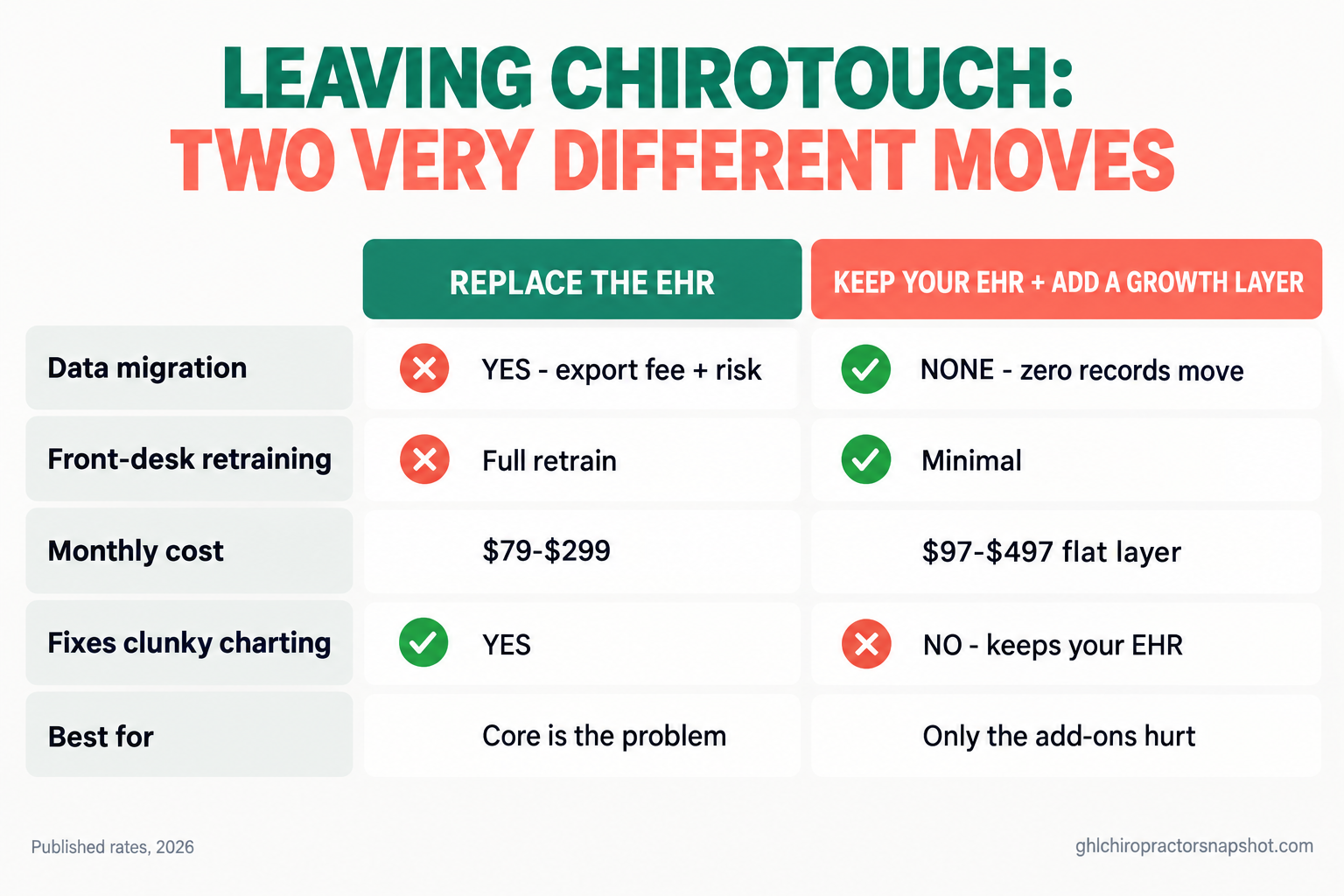
This is the step most “alternatives” lists skip. ChiroTouch does two very different jobs. One is the clinical and billing core: scheduling, SOAP notes, claims, the legal record. The other is the growth layer: reminders, intake forms, review requests, recall, reactivation, missed-call follow-up. Most of what pushes the bill past the headline is that second layer, sold as add-ons. So separate your pain before you price a migration:
- If the clinical core itself is the problem (clunky notes, slow billing, a clumsy interface), you want a true EHR replacement: Jane, ChiroFusion, zHealth, Genesis, or Platinum System.
- If the core is fine and the cost lives in the bolt-ons, you do not need to move your records. Keep the EHR you trust and add a published-price growth layer for texting, reminders, reviews, and reactivation.
That path is quietly the cheapest, lowest-risk move for a lot of solo clinics, because it moves zero records and skips the migration entirely.
The 6 ChiroTouch alternatives for a one-doctor practice
Six honest options, ranked for a solo shop, with what each is good at and where it breaks. The table gives the published prices at a glance.
ChiroTouch alternatives for a solo practice, priced without a demo (2026)
| Plan | ChiroTouch (what you have) | Jane recommended | ChiroFusion | zHealth | Keep your EHR + GoHighLevel layer |
|---|---|---|---|---|---|
| Price | $159–$299 / provider / mo | $54–$99 / mo / practitioner | from $129 / mo + $299 setup | $119–$249 / provider / mo | $97–$497 / mo (flat) |
| Feature 1 | Per-provider pricing (re-multiplies as you grow) | Fully published pricing, self-serve | Transparent cloud EHR pricing | Published tiers, 10% annual discount | No EHR migration, no record moving |
| Feature 2 | $2k–5k setup + data migration | Free migration help, incl. from ChiroTouch | +$49/mo per extra provider | Texting and reminders built in higher up | Two-way SMS, reminders, reviews, reactivation |
| Feature 3 | Full EHR; growth tools sold as paid add-ons | Clean EHR; Balance tier caps 20 appts/mo | Chiropractic notes; Complete tier $299–$329 | Chiropractic EHR; per-provider on upper tiers | Flat published price, 14-day trial |
Sources: ChiroTouch, Jane, ChiroFusion, zHealth, GoHighLevel (all 2026).
1. Jane: the clean, self-serve EHR replacement
Jane is the modern, self-serve EHR most solo docs land on. Pricing is fully public: Balance about $54 a month, Practice about $79, Thrive about $99, billed per practitioner (usecarly, 2026). Extra practitioners add $35 to $40 a month.
Good at: clean charting, strong online booking, and free migration help, including a published ChiroTouch import guide (Jane, 2026). Where it breaks: the cheap Balance tier caps you at 20 appointments a month and one practitioner, so your real plan is Practice or Thrive, and its reactivation automation is lighter than a dedicated marketing platform.
2. ChiroFusion: the budget chiropractic-specific EHR
ChiroFusion is built for chiropractic and prices in the open. Essentials is $129 annual or $149 month-to-month, with a $299 setup fee; Complete runs $299 to $329 a month; extra providers are $49 each (SoftwareAdvice, 2026).
Good at: chiropractic notes, claims, and reminders at a lower entry cost than ChiroTouch, with no per-provider explosion. Where it breaks: the $299 setup and the annual-versus-monthly gap mean you should price the configuration you will actually run. See our Jane vs ChiroTouch vs ChiroFusion vs zHealth comparison.
3. zHealth: transparent tiers with messaging built in
zHealth publishes its pricing too: Essentials around $119 a month and Professional around $249 a month per provider, with a 10 percent annual discount (Capterra, 2026).
Good at: a chiropractic EHR that folds texting and reminders into the higher tiers, so it can replace both the records system and a chunk of the communication add-ons in one bill. Where it breaks: like ChiroTouch, it meters per provider on the upper tiers, so adding a doctor puts you back in multiplying math.
4. Genesis: the data-heavy practice option
Genesis is for owners who love numbers. Third-party listings put it at roughly $79 to $97 a month, with onboarding of $500 to $2,000 (ITQlick, 2026).
Good at: deep practice metrics, claims tracking, and workflow accountability that some high-volume solo clinics genuinely use. Where it breaks: the depth is overkill for a simple cash practice, with a steeper learning curve than Jane.
5. Platinum System: capable, but still quote-only
Platinum System is a long-standing chiropractic platform with a loyal base. The catch is that its pricing is still custom and quote-only, so you cannot budget it without a call (Softwares.com, 2026).
Good at: an established workflow and coaching ecosystem some practices build around. Where it breaks: in a year when nearly every rival publishes a number, being made to book a demo just to learn the price is a real strike for a busy owner leaving ChiroTouch to escape exactly that.
6. Keep your EHR, add a growth layer: the move most lists skip
If your clinical core is fine and the cost pain is reminders, reviews, recall, and missed-call tools, you keep your records system and add a published-price growth layer instead of migrating.
GoHighLevel is the common choice because it is flat and public: $97 to $497 a month with a 14-day self-serve trial, no per-provider multiplier (GoHighLevel, 2026). It handles two-way texting, reminders, reviews, reactivation, and missed-call text-back, the exact add-on layer ChiroTouch charges a premium for.
Good at: killing your most expensive bolt-ons without touching a single record, so there is no migration to fear. Where it breaks: it is not an EHR. It keeps no SOAP notes and files no claims, so it sits beside your records system, not instead of it. It is a platform you configure, so clinics either learn it, hire a GHL development partner, or install a prebuilt system. See our patient communication software comparison for how it compares to Weave and Podium.
What switching actually costs (the part nobody quotes)
The monthly price is easy. The expensive, hidden number is the move itself, and this is where solo docs get surprised. Price all of it before you commit.
Getting your data out. Your demographics, appointments, insurance policies, and SOAP notes live inside ChiroTouch, and a clean, full export can carry a fee and a wait. Jane’s migration guide says ChiroTouch “is now able to perform a full export of your clinic’s data for a fee” and tells you to ask ChiroTouch directly about the cost (Jane, 2026). Get it in writing before you cancel.
The import. Receiving vendors usually help for free; Jane says its migration help is free (Jane, 2026). Still, verify what comes across, especially historical chart notes, and run both systems in parallel briefly so nothing in flight is lost.
The contract you are still in. ChiroTouch agreements frequently run annually and auto-renew unless you cancel inside a notice window. Find your renewal date and cancellation window today.
Claims in flight and training. If you bill insurance, do not switch mid-cycle; keep read access to ChiroTouch for 60 to 90 days while claims clear. And budget for a week of slower check-ins as the front desk learns the new screens. Option six skips most of this, because the clinical system never moves.
Three solo scenarios: cash, insurance-heavy, and growing
The same framework gives three answers, depending on the practice.
The cash or wellness practice. You do not scrub insurance claims, so you are paying for ChiroTouch’s billing engine and barely using it. The clearest case to leave. If the clinical core bugs you, move to Jane (around $79). If the core is fine, keep your EHR and add the growth layer. Your money belongs in reactivation and reviews, not a claims system you never touch.
The insurance-heavy practice. Claims are your lifeblood, so the clinical core matters more than the monthly rate. The honest move is a true chiropractic EHR with strong billing: ChiroFusion (from $129) or zHealth (from $119 per provider) both scrub claims and cost less than ChiroTouch Advanced. Switch between claim cycles, and layer reminders and reactivation on top to attack the no-show rate that hits insurance patients hardest (why they no-show more).
The solo doc about to add an associate. This is where the per-provider model hurts most, because your bill is about to double on the same screens. Price the two-provider total now, not after you hire. Jane adds practitioners at $35 to $40 a month and ChiroFusion at $49. Lock in the growth layer first: a second doctor only pays off if the schedule is full, and that is a marketing-and-recall problem, not an EHR feature.
Compliance you keep no matter which tool you pick
Switching software does not change how you are allowed to contact patients. Under HIPAA, automated SMS and email must not carry diagnosis, condition, or treatment detail in the body, and patients need written notice of the risk of unencrypted messages first (HHS, 2026). “See you Tuesday at 3” is fine. A text naming a condition or a care plan is not, in plain SMS.
TCPA is the second rule: automated texts need prior express consent, a clear opt-out on every message, and respect for quiet hours (FCC, 2026). Capture consent at intake and wire an opt-out into every sequence once. State board advertising rules also bite on the “free exam” hook, and they vary, so verify yours first. The platform never makes your content compliant; your templates do. See our HIPAA-compliant patient texting guide.
Common objections
“I have years of records in ChiroTouch. Isn’t leaving too risky?” The records are exactly why you price the export and run both systems in parallel. But this objection is only about the clinical core. The “keep your EHR, add a layer” path moves zero records and carries none of that risk.
“Isn’t a cheaper tool just a worse tool?” Not automatically. Jane, ChiroFusion, and zHealth are well-regarded and publish their prices. A solo cash practice on ChiroTouch Advanced is usually over-buying a billing engine it barely uses. “Worse” depends on the jobs you need done.
“Do I need to be technical to switch?” No. You need the checklist below and the discipline to make every vendor answer in writing. Receiving vendors handle most migrations; the growth layer you learn, hire out, or install prebuilt.
“What if I like ChiroTouch and just want it cheaper?” Then do not switch EHRs at all. Negotiate the rate and an increase cap at renewal, drop the add-on tiers you do not use, and move that work to a cheaper growth layer. You can shrink a ChiroTouch bill without leaving it.
The switch checklist
Because this is two decisions, your defense is a script. Take it to every vendor, and refuse to move until each line has a written answer.
A vendor that answers all of that plainly is one you can trust. One that keeps steering you to “let’s just get you started” is telling you something.
Frequently asked questions
What is the best ChiroTouch alternative for a solo chiropractor in 2026?
It depends on your payer mix. Cash practices wanting a clean, cheap EHR usually pick Jane (about $54 to $99 a month). Insurance clinics are better with ChiroFusion (from $129) or zHealth (from $119 per provider), which cost less than ChiroTouch Advanced and still scrub claims. If only the add-on bill hurts, keep your EHR and add a growth layer.
How much does it cost to switch away from ChiroTouch?
A full export of your own data from ChiroTouch can carry a fee and a wait, so get the cost and turnaround in writing before you cancel (Jane, 2026). Receiving vendors like Jane handle the import for free. Also budget for running both systems during the cutover and retraining the front desk.
Do I have to replace ChiroTouch to lower my bill?
No. If your clinical core is fine and the pain is the add-ons (reminders, reviews, recall, missed-call follow-up), keep ChiroTouch and move that work to a flat-priced growth layer like GoHighLevel ($97 to $497 a month), with no data migration at all.
Does ChiroTouch charge to export my own data?
Reportedly yes. Jane's migration guide says ChiroTouch can now perform a full export for a fee and advises asking ChiroTouch directly about the cost and turnaround (Jane, 2026). Confirm the number in writing before you give notice, while you are still paying.
Will I lose my patient history if I switch chiropractic software?
Not if you plan it. A full export covers demographics, appointments, insurance policies, and notes. The usual risk is historical chart notes, so confirm what transfers, run both systems in parallel during the cutover, and keep read access to the old system for 60 to 90 days until claims clear.
Related reading
- ChiroTouch pricing in 2026: what it actually costs after add-ons
- Jane vs ChiroTouch vs ChiroFusion vs zHealth: the honest 2026 comparison
- The best chiropractic software in 2026: a practice owner’s buyer’s guide
- The best patient communication software for chiropractors
- Missed-call text-back: turn every missed call into a booked visit
- Build a lapsed-patient reactivation campaign that fills the schedule
Leaving ChiroTouch is really two decisions wearing one coat. Decide the clinical core and the growth layer separately, price the exit as carefully as the entry, and the cheapest move is usually smaller than ripping everything out. Back at that 9 p.m. invoice: the number that shrinks it fastest often moves no records at all.