

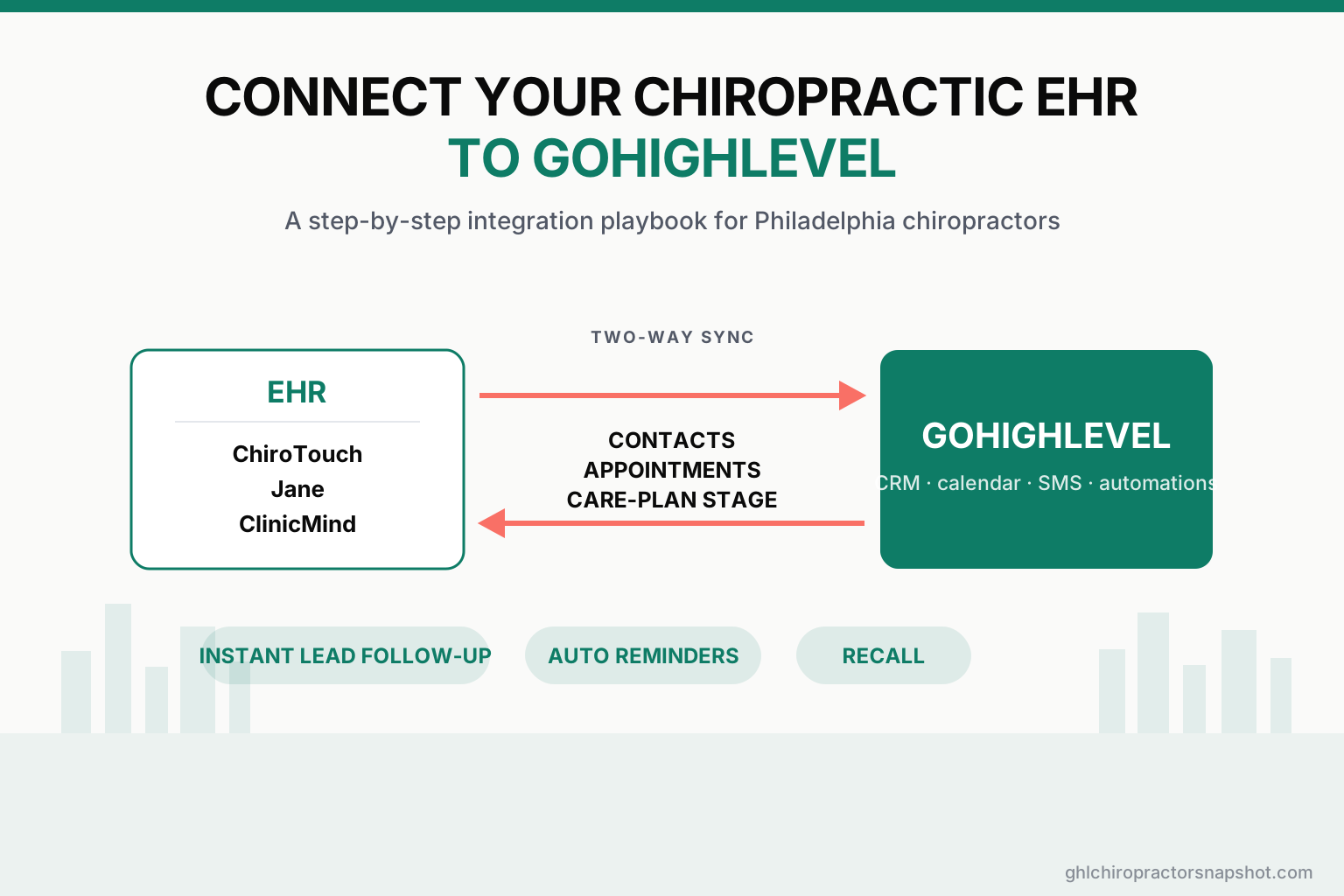
Connecting your chiropractic EHR to GoHighLevel means building a two-way sync so every patient, appointment, and care-plan stage in ChiroTouch, Jane, Genesis, ChiroFusion, or ClinicMind flows automatically into the CRM that runs your follow-up — no double data entry, no new-patient leads sitting untouched, no reminders that never send. For a Philadelphia chiropractic clinic, that one connection is the difference between a front desk copying data between two screens all day and a system that answers leads in seconds, texts appointment reminders on its own, and reactivates lapsed patients overnight.
The stakes are concrete. Across primary-care studies, the mean patient missed-appointment rate is 15.2% (British Journal of General Practice, 2021), and firms that contact a new lead within an hour are roughly seven times more likely to qualify it than those who wait even one hour longer (Harvard Business Review, 2011). A disconnected clinic loses on both ends — reminders that never fire and leads that go cold. This playbook shows Philadelphia chiropractors and the agencies serving them exactly how to wire the two systems together, step by step, with every number sourced.
Table of contents
- What “connecting your EHR to GoHighLevel” actually means
- Why disconnected systems cost Philadelphia clinics patients
- The step-by-step EHR-to-GoHighLevel integration playbook
- How each chiropractic EHR connects to GHL
- HIPAA-aware guardrails for patient data
- What it costs: build vs. DIY
- Frequently asked questions
What “connecting your EHR to GoHighLevel” actually means
Your electronic health record (ChiroTouch, Jane, Genesis, ChiroFusion, ClinicMind) is the system of record for clinical work — visits, SOAP notes, care plans, billing. GoHighLevel (GHL) is the system of engagement — the CRM, calendar, SMS/email, pipelines, and automations that turn a search into a booked exam and a first visit into a completed care plan.
An integration is a connector that keeps the two in agreement. In practice it syncs four things:
- Contacts — a new patient created in either system appears in the other, deduplicated by phone and email.
- Appointments — bookings, reschedules, and cancellations flow both ways so reminders and recall fire from accurate times.
- Care-plan and pipeline stage — “exam → report of findings → corrective → wellness” maps to a GHL pipeline so the right nurture sequence runs at the right moment.
- Custom fields — chief complaint, visit count, insurance-vs-cash, referral source — so messaging is relevant, not generic.
The connection is either two-way (changes in either system propagate) or one-way (usually EHR → GHL, when the EHR is the source of truth). Two-way is the goal; it’s what lets your front desk work in whichever screen is in front of them without anything drifting out of sync.
Why disconnected systems cost Philadelphia clinics patients
Philadelphia is a dense, competitive market, and chiropractic is a growing field nationally — the U.S. Bureau of Labor Statistics projects chiropractor employment to grow 10% from 57,200 jobs in 2024 to 62,600 by 2034, “much faster than average,” with about 2,800 openings a year (BLS, 2024). More clinics means the practice that follows up fastest and most reliably wins the patient. A disconnected stack quietly loses that race in four ways.
1. Missed appointments that reminders would have saved. With a mean missed-appointment rate of 15.2% (BJGP, 2021), and 37% of medical groups reporting no-shows rose year over year (MGMA, 2023), each empty slot is lost revenue and a gap in a patient’s care. Text reminders are the proven fix — a randomized trial cut no-shows from 38.1% to 23.5% (2017 RCT) — and they land: 79% of consumers are opted in to business texts (EZ Texting, 2024). But automated reminders are only as accurate as the appointment data feeding them. If GHL never learns a patient rescheduled in ChiroTouch, it texts the wrong time — worse than no reminder at all.
2. New-patient leads that go cold before anyone calls. The HBR audit of 2,241 U.S. companies found the average lead response time was 42 hours, and 23% of companies never responded at all (HBR, 2011). A patient who fills out your form at 9 p.m. with acute low-back pain will book with whichever clinic replies first. GHL’s automations can fire a text-back in seconds — but only if the web form, chat widget, or missed call actually routes into GHL rather than dying in an EHR inbox no one watches after hours. This is the same missed-call text-back logic that powers the first-visit funnel.
3. The hidden tax of double data entry. When a staffer keys a patient into the EHR and again into the CRM, records drift and errors creep in. Inaccurate patient identification drives 35% of denied claims, costing the average hospital about $2.5 million a year (Black Book Research, 2021). A single clinic won’t see hospital-scale numbers, but the mechanism is identical: mismatched names, wrong phone numbers, duplicate contacts, and reminders sent to the wrong person.
4. Systems that can’t talk to each other by default. Interoperability is still an unsolved problem across healthcare — as of 2023, only about 70% of U.S. hospitals engaged in interoperable exchange across all four domains of finding, sending, receiving, and integrating outside data, with “integrate” the weakest link (ONC/ASTP, 2024). Chiropractic EHRs are no exception. A purpose-built connector is what closes the gap for your clinic.
The step-by-step EHR-to-GoHighLevel integration playbook
Here is the exact sequence we follow to connect a chiropractic EHR to GoHighLevel. Each step is concrete; do them in order.
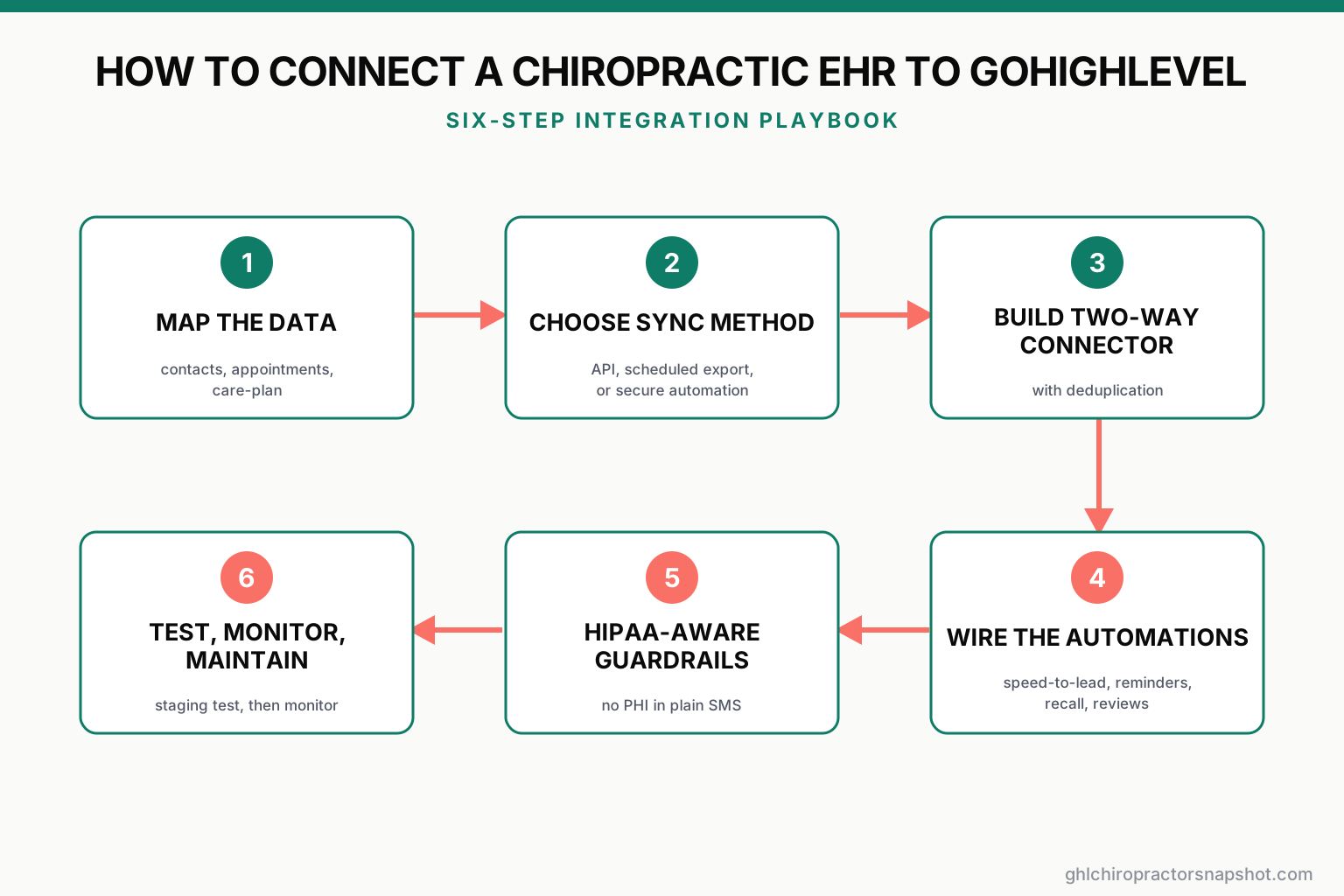
Step 1 — Map the data that must flow
Before any code, list every field that needs to move and in which direction. For most clinics that’s: patient contact (name, phone, email), appointment (start time, type, status), care-plan/pipeline stage, chief complaint, and referral source. Decide the source of truth for each field — usually the EHR owns clinical data, GHL owns marketing consent and communication history. This map is your spec; skip it and you’ll build the wrong sync.
Step 2 — Choose the sync method for your EHR
How you connect depends on what your EHR exposes:
- Direct API — if the platform has a documented API (or a partner API), this is the cleanest path: real-time webhooks push changes as they happen.
- Scheduled export/import — for systems with a report or CSV export but no live API, a scheduled job syncs on an interval (e.g., every 15 minutes).
- Secure browser automation — when there’s no API at all, a headless, credentialed automation reads and writes the data your staff would otherwise re-key by hand.
The right method is whichever ships reliably for your platform. (A full migration into GHL is a different project — that’s replacing the tool, not syncing it.)
Step 3 — Build the two-way connector with deduplication
Now build the connector itself. The non-negotiable feature is deduplication: match on normalized phone and email so the same patient never becomes two contacts. Add conflict rules (which system wins when both change a field), retry logic for failed syncs, and a log of every record moved. This is the difference between a sync you can trust and one that silently corrupts your list.
Step 4 — Wire the automations that make the sync pay off
A connected calendar is only valuable because of what fires off it. With appointments flowing into GHL, turn on:
- Speed-to-lead text-back — an instant SMS the moment a lead comes in, because contacting within the hour makes you ~7× more likely to qualify it.
- Appointment reminders — the sequence that takes no-shows from 38% toward 23% (RCT, 2017).
- Recall and reactivation — when the EHR marks a patient lapsed, GHL re-engages them.
- Review requests — triggered after a completed visit, to build the reputation that wins local search.
Step 5 — Add HIPAA-aware guardrails
Patient data raises the bar. Keep protected health information (PHI) out of plain SMS — reminders reference an appointment, never a diagnosis. Use BAA-eligible vendors where applicable, restrict field access, and log every sync. (More on this below.)
Step 6 — Test, monitor, and maintain
Run the connector against real records in a staging pass: create, reschedule, and cancel a test patient in each system and confirm the other reflects it. Then monitor in production — a sync that breaks silently is worse than none, because staff stop double-checking. Alerting on failed syncs and a monthly reconciliation keep the two systems honest over time.
How each chiropractic EHR connects to GHL
The method varies by platform. Here’s how the major chiropractic systems typically connect to GoHighLevel:
| EHR / PM system | Typical connection method | What syncs |
|---|---|---|
| ChiroTouch | API or secure automation | Patients, appointments, visit status |
| Jane | Two-way API sync | Contacts and bookings, kept in step |
| Genesis Chiropractic | Pipeline-stage push | Genesis stages → GHL recall/nurture flows |
| ChiroFusion | Record + care-plan mirror | Patient records and care-plan fields in GHL |
| ClinicMind | Billing + clinical connect | ClinicMind data → GHL automations |
| Cash Practice | Care-plan + auto-debit data | Care-plan and payment data into GHL reporting |
If your platform has an API, the connector integrates directly; if it doesn’t, secure browser automation or scheduled exports do the same job (Chiropractor Snapshot GHL development). Anything with an API — Calendly, Stripe, Twilio, QuickBooks, Google Sheets — can join the same sync.
HIPAA-aware guardrails for patient data
Chiropractic clinics handle PHI, so an integration has to be built with compliance in mind from the first line of code. Patients increasingly want text contact — surveys find they prefer secure texting from their physicians over portal messages (DrFirst, 2023) — but preference doesn’t relax the rules. Practical guardrails:
- No PHI in plain SMS. A reminder says “your appointment is Tuesday at 3 p.m.” — never a diagnosis, procedure, or clinical note.
- BAA-eligible vendors. Use business-associate-agreement-eligible services for any tool that touches PHI, and configure them accordingly.
- Least-privilege access and logging. Sync only the fields you need, restrict who can see them, and log every record moved so you have an audit trail.
- Consent and TCPA. Capture and honor SMS opt-in, and give patients a clear way to stop messages.
Compliance is ultimately the clinic’s responsibility to operate within HIPAA and your state chiropractic-board rules — a well-built integration makes that easier, not automatic. A capable GHL development partner will scope these requirements at the discovery call, not after launch.
What it costs: build vs. DIY
You can wire some of this yourself with no-code tools (Zapier, Make, n8n) if your EHR has a friendly API and your needs are simple — a one-way contact push is a reasonable weekend project. The moment you need two-way sync, deduplication, care-plan-stage mapping, or a platform without an API, it becomes a real engineering project, and DIY tends to produce a brittle chain that breaks on the first schema change.
A done-for-you connector removes that risk. At Chiropractor Snapshot, EHR-to-GHL connectors start at $3K–$8K, typically ship in 2–4 weeks, and include a written scope, a 30-day bug-fix warranty, and full ownership of the code — it lives in your repo and runs under your accounts (GHL development). Prefer pay-as-you-go? There’s a $75/hour retainer with no minimums.
The payoff is compounding. Once the sync is live, every downstream system — reminders, reactivation, reviews, the AI employee that answers after hours — runs on accurate, real-time data instead of a staffer’s spare minutes. In a market as competitive as Philadelphia, that reliability is what keeps your calendar full while the clinic down the street is still copying names between two screens.
Frequently asked questions
EHR-to-GoHighLevel integration — FAQ
Can you connect ChiroTouch, Jane, Genesis, ChiroFusion, or ClinicMind to GoHighLevel?
Yes — that's the most common chiropractic build. We create two-way (or one-way) syncs between your EHR/PM system and GoHighLevel covering contacts, appointments, care-plan fields, and pipeline stages. If your platform has an API we integrate directly; if it doesn't, we use secure browser automation or scheduled exports to move the same data reliably.
Is a two-way EHR-to-GHL sync safe for patient data (HIPAA)?
It can be, when built correctly. We keep protected health information out of plain SMS, use business-associate-agreement-eligible vendors where applicable, apply least-privilege field access, and log every record moved. Compliance remains the clinic's responsibility under HIPAA and your state chiropractic-board rules, but a purpose-built connector is designed to make staying compliant straightforward.
How long does an EHR-to-GoHighLevel integration take to build?
A typical chiropractic EHR-to-GHL connector ships in 2 to 4 weeks. Timeline depends on whether your platform has a documented API, how many fields and directions you need synced, and the volume of historical data. Every project is scoped with a fixed timeline and milestones before work starts.
What does an EHR-to-GHL connector cost?
EHR-to-GHL connectors start at $3K–$8K as a fixed-price project that includes a written scope, a 30-day bug-fix warranty, and full ownership of the code. If you prefer pay-as-you-go, there's a $75/hour retainer with no minimums. Simple one-way pushes can sometimes be done with no-code tools; two-way sync with deduplication is an engineering build.
Do I own the integration code, or does it lock me to an agency?
You own it — full IP transfer is included by default. The connector lives in your repository, deploys to your infrastructure, and runs under your own accounts. Your brand, your data, your code, with no lock-in.
Will connecting my EHR to GoHighLevel actually reduce no-shows?
Indirectly, yes — the integration is what makes automated reminders reliable. Text reminders are proven to cut no-shows (a 2017 randomized trial dropped them from 38.1% to 23.5%), but they only work if GoHighLevel has accurate, real-time appointment data. The sync is the plumbing; the reminder automation is the result.
About the author
Rey Alcantara is a GHL Automation Strategist on the GHL Chiropractor Snapshot team, based in Austin, TX. He builds the new-patient intake, EHR-sync, and recall systems that ship inside the Chiropractor Snapshot, after a decade running marketing-ops for multi-location wellness brands. He writes about speed-to-lead, no-show recovery, and the unglamorous plumbing that keeps a chiropractic schedule full. Rey is an automation and marketing specialist, not a licensed chiropractor, and nothing here is medical, legal, or compliance advice.
Related posts
- GoHighLevel Migration for an Atlanta Chiropractor: Moving Your Whole Clinic Onto GHL — when you’re replacing the tool, not just syncing it.
- Missed-Call Text-Back for Chiropractors: Never Lose Another New Patient — the speed-to-lead automation your sync powers.
- The GoHighLevel AI Employee for Chiropractors — what runs on top of a connected, real-time data layer.
- Reduce No-Shows in Your Chiropractic Clinic — the reminder playbook a synced calendar makes reliable.
Sources
- British Journal of General Practice — Which patients miss appointments with general practice and the reasons why (systematic review) (2021)
- MGMA — Patient no-shows holding steady at medical groups in 2023 (2023)
- PMC — Text Message Reminders Increase Appointment Adherence in a Pediatric Clinic: A Randomized Controlled Trial (2017)
- Harvard Business Review — The Short Life of Online Sales Leads (2011)
- Black Book Research (via PR Newswire) — Patient identification error survey (2021)
- ONC / ASTP — Interoperable Exchange of Patient Health Information Among U.S. Hospitals: 2023 (2024)
- EZ Texting — 2024 Consumer Texting Report (2024)
- DrFirst — Survey: patients prefer secure texting over patient-portal communication (2023)
- Think with Google — Mobile Search Trends: Consumers to Stores (2016)
- U.S. Bureau of Labor Statistics — Occupational Outlook Handbook: Chiropractors (2024)
Figures are attributed to the sources and years shown. The missed-appointment and text-reminder statistics come from peer-reviewed studies of general and pediatric practice, not chiropractic clinics specifically, and real-world rates vary by clinic, population, and methodology; treat them as directional benchmarks, not guarantees. The Harvard Business Review lead-response figures are from a 2011 audit of 2,241 U.S. companies across industries. “Near me” local-search behavior is from Google first-party data (2016). Build pricing and timelines are typical ranges and are scoped per project. This article is marketing and operations guidance for chiropractic clinics and the agencies that serve them; it is not medical, legal, or compliance advice.