
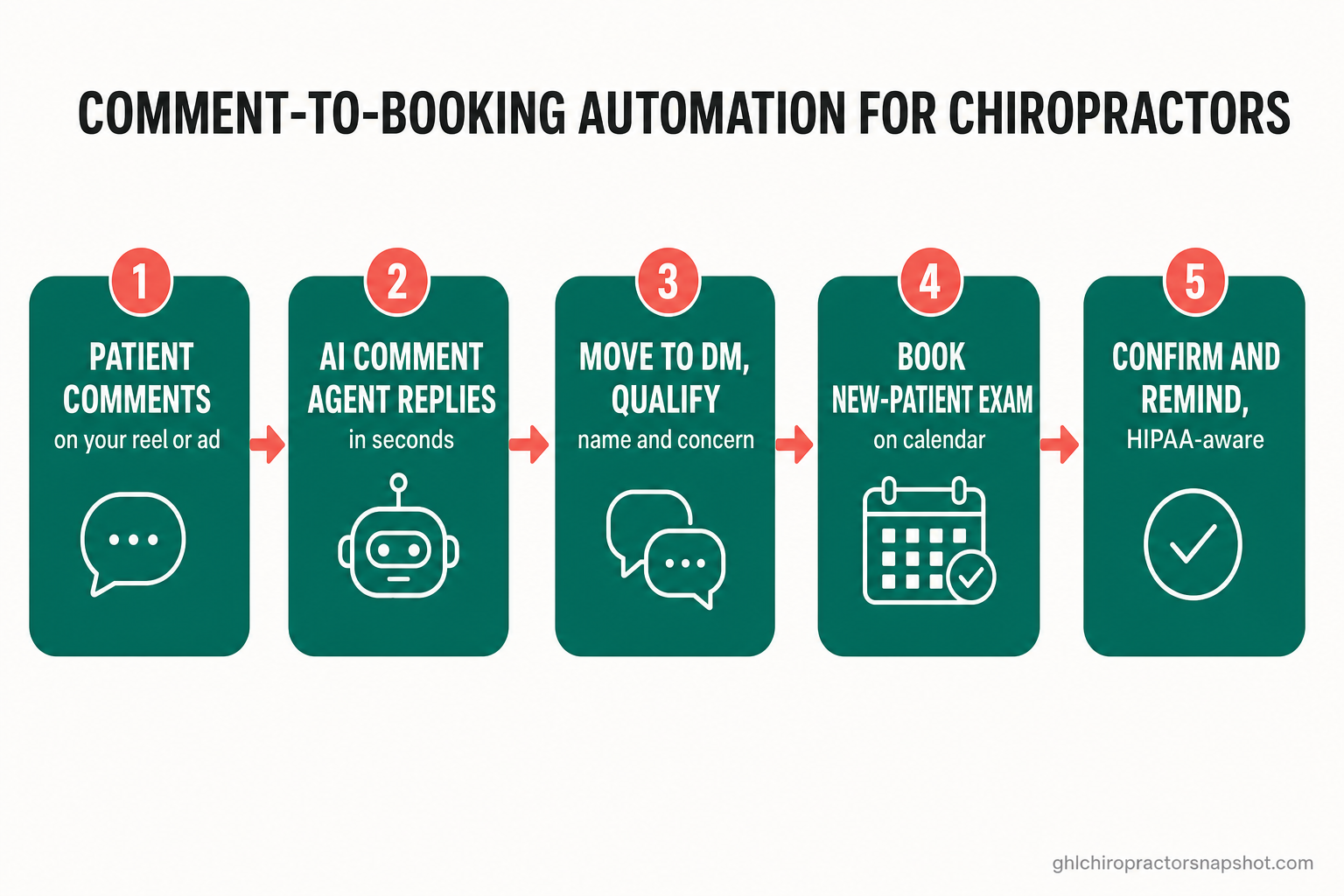
How does an Orlando chiropractor turn Instagram and Facebook comments into booked appointments? Set up a comment-to-DM automation: the moment someone comments “price” or “book” on your reel or ad, an AI agent replies publicly in seconds, moves the conversation to a direct message, qualifies the person, and drops a new-patient exam onto your calendar — before a competitor answers. Speed is the whole game. Harvard Business Review’s landmark study of more than 15,000 leads found you are 21 times more likely to qualify a lead when you respond within five minutes instead of thirty (Harvard Business Review, 2011). A comment sitting unanswered while your front desk is mid-adjustment is a patient walking to the next clinic on the map.
This is a practical playbook for chiropractic and wellness clinics in Orlando — and the GoHighLevel agencies that build for them. Every statistic is sourced and dated, every step is something you can actually wire up, and the patient-facing language stays HIPAA-aware and TCPA-conscious throughout.
Table of contents
- The short answer for Orlando clinics
- Why a comment is the warmest lead you’ll get all day
- Why reply speed decides who books the patient
- The comment-to-DM automation, step by step
- Keeping it HIPAA-aware and TCPA-conscious
- How this compounds your Orlando local reach
- Frequently asked questions
The short answer for Orlando clinics
If your clinic posts reels, runs Facebook or Instagram ads, or answers patient questions online, you are already generating high-intent leads in your comment section — and most of them are going cold. The fix isn’t posting more; it’s responding faster. A comment-to-DM automation watches for intent words on your posts and ads (“price,” “cost,” “book,” “insurance,” “hours”), fires an instant public reply, then opens a direct message that collects the person’s name, phone, and chief complaint and books a new-patient exam on your calendar.
This matters more in a market like Orlando, where a wellness-heavy, mobile-first population is actively searching and scrolling for care. Adults in the U.S. now spend an average of 2 hours and 16 minutes a day on social media (DataReportal, 2025) — that’s where your next patient is discovering you, and where they expect to be able to reach you. The clinic that answers first, in seconds, wins the booking. Everyone else gets the leftovers.
Why a comment is the warmest lead you’ll get all day
A comment is not a like. A like is a nod; a comment is a hand raised in public. When someone types “Do you take my insurance?” or “How much for a first visit?” under your reel, they’ve moved from passive scrolling to active buying intent — and they’ve done it on a platform built for conversation.
That intent is enormous and growing. Messaging a business has become a default consumer behavior: close to one billion people message a business every week across Facebook, Instagram, and WhatsApp (Meta, via U.S. Chamber of Commerce), and Meta and BCG found one in three consumers now message a business at least once a week (BCG). Your patients are not waiting on hold — they’re typing.
The problem is what happens next at a typical clinic. The comment lands at 7:40 p.m., or during a packed Tuesday afternoon. Nobody sees it for hours. By the time your front desk replies “DM us!” the next morning, the person has already booked with a clinic that answered. The lead was warm; the response was cold. That gap — between a patient’s intent and your clinic’s reply — is exactly where a comment-to-DM automation lives.
Why reply speed decides who books the patient
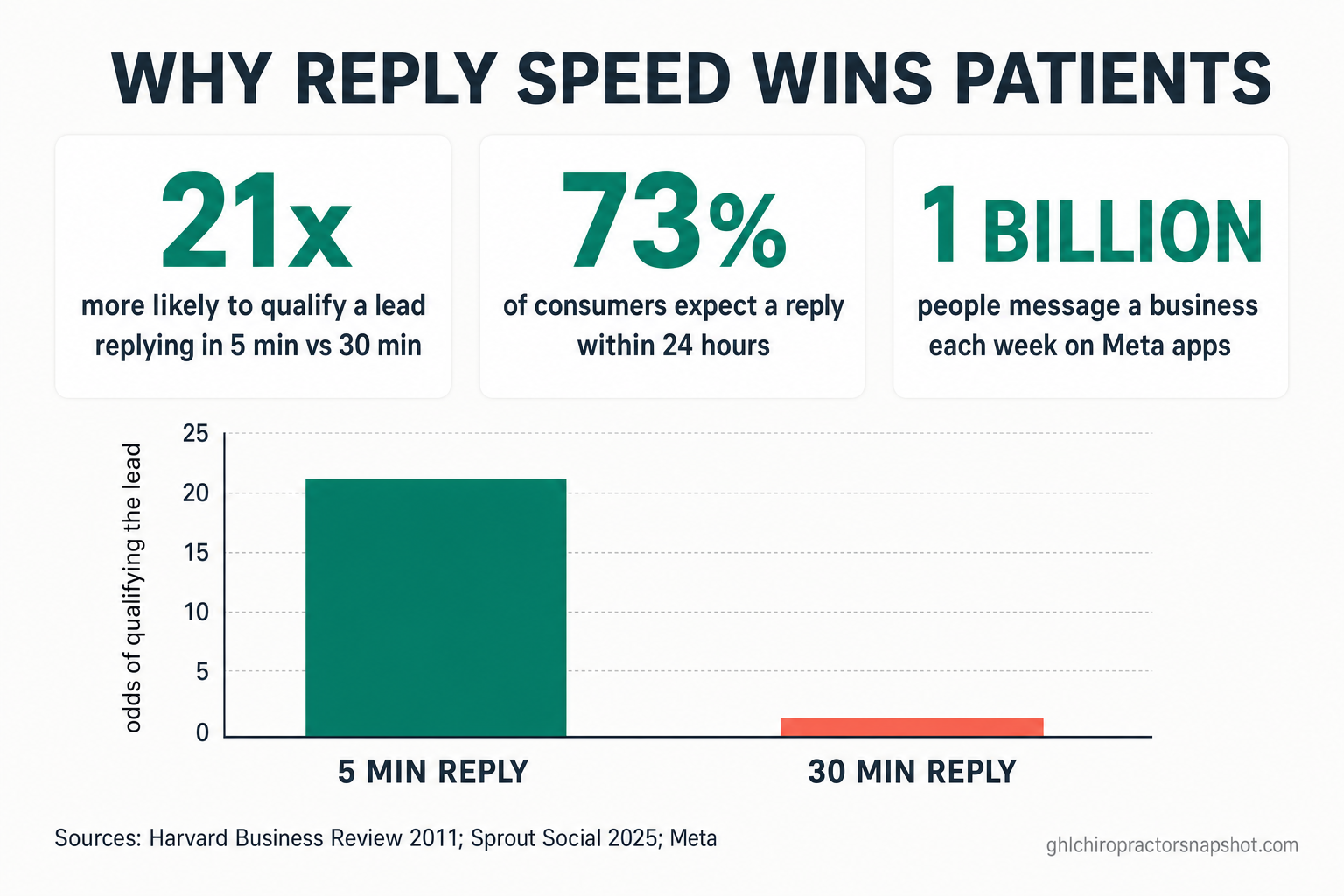
The single most important number in this playbook comes from Harvard Business Review’s study of more than 15,000 leads and 100,000 call attempts. Responding to a new lead within five minutes rather than thirty makes you 21 times more likely to qualify that lead — and firms that reach out within an hour are seven times more likely to have a meaningful conversation than those who wait even sixty minutes longer (Harvard Business Review, 2011). Wait a full day, and the odds of qualifying collapse by roughly 60 times versus a one-hour response.
Those findings predate the messaging era, and messaging has only compressed the window further. Patients now bring “text-message expectations” to every business interaction: the 2025 Sprout Social Index found 73% of consumers expect a response within 24 hours or sooner, and a majority say they’ll take their business to a competitor when a brand goes quiet (Sprout Social, 2025). On social, “later” effectively means “never.”
No human front desk can hit a five-minute reply on every comment, every ad, at 9 p.m. on a Sunday. That’s not a knock on your team — it’s a math problem. Automation is the only way to guarantee the speed the data says you need. It’s the same logic behind missed-call text-back: capture the intent the instant it appears, because the second it cools, it’s gone.
The comment-to-DM automation, step by step
Here’s the workflow we build inside GoHighLevel and the Meta APIs. Each step maps to a box in the flow diagram above.
Step 1 — Listen for intent on the right posts
Point the automation at the content that actually generates buying questions: new-patient offer reels, “what to expect at visit one” carousels, and any Facebook or Instagram ad. Define your trigger words — the phrases patients actually type: “price,” “cost,” “how much,” “book,” “appointment,” “insurance,” “hours,” “info.” The agent watches comments on those posts and ads for a match. General comments (“great post!”) get a friendly like or reply but don’t enter the booking flow.
Step 2 — Reply publicly, in seconds
The instant a trigger word appears, the AI comment agent posts a short, on-brand public reply — “Great question! Just sent you a DM with the details 👍” This does two jobs at once. It answers the person immediately, and it shows every other reader that your clinic is responsive. That public visibility is engagement the algorithm rewards, which is why a fast reply agent quietly extends the reach of the very post it’s replying to.
Step 3 — Move the real conversation to a DM
Prices, insurance, and anything patient-specific do not belong in a public comment thread — that’s both a privacy and a HIPAA-awareness issue. So the agent opens a direct message and carries the conversation there: “Hi! Happy to help. Are you looking to come in for neck pain, back pain, or something else?” The DM is private, on your clinic’s voice, and available 24/7 — which matters because Instagram DMs convert conversations to customers at rates well above the 2–3% typical of standard e-commerce funnels.
Step 4 — Qualify: name, phone, and chief concern
Inside the DM, the AI DM agent collects exactly what your front desk needs to book: the person’s name, phone number, and primary concern (and, if relevant, whether it’s an auto-injury or a general wellness visit — the kind of routing that feeds your personal-injury referral pipeline). It handles the common objections — “Do you take my insurance?”, “How much is the first visit?” — with pre-approved answers, and it never gives clinical advice. It qualifies; it doesn’t diagnose.
Step 5 — Book the exam and confirm
Once qualified, the agent offers real open slots from your GoHighLevel calendar and books the new-patient exam right inside the chat — no “call us to schedule,” no phone tag. It then fires a HIPAA-aware confirmation and drops the patient into your reminder sequence to cut no-shows. This is the same booking discipline covered in the first-visit funnel and online scheduling playbooks — just triggered from a comment instead of a form.
Keeping it HIPAA-aware and TCPA-conscious
Automation is only an asset if it’s compliant. Two guardrails are non-negotiable, and both are baked into how we build:
- No PHI in public or plain channels. The public comment reply never references a person’s condition. Anything patient-specific moves to the DM, and no protected health information is sent over plain SMS. The agent asks about a “concern” to route the booking — it does not create a medical record in the comment thread.
- Consent before texting. Before the automation sends SMS reminders, it captures clear opt-in and honors STOP/opt-out instantly, in line with TCPA expectations. The patient chooses to move from the DM to text; you don’t cold-text a commenter.
The same principle runs through everything the snapshot does: we’re an automation system for clinics, never a substitute for clinical judgment, and never a shortcut around privacy law. If you’re layering this on top of DM automation you already run, the Chicago DM-automation playbook covers the messaging side in depth.
How this compounds your Orlando local reach
The booking is the immediate win. The compounding win is reach. Instagram and Facebook decide who sees your posts partly by how much engagement they earn in the first minutes and hours — and comments plus replies are premium engagement signals. An agent that answers every comment instantly keeps your reply rate high and your threads active, which nudges the algorithm to show that reel to more people in the Orlando area.
That’s the same flywheel behind consistent short-form video: reels get discovered by new local patients, comments roll in, the agent converts them to booked exams, and the engagement earns even more reach. Layer it onto a real posting cadence — the kind of done-for-you social system that ships content five days a week — and your comment section stops being a place questions go to die and becomes a booking channel that runs itself. It pairs naturally with your broader local SEO so patients find you in the map pack and get an instant answer when they reach out on social.
Frequently asked questions
Comment-to-DM automation for chiropractors — FAQ
What exactly is comment-to-DM automation for a chiropractic clinic?
It's an automated workflow that watches your Instagram and Facebook posts and ads for high-intent comments (like 'price,' 'book,' or 'insurance'), instantly posts a public reply, then opens a private direct message to qualify the person — collecting their name, phone, and concern — and books a new-patient exam on your calendar. It captures buying intent the moment it appears instead of hours later.
Why does responding in five minutes matter so much?
Harvard Business Review's study of 15,000+ leads found you're 21 times more likely to qualify a lead when you respond within five minutes rather than thirty, and the odds keep collapsing the longer you wait. Patients now expect fast replies too — 73% expect a response within 24 hours or sooner (Sprout Social 2025). No human front desk can guarantee a five-minute reply on every comment around the clock; automation can.
Is this HIPAA-compliant and TCPA-safe?
Built correctly, yes. The public comment reply never mentions a patient's condition — anything specific moves to a private DM, and no protected health information is sent over plain SMS. Before any text reminders go out, the automation captures clear opt-in and honors opt-out instantly. It's an automation product for clinics, not a healthcare provider, and it never gives clinical advice or creates a medical record in a comment thread.
Will patients know they're talking to an AI agent?
The agent handles routine questions — pricing, hours, insurance, and booking — in your clinic's voice, and hands off to a human the moment a question is clinical, sensitive, or beyond its script. The goal is instant answers on the easy 80% and a real person on the judgment calls, so patients feel helped, never trapped.
Do I need to be in Orlando for this to work?
No — the automation works for any clinic on Instagram and Facebook. We highlight Orlando because it's a mobile-first, wellness-heavy market where patients actively scroll and message, but the same comment-to-DM system books exams for chiropractic and wellness practices anywhere in the U.S.
How much does it cost to set this up?
The AI comment agent, DM agent, and web-chat agent are included in our done-for-you social media service — $397/month for one clinic brand, or $997/month for up to four brands — which also delivers content posted five days a week across nine channels. That's the work of a designer, video editor, and community manager (typically $4,000–$8,000/month) in one managed system.
About the author
Rey Alcantara is a GHL Automation Strategist on the GHL Chiropractor Snapshot team, based in Austin, TX. He designs the new-patient intake, speed-to-lead, and missed-call recovery systems that ship inside the snapshot, after a decade running marketing-ops for multi-location wellness brands. He writes about the unglamorous plumbing that keeps a chiropractic schedule full. Rey is an automation and marketing specialist, not a licensed chiropractor, and nothing here is medical advice.
Related posts
- Missed-Call Text-Back for Chiropractors: Turn Every Missed Call Into a Booked Visit — the same speed-to-lead logic, applied to your phone line.
- Chiropractic DM Automation in Chicago: Book Patients From Instagram & Facebook Messages — a deeper look at the private-message side of the funnel.
- Instagram Reels for Chiropractors in New York City: The Local Reach Playbook — the content that generates the comments this system converts.
- Done-For-You Social Media Marketing for Chiropractors — the full posting cadence that feeds your comment section.
Sources
- Harvard Business Review — The Short Life of Online Sales Leads (2011)
- Sprout Social — The 2025 Sprout Social Index (2025)
- Meta / U.S. Chamber of Commerce — Meta’s messaging apps for businesses
- Boston Consulting Group — Business messaging across social platforms (2022)
- DataReportal — Digital 2025: The United States of America (2025)
Figures are attributed to the sources and years shown. The Harvard Business Review response-time findings are from a 2011 study of online sales leads and are widely applied to speed-to-lead across industries; results vary by market, offer, and execution. This article is marketing and operations guidance for chiropractic clinics and the agencies that serve them; it is not medical, legal, or financial advice. GHL Chiropractor Snapshot is an automation product, not a healthcare provider.