

It is 8:55am on a Tuesday. Two patients are booked for 9:00. One is a cash wellness patient who paid for her 12-visit care plan up front. The other is an insurance patient three visits into an authorized plan, copay $20, most of the visit billed to his plan. At 9:02 the cash patient is on the table. At 9:15 the insurance patient still has not called. By 9:30 your front desk has stopped expecting him. You have seen this pattern for years and never quite named it: the people paying the least out of pocket are the ones who flake.
Insurance patients no-show more than prepaid cash patients because they have less skin in the game on the day of the visit. When a patient has already handed over the money, or has a card on file that gets charged if they vanish, missing an appointment costs them something real. When the visit feels “free” because a plan covers most of it, the cost of skipping is close to zero, so a busy morning or a little back-pain relief is enough to tip them into a no-show. Once you see that, the fix stops being about nagging patients and becomes about redesigning the moment they commit.
This is not an argument to drop insurance. Most clinics need that base. It is a playbook for closing the no-show gap between your payer segments, using commitment design, a confirmation cadence, and a recovery sequence you set up once. Every number below is sourced and dated.
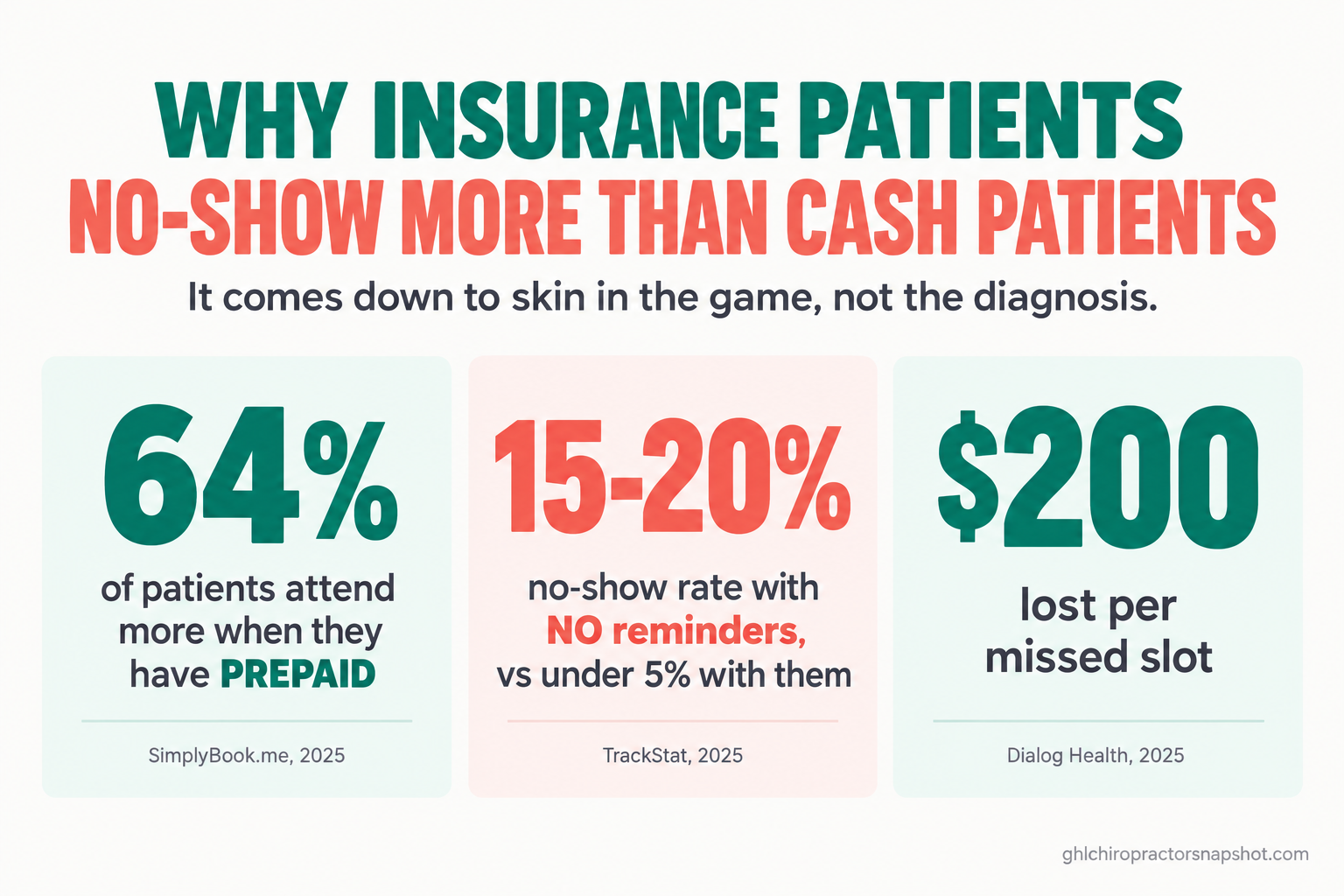
Table of contents
- What the data says about no-shows by payer type
- Why insurance patients flake: two forces, one gap
- Stage 1: Turn the booking into a commitment
- Stage 2: A confirmation cadence that catches the flake early
- Stage 3: Set the expectation at the first visit
- Stage 4: The same-day recovery sequence
- Stage 5: Move the right insurance patients to prepaid plans
- Stage 6: Measure no-shows by payer segment
- Run the system for three clinic sizes
- Staying HIPAA-aware and TCPA-conscious
- Objections from the front desk
- Frequently asked questions
What the data says about no-shows by payer type
Start with the pattern you already feel. When researchers sorted 5,817 scheduled visits at one practice by insurance type, they found something clean: Medicaid patients, who owe little or nothing at the point of care, had the highest no-show rate of any payer group, and commercially insured patients were the most likely to show up (Comer et al., Ear Nose Throat J, 2019). The reported rates by payer type make the gap concrete.
Chiropractic is not otolaryngology, but the driver is the same, and chiropractic clinics live in the same no-show band. Clinics without automated outreach commonly run 15% to 20% no-show rates, versus under 5% for clinics that run consistent reminders (TrackStat, 2025). A single missed slot runs about $200 in lost revenue (Dialog Health, 2025), and across a year the drain lands between $15,000 and $40,000 for the average clinic (TrackStat, 2025).
The reason this matters for your payer mix: the segment that owes the least per visit is the segment that skips the most. If your practice leans on low-copay or Medicaid patients, your no-show rate is structurally higher than a cash-heavy clinic down the road, and no amount of “we need to hold patients accountable” fixes a cost-sharing problem. You fix it by changing what a missed visit costs the patient.
Why insurance patients flake: two forces, one gap
There are actually two different money forces pushing patients to miss, and they pull in opposite directions. Understanding both keeps you from applying the wrong fix.
The first force is low marginal cost. When a patient’s plan covers most of the visit and the copay is small or zero, skipping today costs almost nothing. There is no prepaid plan in their account, no card that gets charged, no sunk investment to protect. Behavioral economists call the flip side of this the sunk-cost effect: people who have already paid show up to protect what they spent, which is why a majority of clients, roughly 64%, say they are more likely to attend when they have prepaid (SimplyBook.me, 2025). Your cash care-plan patient is not more disciplined than your insurance patient. She just has money on the table.
The second force is the opposite: cost as a barrier. High deductibles and rising out-of-pocket costs make some insured patients skip care they actually need. About 36% of adults say they have skipped or postponed needed health care in the past year because of cost, and roughly 37% of insured adults report the same (KFF, 2025). This is not a low-commitment flake. It is a patient who cannot, or will not, absorb the bill, and it shows up most on high-deductible plans early in the year, before the deductible is met, when a visit feels like a full-price expense.
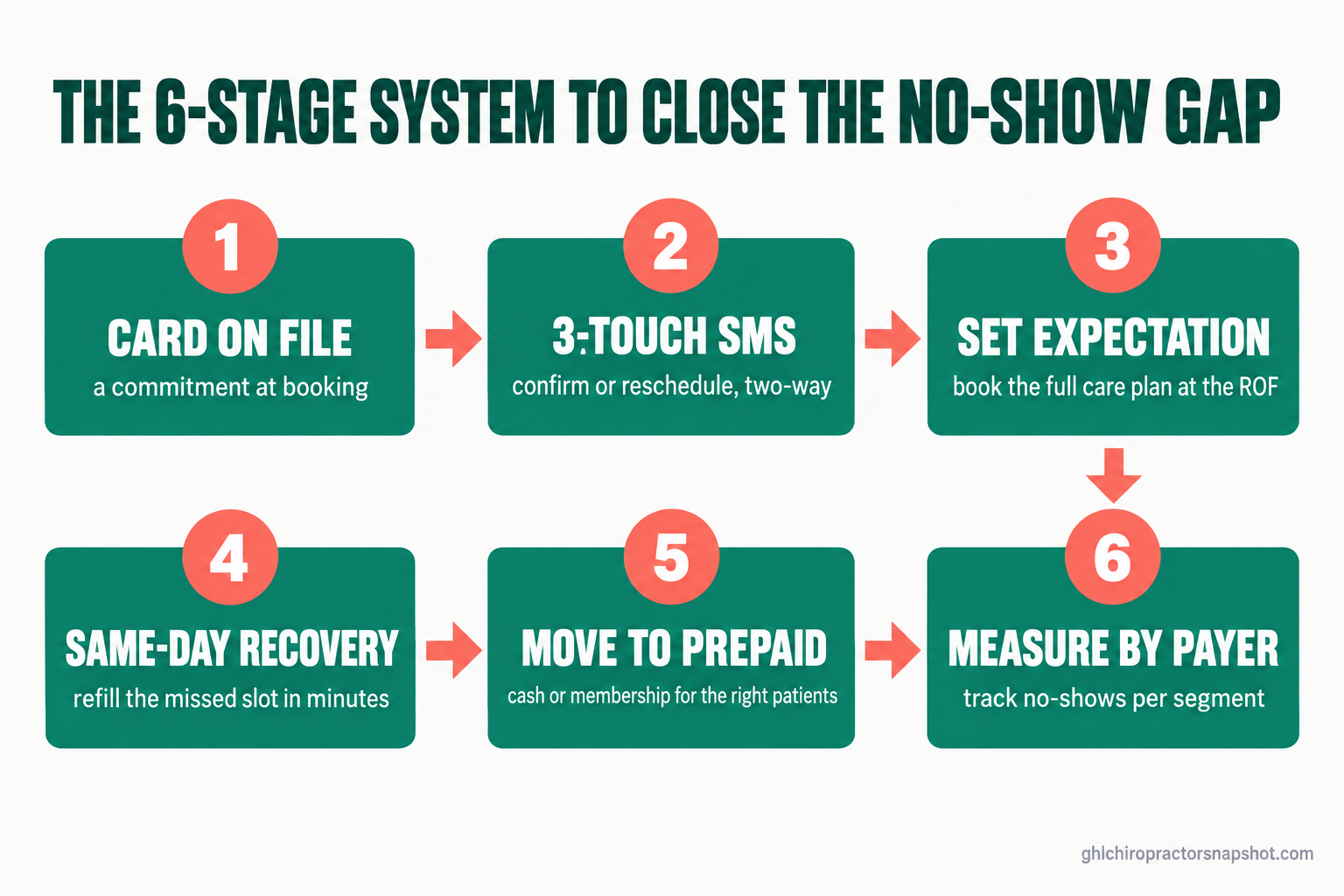
The two forces need different fixes. Low-marginal-cost flaking is solved with commitment design: card on file, prepaid plans, a confirmation cadence. Cost-as-a-barrier missing is solved with financial clarity, so the patient is not silently deciding they cannot afford the next visit. Treat every no-show as laziness and you keep the wrong patients while losing the right ones. The clinics that win redesign the six moments where a patient decides whether to show. Here is the system, stage by stage, with the copy you can lift and the ways each stage breaks.
Stage 1: Turn the booking into a commitment
The highest-impact change is to make booking cost something, even a little. For cash and wellness patients, that means prepaying the plan or the visit. For insurance patients, where you cannot collect the visit fee up front, it means a card on file with a clear, signed no-show policy tied to it. Requiring payment details at booking converts a free reservation into a small commitment. In dentistry, one practice reported that a $75 deposit for longer appointments nearly eliminated no-shows for those slots, and healthcare payment guides now treat card-on-file as a standard tool for high-value visits (Helcim, 2025).
Here is policy language you can adapt. Keep it plain and put it in the intake paperwork and the booking confirmation, not buried in a portal.
How it breaks. Front desks quietly stop enforcing the fee because the conversation is awkward, and once patients learn it is never charged, the deterrent is gone. Fix it by automating the charge through your booking system so no human has to decide, and by framing the fee as protecting the patient’s own reserved time, not as a punishment. To avoid scaring off price-sensitive new patients, waive the fee on a patient’s first-ever cancellation and say so up front.
Stage 2: A confirmation cadence that catches the flake early
A no-show is usually decided hours before the visit. The job of your reminder cadence is to surface that decision while you can still fill the slot. Text is the channel that does this: SMS runs a 98% open rate, with most messages read within three minutes (Notifyre, 2025), and text reminders cut no-shows by as much as 38% (Klara, 2024). Email is where reminders go to be ignored. The cadence that works is three touches, and the middle one asks for a reply so you get an early warning.
Notice what is not in those messages: no diagnosis, no treatment detail, no “your adjustment for lumbar pain.” That keeps the cadence HIPAA-aware, which matters because these texts are unencrypted. The reschedule option in every message is deliberate. A patient who replies R at 7am is not a no-show, they are a rebooking, and you have hours to sell that empty slot to someone on a waitlist.
How it breaks. One-way reminders that cannot take a reply are half a system. If a patient reads “your visit is tomorrow” and has no way to say “actually I can’t make it,” they just do not come, and you learn about it at the empty slot. Make every reminder two-way and route replies to a real inbox the front desk watches. Then cap the volume at three touches per visit so patients on multiple visits a week do not go numb.
Stage 3: Set the expectation at the first visit
The report of findings, where you lay out the care plan, is where attendance is really won or lost. A patient who understands why visit 9 matters as much as visit 1 does not treat the back half of the plan as optional, and this is where you convert the plan into a financial commitment, looping back to Stage 1. Our report of findings script for care-plan conversion breaks that conversation down line by line. The move that lowers no-shows specifically: tie the schedule to the outcome, out loud, and book the whole plan in one sitting rather than one visit at a time.
How it breaks. Booking visit by visit is the quiet killer. Every time a patient re-decides to book the next one, some decide not to, and the plan unravels around the middle, which is exactly where the care-plan drop-off at visit 14 shows up in the data. Book the full arc at the ROF, and never run a purely clinical ROF that skips money and the schedule, which leaves the patient to discover the cost later and silently start skipping.
Stage 4: The same-day recovery sequence
Even a good system leaks some appointments. The difference between a clinic that recovers and one that eats the loss is a sequence that fires the moment a slot goes empty. Speed matters here the same way it does for a new lead: the faster you reach out, the more likely the rebooking. A patient who no-shows and hears nothing for three days has quietly become a lapsed patient, which is a far harder and more expensive reactivation campaign to run later.
How it breaks. The sequence never fires because marking the no-show and starting the outreach is a manual step nobody has time for at 9:30 in a busy clinic. Automate the trigger off the missed appointment status so the first text sends itself. The other failure is a cold, transactional tone that makes the patient feel processed. Keep it human, keep it about their care, and never lead with the fee. The fee is a Stage 1 deterrent, not a Stage 4 collections message.
Stage 5: Move the right insurance patients to prepaid plans
This is the strategic play the first four stages set up. If low marginal cost is what makes insurance patients flake, the durable fix is to convert the patients who fit onto prepaid cash plans or memberships, where they have skin in the game and you have predictable revenue. This is not about abandoning insurance. It is a cash path for the patients it genuinely fits: wellness and maintenance patients, patients whose benefits have run out, and high-deductible patients effectively paying cash anyway.
Prepaid plans change behavior twice over. The patient shows up because they already paid, and the clinic stops riding the reimbursement rollercoaster. The math is in our breakdown of membership pricing and the retention math and the longer view of patient lifetime value.
How it breaks. Pushing cash plans on patients who need to use their benefits feels salesy and erodes trust, so keep the offer honest and let the numbers decide. The compliance trap is the discount size: time-of-service cash discounts are generally held to roughly 5% to 15% to avoid dual-fee-schedule exposure (industry guidance, so verify with your own compliance counsel and payers). A steep cash discount can look like you are running two fee schedules, which is a problem with insurers. Keep discounts modest and documented.
Stage 6: Measure no-shows by payer segment
You cannot fix what you average away. Most clinics track one blended no-show rate, which hides the exact gap this article is about. Break the number out by payer type and you can see whether your commitment design is working where it needs to.
Track these no-show metrics by payer segment
| Plan | Cash / Membership | Commercial Insurance recommended | Medicaid / Low-Copay |
|---|---|---|---|
| Price | Target: <5% | Target: <10% | Watch closely |
| Feature 1 | No-show rate by month | No-show rate by month | No-show rate by month |
| Feature 2 | Prepaid vs pay-per-visit split | Card-on-file adoption % | Confirmation reply rate |
| Feature 3 | Recovery rebook rate | Recovery rebook rate | Recovery rebook rate |
| Feature 4 | Plan completion rate | Deductible-season dip | Slots refilled from waitlist |
Watch two numbers in particular. The confirmation reply rate tells you whether your cadence is landing, segment by segment. The recovery rebook rate, the share of missed slots you turn back into kept visits, is where a good clinic separates from an average one. A high no-show rate with a high recovery rebook rate means you are managing it well; if both are bad, the cadence and recovery sequence are where to invest first. For the wider set of numbers, see the chiropractic practice KPIs worth tracking.
Run the system for three clinic sizes
The framework is the same at every size. What changes is who runs it and how much you lean on automation versus people.
The solo DC with one front-desk person. You do not have the labor to chase no-shows by hand, so automation is the whole plan. Card-on-file at booking, the three-touch SMS cadence, and the first two recovery texts should all fire without anyone touching them, leaving your one staffer to handle only the day-3 recovery call and the waitlist fill. Book full care plans at the ROF so nobody is rebooking visit by visit, and start by segmenting just two buckets, cash and insurance.
The multi-doc practice, two to five DCs. More slots to fill from a waitlist, but more patients to keep straight. Assign one team member to own the recovery inbox and the daily no-show list across providers, and standardize the cadence so every provider’s patients get the same experience. This is the size where card-on-file pays for itself fastest, because a single filled slot covers the admin time. Track no-shows by provider as well as by payer, since provider-level gaps usually point to scheduling or ROF habits, not patient type.
The high-insurance-mix or personal-injury clinic. If your mix leans Medicaid, low-copay, or PI, your structural no-show rate is higher, so plan for it rather than fight your patient base. Lean hard on the two-way cadence and the recovery sequence, keep a live waitlist so empty slots refill fast, and be aggressive about the day-3 recovery call because these patients respond to a human. On the PI side, gaps in treatment also hurt the claim, so tie your reminders to that reality. Our note on personal-injury attorney relationships covers how consistent attendance protects the case and the referral.
Staying HIPAA-aware and TCPA-conscious
Automating patient messaging means living inside two rulebooks, and both are manageable if you build for them on purpose.
HIPAA. Automated SMS and email must not carry diagnosis, condition, or treatment detail, because plain text is unencrypted. “Your visit is tomorrow at 3pm” is fine. “Your lumbar decompression follow-up” is not. Patients should also get written notice of the risk of unencrypted messaging and consent to it before you start. The U.S. Department of Health and Human Services publishes the HIPAA Privacy Rule guidance that governs this.
TCPA. Automated texts need prior express consent, a clear opt-out, and honored opt-outs. Reminders sit in a friendlier category than marketing blasts, but you still capture consent at intake and include a “reply STOP to opt out” path. The FCC’s TCPA rules are the reference.
Advertising and fee rules. If you use a free or discounted exam to pull new patients, some states regulate it: Louisiana and West Virginia require the ad to disclose the usual charge and have the patient sign a disclosure, and Arizona bars vague free-service ads. Keep no-show fees and cash discounts reasonable and documented, since aggressive versions of either can create dual-fee-schedule or contract problems with payers. Verify the specifics for your state and payer contracts.
Objections from the front desk
“Won’t a card-on-file policy scare off new patients?” A small share of price-shoppers, yes. But the patients a clear policy filters out are the ones most likely to no-show anyway, and you can soften the edge by waiving the first cancellation and framing the card as protecting the patient’s reserved time. Clinics that adopt it rarely go back, because the filled schedule is worth more than the tire-kickers it deters.
“Our Medicaid patients need care. Isn’t charging fees unfair?” The goal is not to punish anyone, it is to change what a missed visit costs so more patients actually get the care they came for. For low-copay and Medicaid segments, lean on the free tools first, the two-way cadence and the recovery sequence, and keep any fee modest and forgiving.
“We already send reminders. Why are we still getting no-shows?” Almost always because the reminders are one-way and cannot take a reply, so you learn about the miss at the empty slot instead of at 7am. Make every reminder two-way, route replies to a watched inbox, and add the same-day recovery sequence. One-way reminders prevent forgetting; they do nothing for the patient who quietly decided not to come.
“Do I need to be technical to run all this?” No. This is standard automation in a modern practice platform: booking with card-on-file, triggered SMS sequences, and a no-show status that fires a recovery workflow. The setup is the work, not the daily running. Once it is wired, the front desk manages exceptions, not the machinery.
Frequently asked questions
Do insurance patients really no-show more than cash patients?
The pattern tracks with cost-sharing, not payment method itself. In a 5,817-visit study, Medicaid patients, who owe the least at the point of care, had the highest no-show rate of any payer type, and commercial patients were most likely to show (Comer et al., Ear Nose Throat J, 2019). Prepaid cash and membership patients tend to show at the highest rates because they have already invested money, and roughly 64% of clients say prepaying makes them more likely to attend.
What is a normal no-show rate for a chiropractic clinic?
Clinics without automated outreach commonly run 15% to 20% no-shows, while clinics with a consistent reminder and recovery system run under 5% (TrackStat, 2025). Your realistic target depends on payer mix: a cash-heavy clinic can hold under 5%, while a Medicaid- or PI-heavy clinic should expect a higher floor and manage it with a strong cadence and recovery sequence.
Is it legal to charge a no-show fee to insurance patients?
Generally yes for the patient's own responsibility, but you cannot bill the insurer for a missed visit, and the fee is separate from any copay. Keep the policy written, disclosed at booking, and applied consistently. Some states and payer contracts have specifics, so verify locally before setting an amount.
How do I reduce no-shows without a card-on-file policy?
Start with the free levers: a two-way SMS confirmation cadence so patients can reschedule instead of vanishing, booking the full care plan at the report of findings, and a same-day recovery sequence that refills missed slots. These alone move most clinics from the high teens down toward single digits.
Can automated reminders share appointment details without breaking HIPAA?
Yes, as long as the message contains no diagnosis, condition, or treatment detail. Time, date, location, and a confirm or reschedule prompt are fine in plain SMS. Get written consent for unencrypted messaging at intake, and include an opt-out path to stay TCPA-conscious.
Should I move insurance patients to cash plans to fix no-shows?
Only where it genuinely fits the patient, such as wellness and maintenance patients, patients whose benefits have run out, or high-deductible patients effectively paying cash already. Prepaid plans reduce no-shows through the sunk-cost effect and stabilize revenue, but pushing them on patients who need their benefits erodes trust. Keep cash discounts modest, roughly 5% to 15%, to avoid dual-fee-schedule problems.
The Tuesday morning, rewritten
Back to 8:55am. This time the insurance patient got a text at 7:10 that read “See you today at 9, reply R if something came up.” He was slammed at work, tapped R, and the front desk moved him to Thursday and pulled a waitlist patient into the 9:00 slot before the coffee finished brewing. No empty table, no lost $200, no patient quietly drifting off his plan. The cash patient still showed early, because she always does, because she paid.
That is the point: no-shows are not a discipline problem you solve patient by patient every morning. They are a design problem you solve once, in how patients commit, get reminded, and get recovered. Build it for your payer mix and the schedule stops leaking.